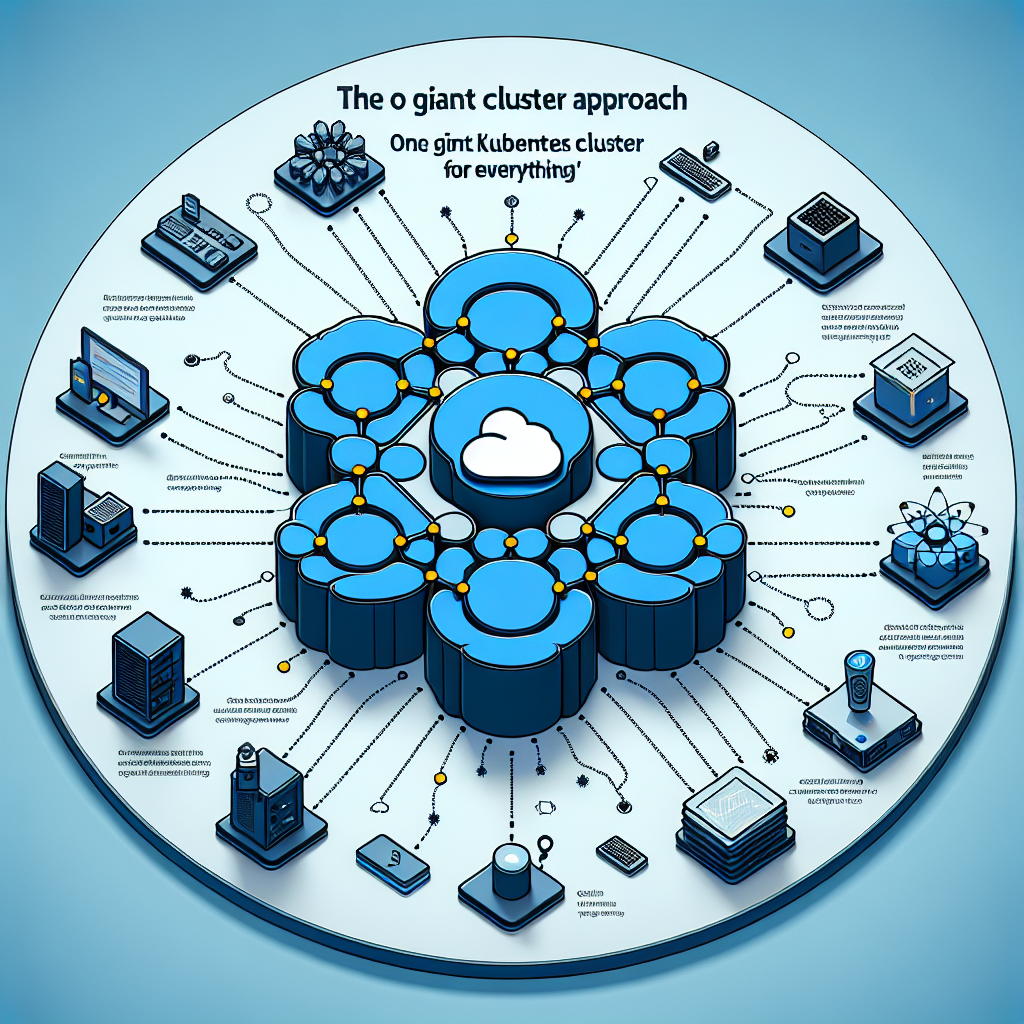
The ideal size for Kubernetes clusters has been a fundamental question from the start and requires a definitive answer.
On one hand, you can opt for a single giant cluster, and on the other, manage several small clusters with different intermediate combinations. This decision will impact the organization in the long term, and if you later decide to change the topology, the process will be costly and complex.
In this article, we will analyze the advantages and disadvantages of each approach, and then argue why a giant cluster is the best choice.
Better resource utilization: Kubernetes is designed to handle large-scale deployments, allowing efficient distribution of workloads across nodes. A single cluster makes better use of resources by dynamically balancing loads and preventing some clusters from being idle while others reach their capacity limit.
Lower operational overhead: Managing multiple clusters requires configuring essential tools like monitoring, security, and backups multiple times. With a single cluster, these tasks are configured once, reducing effort and operational costs.
Simpler communication and networking: In a single cluster, communication between services is more direct and efficient. In multi-cluster environments, additional tools are needed to manage connections, complicating operations.
Centralized governance: A single cluster facilitates the application of centralized policies, establishing namespaces for different teams and environments without duplicating rules across multiple clusters.
Cost efficiency: A single cluster reduces duplication of the control plane and minimizes operational costs, as less infrastructure is needed to maintain monitoring, security, and logging systems.
Despite these benefits, a large cluster also presents some challenges:
Greater impact of failures: If the cluster fails, it affects all teams that depend on it. Additionally, an attacker who compromises security will have access to more resources.
Complex multi-tenancy management: Sharing a cluster among multiple teams requires strict security policies, access limitations, and fair resource distribution.
Scalability limits: Although Kubernetes is highly scalable, there are physical limits that can affect performance as the number of objects and requests grows.
Restrictions on cluster-level objects: Some objects, such as Custom Resource Definitions (CRDs), apply to the entire cluster, which can cause conflicts when different teams require different versions.
The ideal solution is to find an optimized middle ground. The best strategy is to use only two clusters: one for production and one for everything else. To further optimize this approach, vCluster can be used.
vCluster: This technology allows creating virtual clusters within a single main cluster, providing isolation without the costs and complexities of multiple physical clusters. Each team can operate in its own separate environment, avoiding conflicts, improving security, and simplifying management.
How does vCluster mitigate the disadvantages of a giant cluster?
- Reduces the impact of failures by segmenting environments within virtual clusters.
- Facilitates multi-tenancy administration by isolating teams and applications.
- Improves scalability by distributing loads among virtual clusters.
- Minimizes risks in maintenance and updates by restricting them to specific virtual clusters.
- Allows each team to use different versions of CRDs without affecting others.
There are cases where multiple physical clusters are required, such as geographic distribution for regulatory compliance or latency reduction. However, even in these cases, vCluster helps minimize the number of physical clusters needed.
At Q2BSTUDIO, as specialists in software development and technological solutions, we recommend consolidating infrastructure into the fewest possible physical clusters and leveraging vCluster to provide efficient isolation. This strategy maximizes resource utilization, simplifies administration, and reduces operational costs.
Opting for a single cluster for production and one for development and testing, backed by vCluster, guarantees scalability, security, and operational efficiency for any company implementing Kubernetes at scale.