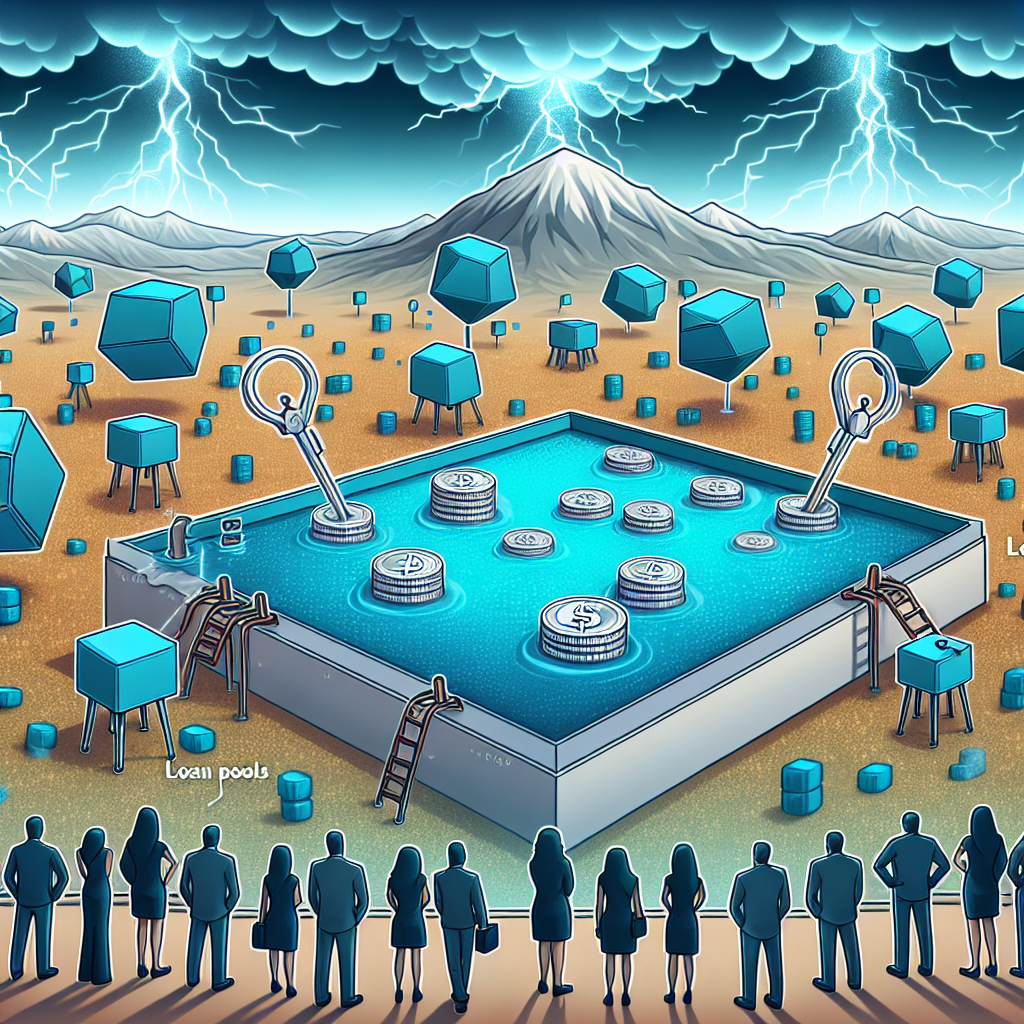
This article analyzes historical changes in the parameters of Aave V2 lending pools and presents formalized strategies and algorithms for detecting direct and indirect leverage staking behaviors, as well as their impact on the DeFi risk landscape.
Context and changes in Aave V2: adjustments in parameters such as loan to value LTV, liquidation threshold, reserve factor, and interest rate curves have modified risk dynamics and capital efficiency. Frequent parameter changes can favor leverage schemes that increase systemic fragility when staking incentives and liquidity rewards are combined with collateralized loans.
How leverage staking shapes DeFi risk: direct leverage staking occurs when an actor uses collateral to borrow and re-deploys those funds into staking or yield farming pools within the same protocol or in connected protocols. Indirect leverage staking manifests when leverage is channeled through derivatives, liquid staking protocols, or agents and aggregators that hide relationships between addresses. Both types increase the risk of liquidation cascades and stress propagation between protocols.
Summary of detection strategies: monitor on-chain parameter changes, correlate borrowing spikes with votes or parameter updates, build interaction graphs between users and contracts, and apply statistical and machine learning models to detect unusual leverage patterns. Integrating oracle signals, prices, and liquidity flows improves detection accuracy.
Basic algorithm for direct leverage staking detection: 1 Capture relevant on-chain events: borrow, repay, supply, transfer, and pool parameter changes. 2 Group by address and time window to calculate collateral-to-debt ratios and rapid changes in effective LTV. 3 Identify capital loops: recurring transfers from borrower addresses to staking contracts. 4 Assign a risk score based on thresholds and supervised learning trained with labeled examples. 5 Generate alerts and mitigation recommendations.
Algorithm for indirect leverage staking detection: 1 Build a contract interaction graph including bridges, staking derivatives, and aggregators. 2 Apply community detection and centrality to locate leverage hubs. 3 Analyze final collateral composition to assess cross-exposure between protocols. 4 Use clustering and unsupervised models to find atypical patterns in capital routes. 5 Correlate with parameter changes in source and destination protocols to establish temporal causality.
Key features and signals to consider: abrupt variations in borrow balances, simultaneous increases in utilization and exceeding safe LTV limits, internal swaps between stablecoins and volatile assets, debt concentrations in few addresses, use of proxies and governance contracts to modify parameters, and activity from AI agents or coordinated bots.
Recommended advanced techniques: temporal modeling with LSTM or transformers for loan series, dynamic graphs with anomaly detection based on embeddings, and ensembles combining on-chain rules with supervised classifiers. For explanation and adoption of measures, include reproducible pipelines that integrate on-chain data ingestion, cloud data lake storage, and Power BI dashboards for operational tracking.
Mitigation and governance: implement dynamic limits linked to pool health metrics, emergency thresholds, and liquidation orchestration systems that reduce the risk of cascades. Governance should include stress tests prior to parameter changes and automatic pause mechanisms upon detection of systemic leverage.
About Q2BSTUDIO: Q2BSTUDIO is a custom software and application development company specialized in artificial intelligence solutions, cybersecurity, and cloud services. Our team designs custom software and custom applications for companies that need scalable and secure solutions. We offer AWS and Azure cloud services, business intelligence services, and Power BI implementations to transform data into actionable decisions.
Services applicable to DeFi detection: Q2BSTUDIO develops on-chain data pipelines, custom artificial intelligence models for fraud and leverage detection, monitoring systems with real-time alerts, and secure architectures that comply with cybersecurity best practices. We can create specialized AI agents for pool surveillance, AI solutions for companies that automate responses, and Power BI dashboards integrated with business intelligence services.
Benefits of working with Q2BSTUDIO: end-to-end solution delivery, integration with AWS and Azure cloud services, cybersecurity support to protect keys and orchestrators, and development of AI agents that operate as proactive detectors in DeFi environments. Our custom applications and custom software are designed to reduce risk exposure and improve resilience against extreme leverage events.
Conclusion: understanding how parameter changes in protocols like Aave V2 interact with leverage staking practices is key to managing systemic risk in DeFi. Combining on-chain analysis, detection algorithms, machine learning, and professional solution implementation by companies like Q2BSTUDIO makes it possible to anticipate and mitigate risks, improve governance, and protect capital in an increasingly interconnected ecosystem.