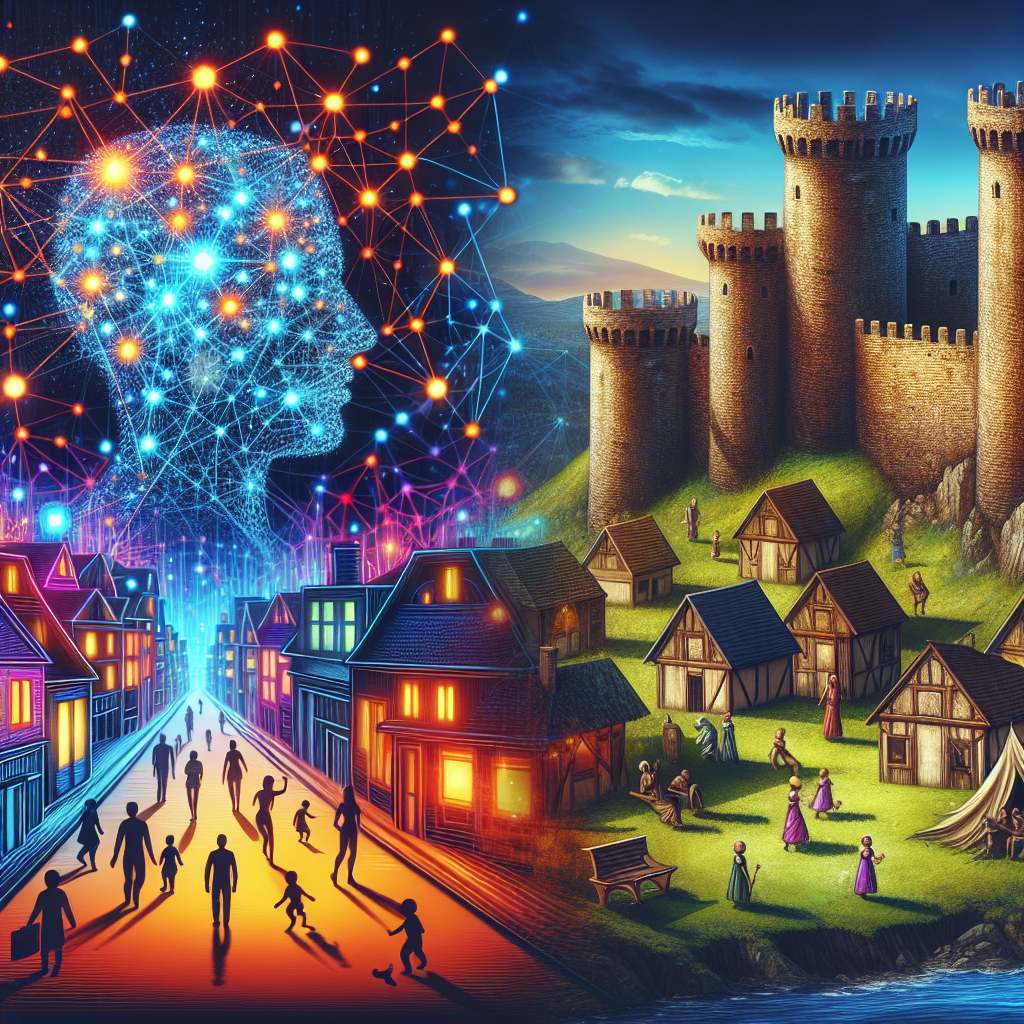
Imagine all the smartest robots and algorithms we call artificial intelligence living in a big castle.
It is huge, strong, with high walls and guards. You need permission to enter and only a few have the keys. Inside, they make the big decisions: what data is used, how the AI learns, and who it helps.
Now imagine the opposite.
It is not a castle, but a neighborhood. Each home has a small AI brain, a piece of the puzzle. These small brains can communicate with each other, learn together, and help their owners. There are no walls or doors. Each one contributes a little, and the whole community becomes smarter.
That is the difference between centralized and decentralized artificial intelligence.
This shift is crucial for the future of AI, especially in terms of privacy, security, and trust.
Today, most AI operates in giant data centers owned by large companies. This means these companies control what the AI learns, what it does with that knowledge, and who can use it.
This centralized model is efficient and fast, but it also has problems. If someone manages to infiltrate the castle, they can steal all the information. Additionally, the castle owners can sell your data, censor some users, or control what the AI says or does.
On the other hand, decentralized AI works more like a neighborhood: instead of a single castle, there are many small systems running the AI. There is no single owner and no single point of failure.
With this approach, users retain ownership of their data and can continue training the AI without sacrificing their privacy. Furthermore, these decentralized systems can communicate with each other and share information securely.
How is this made possible? With solutions like Aleph Cloud, which act like the roads connecting the houses in this AI neighborhood.
This type of technology helps decentralize storage, breaking data into small fragments and distributing them across multiple locations. It also allows the computing process to take place on small devices instead of relying on centralized servers.
This not only improves security and privacy but also makes artificial intelligence more accessible and transparent.
At Q2BSTUDIO, we believe in the power of technology to transform the future of AI. We develop innovative solutions for companies looking to leverage decentralization and improve the privacy of their systems.
The use cases for decentralized AI are already here. In healthcare, AI can help diagnose diseases without sending sensitive data to the cloud. Autonomous cars can share traffic information without compromising passenger privacy. In finance, AI can detect fraud without exposing users' banking information. Even in agriculture, smart sensors can train models locally without relying on fast internet connections.
However, decentralization also presents challenges. It can be slower than centralized systems, harder to organize, and more complicated to update. But tools like Aleph Cloud are making it easier to overcome these difficulties.
In summary, centralized AI is like a king in his castle: powerful and fast, but not necessarily fair. Decentralized AI, on the other hand, is like a neighborhood: smart, connected, and more equitable for everyone.
At Q2BSTUDIO, we work on development solutions and technology services that bring this new era of AI closer to companies and organizations seeking innovation with values of privacy, transparency, and security.