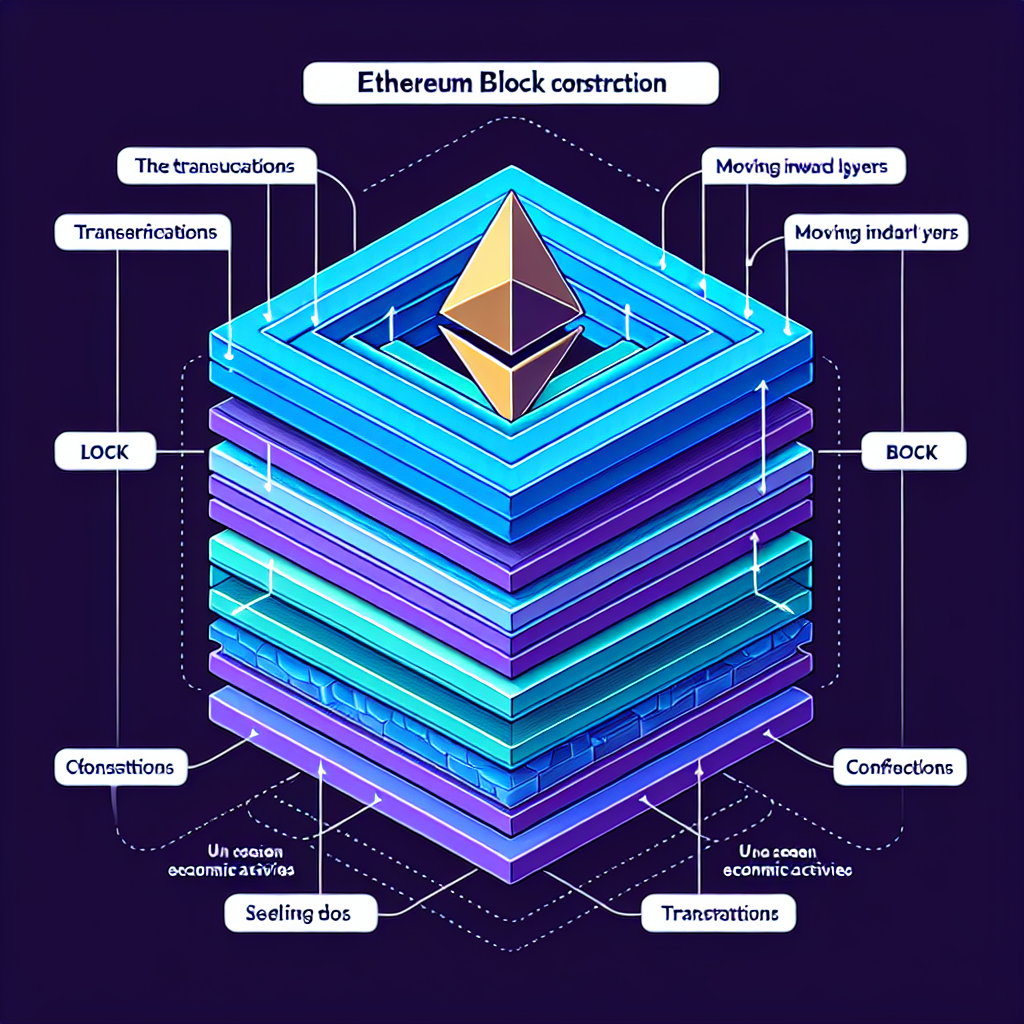
Block building in Ethereum is a crucial aspect of the network's lifecycle, with multiple components constantly evolving. This process determines which transactions are included in a block and in what order, directly impacting the network's efficiency, decentralization, and fairness. Over time, Ethereum's block production process has changed, especially with the growing role of MEV and the transition from validator-controlled selection to a system with specialized builders.
In this article, we will explore how the block building process in Ethereum has evolved, the introduction of Proposer-Builder Separation (PBS), and future research in this area.
Basic components of block building in Ethereum
Ethereum organizes time into discrete units called slots and epochs. A slot is a 12-second period in which a single block can be proposed. If no validator submits a block in that interval, the slot is skipped. An epoch, on the other hand, consists of 32 slots, equivalent to 6.4 minutes. At the end of each epoch, validator roles are randomly reshuffled to improve network decentralization and security. Ethereum reaches economic finality after two epochs (approximately 12.8 minutes), making it practically impossible to revert validated blocks.
The role of committees
To enable continuous block validation without overloading the network, Ethereum divides validators into committees. Each committee consists of a subset of validators randomly assigned at the start of an epoch, ensuring that no entity has disproportionate influence. These validators participate in the voting and block validation process. Additionally, aggregators within each committee consolidate validator confirmations to reduce communication load on the network.
Miner Extractable Value (MEV)
MEV refers to the additional profits validators can obtain by reordering, including, or censoring transactions in a block. This has led to various strategies such as front-running, back-running, and sandwich attacks, which can affect users on the network.
Before PBS: Validator-centric block building
Prior to the introduction of Proposer-Builder Separation (PBS), validators had full control over the selection and ordering of transactions in blocks. This caused issues such as centralization of MEV power, increased censorship risk, and network congestion due to bidding wars.
After PBS: Separation of builders and validators
To address these issues, PBS introduced a separation between block builders and validators. In this model, builders create optimized blocks while validators only select the most profitable block. This new mechanism improves block space efficiency and reduces the disproportionate power of larger validators.
Current operation of block building in Ethereum
Today, block building in Ethereum follows a structured flow:
- Users send transactions to the Ethereum network.
- Transactions enter the public mempool or private order flows.
- Searchers identify MEV opportunities and create transaction bundles.
- Block builders organize transactions into optimized blocks.
- Relays select the most profitable block for validators.
- The validator chooses the block that will provide the highest reward and proposes it to the network.
Challenges and solutions in block building
Despite the decentralization introduced by PBS, there are still challenges such as potential centralization among block builders and the risk of transaction censorship. New solutions, such as Inclusion Lists and FOCIL (Fork Choice enforced Inclusion Lists), are being explored to ensure greater censorship resistance and neutrality.
The role of Q2BSTUDIO in technological innovation
At Q2BSTUDIO, a company specialized in technology development and services, we are committed to innovation in blockchain and decentralized solutions. Our team continuously works on projects that optimize efficiency and security in the industry, exploring new ways to leverage Ethereum's technology to ensure a fairer and more efficient network.
Block building in Ethereum will continue to evolve with advances in decentralization, scalability, and MEV management. At Q2BSTUDIO, we continue researching and developing tools to actively contribute to the growth of the blockchain ecosystem.