
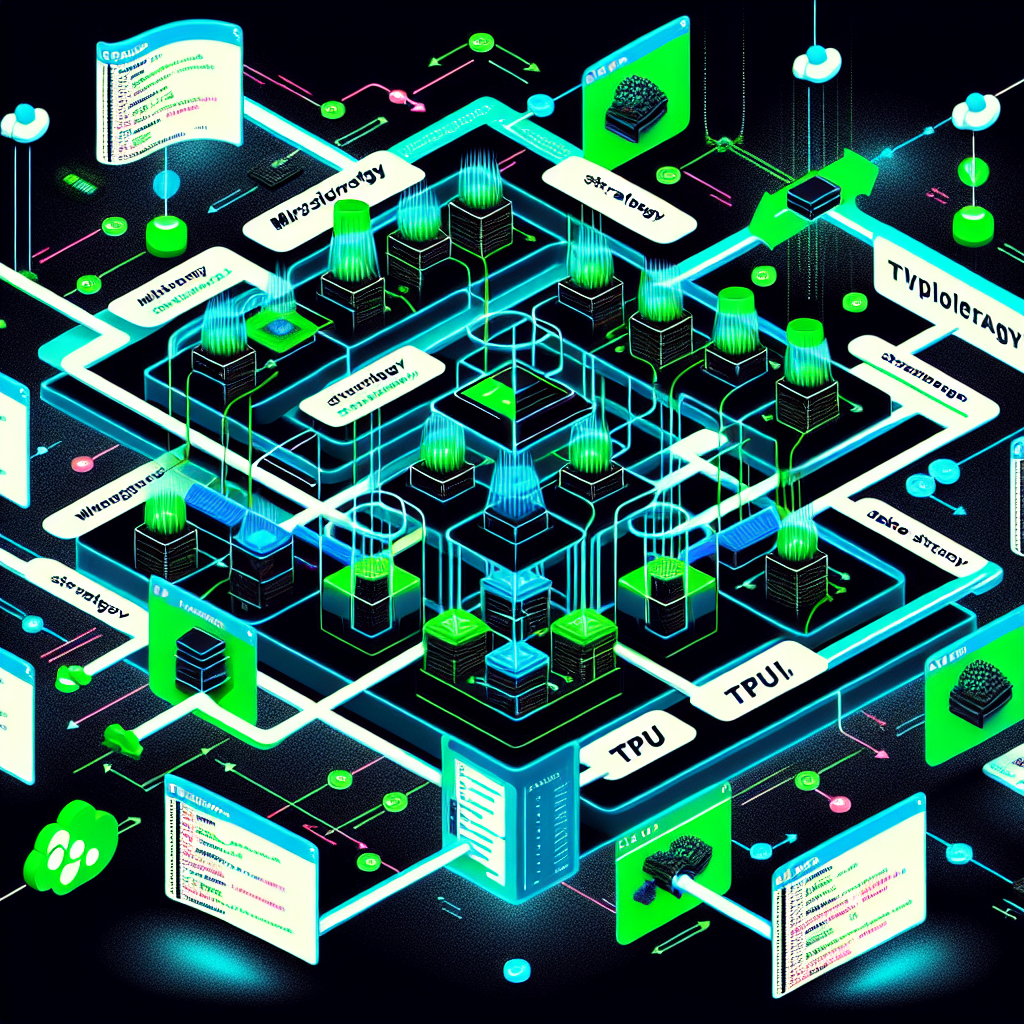
TensorFlow tf.distribute.Strategy makes it easy to scale training across GPUs, TPUs, and multiple machines. This comprehensive guide explains the available strategies such as MirroredStrategy, TPUStrategy, MultiWorkerMirroredStrategy, and ParameterServerStrategy, and shows how to integrate them with Keras Model.fit and custom training loops. Whether you want to accelerate local GPU training, fine-tune a BERT model on TPUs, or deploy distributed training in the cloud, you will find practical recommendations and use cases here.
Overview of the strategies: MirroredStrategy runs synchronized replicas across multiple GPUs on the same machine and automatically replicates weights; it is ideal for training on workstations with several GPUs. TPUStrategy is optimized for TPU accelerators and allows you to take full advantage of Google Cloud's architecture for tasks such as BERT fine-tuning and large-scale NLP models. MultiWorkerMirroredStrategy extends MirroredStrategy to multi-node clusters for horizontal scaling. ParameterServerStrategy separates the roles of parameter servers and workers and can be useful in scenarios where communication and memory require heterogeneous topologies. Other options such as OneDeviceStrategy and CentralStorageStrategy can serve for testing or special scenarios.
Integration with Keras Model.fit: the general pattern consists of creating the strategy object, entering strategy.scope, building the model, compiling it, and then calling model.fit as usual. In distributed environments, make sure to adjust the batch size per replica to maintain training stability and use callbacks for checkpointing and evaluation. For TPUs, configuring the TPU resolver and converting datasets with optimized tf.data is key to avoiding I/O bottlenecks.
Custom training loops: with strategies, you can use strategy.experimental_distribute_dataset to distribute tf.data datasets and strategy.run to execute the training step function on each replica. Use strategy.reduce to aggregate gradients or metrics across replicas. This approach provides maximum flexibility and control over data flow, gradient accumulation, and advanced techniques such as staged learning, composite gradients, or mixed precision.
Best practices and tuning: scale the total batch size as you add replicas, enable mixed precision to leverage Tensor Cores on modern GPUs, use gradient accumulation when memory limits the batch size per replica, and configure frequent checkpointing along with distributed evaluation. Monitor communication latency and memory usage, and select optimizer libraries compatible with distributed training.
Practical case: fine-tuning BERT on TPUs. Prepare the dataset with tf.data, tokenize in parallel, create the model within TPUStrategy scope, and evaluate throughput. On TPUs, it is critical to prefer vectorized operations and reduce Python operations, for example by avoiding map with slow functions. For local GPUs, MirroredStrategy is usually sufficient and allows scaling to multiple GPUs without changing the Keras API.
Cloud deployment tips: on AWS and Azure, configuring GPU-optimized instances or TPU equivalents and using high-speed storage and networking services improves performance. Consider using orchestration and autoscaling solutions for multi-worker training clusters and use aws and azure cloud services to integrate data pipelines and model deployment.
About Q2BSTUDIO: at Q2BSTUDIO, we are a custom software and application development company, specializing in artificial intelligence and cybersecurity. We offer custom software and custom application development for companies that need solutions adapted to their processes. Our services include integration of AI models into production, custom AI agents, business intelligence services, and power bi consulting. We also provide aws and azure cloud services, managed cybersecurity, and support for artificial intelligence projects and AI for companies looking to turn data into value.
Why choose Q2BSTUDIO: we combine software engineering experience with know-how in deep learning and cloud operations to design scalable solutions that include distributed training with tf.distribute.Strategy, data pipelines, Kubernetes deployment, and continuous monitoring. If you need to accelerate AI projects, implement AI agents, build dashboards with power bi, or develop custom software, Q2BSTUDIO can help you from the prototype phase to production.
Keywords and positioning: custom applications, custom software, artificial intelligence, cybersecurity, aws and azure cloud services, business intelligence services, AI for companies, AI agents, power bi. Contact Q2BSTUDIO for an initial consultation and discover how to apply distributed training and artificial intelligence solutions tailored to your business.


