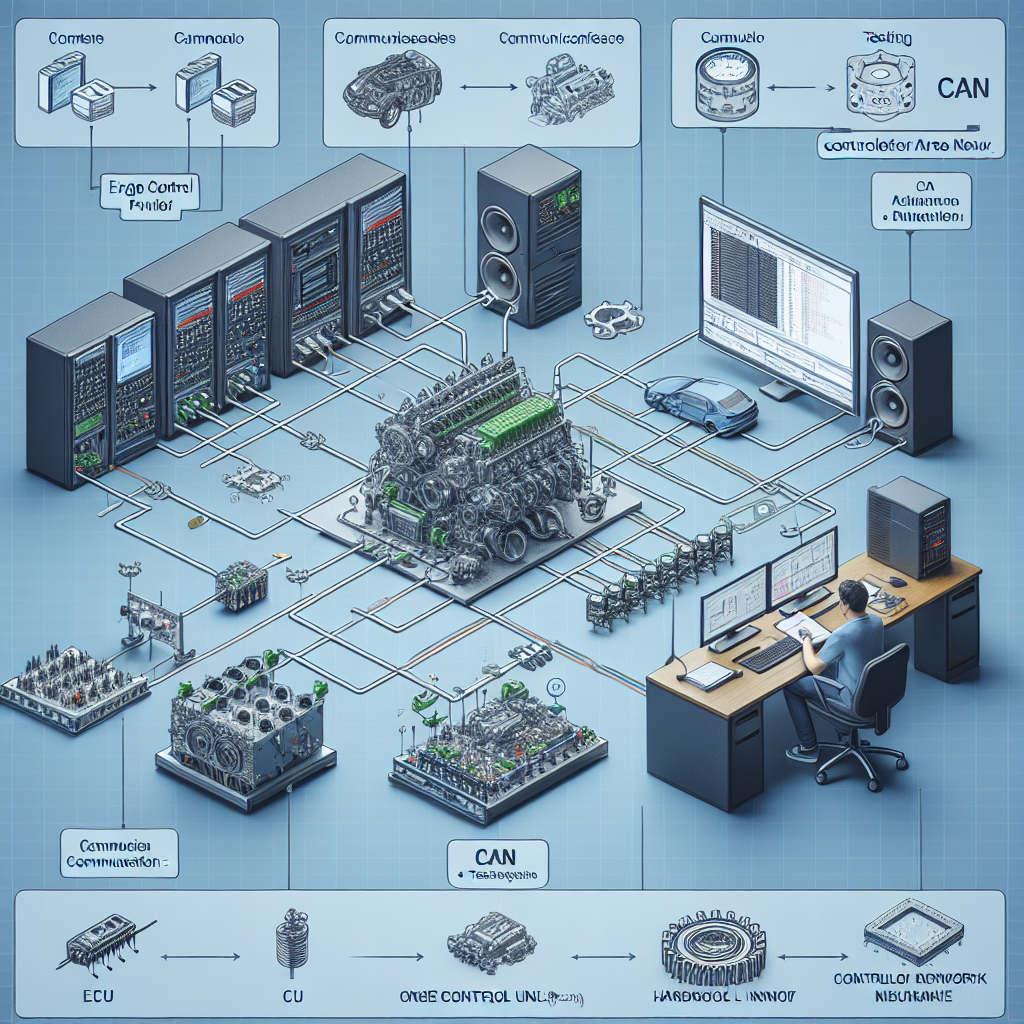
Building a factory test code (FTC) framework to validate low-level APIs in a Controller Area Network (CAN) environment focused on Hardware-in-the-Loop (HIL) systems requires a rigorous and modular approach that ensures test reproducibility, traceability, and safety. This article describes a practical architecture, use cases, validation methodologies, hardware and software considerations, and recommendations for integrating the framework into continuous development processes. We also introduce Q2BSTUDIO as your technology partner in custom software development and advanced solutions.
FTC framework architecture The framework design must be modular and separated into layers: a hardware layer with the HIL bench and CAN gateways, a hardware abstraction layer that normalizes access to CAN and I/O pins, a low-level API layer that exposes communication and diagnostic functions, a test layer that orchestrates validation cases, and a logging and reporting layer. Each test must be parameterizable to execute variations in CAN messages, timings, priorities, and error conditions.
Key components HIL bench with sensor and actuator simulation, CAN interface with frame injection and capture capability, fault injection module for robustness testing, versioned test case repository, execution engine supporting sequences and concurrent tests, and reporting system with coverage metrics and requirements traceability. Integrating telemetry and structured logs facilitates post-execution analysis and compliance with functional and safety requirements.
Types of tests CAN communication tests to validate timing, idempotency, and message priority. Functional tests of low-level APIs to verify register read/write, initialization functions, and fault recovery. Robustness and stress tests including bit flip injection, frame loss, and bus saturation. Compatibility and regression tests to ensure integrity after firmware or middleware changes.
Methodology and automation Define test cases based on requirements and ECU state models. Use reusable scripts and libraries to describe CAN scenarios. Integrate the framework with CI/CD pipelines to run tests on each build or before releases. Automate report generation with results, requirements traceability, and binary logs to facilitate audits and certifications.
Validation and acceptance criteria Establish clear criteria: maximum response latency, tolerance to frame loss, deterministic behavior under nominal and degraded conditions, and recoverability after restart. Include test coverage metrics and stability across multiple temperature cycles if applicable.
Integration with tools and standards Support traceability formats such as XML or JSON for requirements, integrate with test management and version control systems. Consider support for MATLAB Simulink-based models in HIL environments. Document interfaces and contracts of low-level APIs to facilitate automated and white-box testing.
Safety and cybersecurity Include specific cybersecurity tests for CAN communications: detection of malicious frames, message authenticity, key management if applicable, and attack surface analysis. Implement access controls to HIL benches and secure result logging. Cybersecurity must be part of the FTC design to meet regulatory requirements and reduce risks.
Reporting and analysis Generate aggregated reports with key metrics: percentage of passed tests, failures by category, regression trends, and execution times. Integrate dashboards to visualize results with tools such as Power BI for interactive analysis. Reports must be exportable and storable in AWS and Azure cloud services for availability and scalability.
Development best practices Adopt version control for test cases and HIL configurations. Implement test reviews and code coverage for low-level APIs. Use reproducible environments with containers and automate service deployments on test servers. Connect test execution with monitoring services for early alerts.
Example test cases Validate controller initialization and startup sequence, verify transmission and reception of diagnostic frames, simulate bus loss and verify recovery, inject errors in CRC or data fields and validate error handling, and measure latencies under traffic bursts.
Benefits of a well-implemented FTC Greater test coverage, reduced time to detect regressions, traceability between requirements and tests, improved firmware quality, and the ability to automate certifications. A robust framework facilitates continuous integration and safe production deployments.
About Q2BSTUDIO Q2BSTUDIO is a software development company specialized in custom solutions, including custom applications and custom software for embedded environments and industrial systems. We are specialists in artificial intelligence and AI for businesses, AI agent design, and Power BI analytics. We offer AWS and Azure cloud services, business intelligence services, and complete cybersecurity solutions to protect your assets. Our experience in HIL, CAN integration, and test automation allows us to design and deliver customized FTC frameworks covering everything from low-level testing to advanced dashboard reporting.
How we can help Q2BSTUDIO can collaborate on FTC framework design, develop adapters for your HIL bench, create automated test cases, integrate CI/CD pipelines, and deploy analytics solutions on AWS and Azure cloud services. We also provide security consulting, implementation of AI agents for monitoring and optimization, and business intelligence services to turn test results into actionable decisions.
Conclusion and call to action An FTC framework to validate low-level APIs in CAN and HIL environments is essential to ensure the quality and resilience of embedded software. If you need a partner to design and implement automated tests, optimize your validation strategy, or integrate artificial intelligence and cloud services solutions, Q2BSTUDIO is ready to help with custom application solutions, custom software, artificial intelligence, cybersecurity, business intelligence services, AI agents, and Power BI. Contact us to evaluate your project and create a tailored test plan that reduces risks and accelerates deliveries.