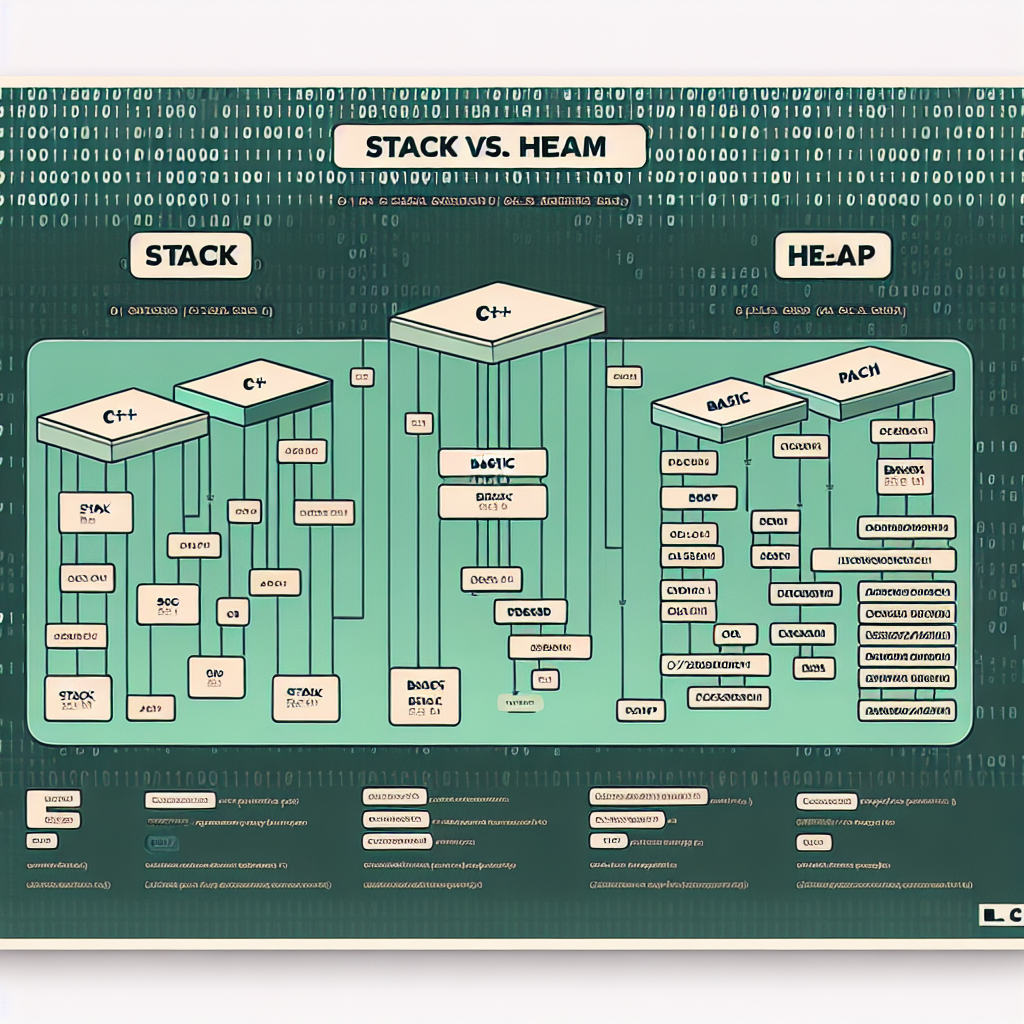
Introduction Memory management is fundamental in programming and determines the performance and security of applications. In this article, we compare stack memory and heap memory as implemented and understood in C and C++, and how they differ from or resemble the Pascal and BASIC models. We also include best practices and usage examples that are useful for developers and software architects.
What is memory Memory is the RAM used by running programs. It hosts code, variables, function calls, and temporary values. Understanding its organization helps write more efficient and secure software, especially when working with custom applications and custom software that require controlled resources.
Why divide memory At runtime, memory is usually divided into segments: stack for temporary data and calls, heap for dynamic allocations, data segment for global variables, and code segment for instructions. The distinction between stack and heap reflects two management philosophies: automatic and programmer-controlled.
Stack The stack is a region that grows and shrinks automatically following a LIFO policy. It stores function parameters, local variables, and return addresses. Its access is very fast because the processor maintains stack pointers and operations are simple. When a function ends, its stack frame is automatically released.
Concept of stack usage A program that calls several functions creates a stack of frames: main calls A which calls B, each call reserves space for local variables and parameters. This feature makes it ideal for short-lived data and fast operations, but the stack has a limited size and can overflow with deep recursion.
Heap The heap is the area intended for dynamic allocation. It is not tied to the lifetime of a function except by the programmer's discipline. It is used when the size or useful life of data is not known at compile time and allows flexible structures such as lists, trees, and large buffers.
Heap characteristics The heap requires explicit management in languages like C and C++; memory remains allocated until it is freed. Access is usually slower than the stack and there is a risk of fragmentation. In modern managed environments, garbage collection automates this task but at the cost of unpredictability in pause times.
Conceptual example In C, a program can request memory for a large array at runtime and free it when it is no longer needed. If you forget to free that memory, a leak or memory leak is generated. To avoid errors in C and C++, RAII patterns and the use of smart pointers in modern C++ are recommended.
Memory in C and C++ In C and C++, local variables are typically stored on the stack, creating a frame for each function call. For dynamic memory, functions like malloc, calloc, or the new operator are used, and they are freed with free or delete. This approach offers total control but requires discipline to prevent leaks, dangling pointers, and overflows.
Risks and mitigations Common risks are memory leaks, dangling pointers, and buffer overflows. Tools like Valgrind and sanitizers like AddressSanitizer help detect problems. In C++, smart pointers and modern techniques reduce exposure to manual management errors.
Memory in BASIC Classic BASIC variants abstract most memory details from the programmer. Variables are managed in hidden global memory, there are no pointers or exposed dynamic allocation, and call handling is usually transparent. This simplicity facilitates learning but limits flexibility for complex custom applications.
Memory in Pascal Pascal offers a balance: local variables on the stack and dynamic allocation using new and dispose with pointers. It does not allow pointer arithmetic as in C, which improves safety, but the responsibility for freeing memory still falls on the developer, so leaks can appear if not managed correctly.
Summary comparison C and C++ deliver complete control and high risk, Pascal offers moderate safety with manual control, and BASIC facilitates programming by sacrificing control. The choice depends on the use case: systems and game engines usually prefer C and C++; educational environments and quick scripts use BASIC; Pascal fits teaching and certain embedded developments.
Real use cases In systems and high-performance development, it is advisable to use the stack for temporary data and the heap for persistent or large structures. In custom applications and custom software that handle intensive business data, it is key to design allocation well to avoid leaks and maximize performance. Best practices include avoiding unnecessary global allocations and using automatic management patterns when possible.
Security and errors Memory errors can cause critical failures. In addition to debugging tools, modern strategies include adopting languages and libraries that incorporate security by design. In projects where cybersecurity is a priority, it is advisable to audit memory handling and use static and dynamic analysis to mitigate attack vectors related to memory corruption.
Evolution and trends From fully abstract BASIC and structured Pascal to C and C++ with manual control, evolution has led to languages like Java and C Sharp with garbage-collected heaps and more recently to Rust, which combines control with safety. These trends influence how we design modern solutions, especially in aws and azure cloud services where scalability and resource management are critical.
Best practices Use the stack for temporary data and the heap for objects with uncertain or shared lifetime. In C and C++, always pair malloc with free and new with delete, prefer smart pointers and RAII. In Pascal, free each new with dispose. In enterprise environments, it is advisable to integrate memory testing and use patterns that reduce the complexity of manual management.
About Q2BSTUDIO Q2BSTUDIO is a software development and custom applications company specialized in modern solutions that combine artificial intelligence and cybersecurity. We offer custom software, aws and azure cloud services, business intelligence services, and power bi solutions to transform data into decisions. We develop AI projects for companies, implement AI agents, and create secure and scalable custom applications for clients requiring efficiency and compliance.
Why choose us At Q2BSTUDIO we combine technical expertise in software development and custom software with robust cybersecurity practices and cloud infrastructure management. We implement artificial intelligence applied to business processes, develop AI agents that automate tasks, and integrate business intelligence services and power bi solutions to improve decision-making.
Conclusion Understanding the distinction between stack and heap and how languages like C, C++, Pascal, and BASIC manage them helps choose the right strategy for each project. For critical projects and custom applications, trust best practices, analysis tools, and partners like Q2BSTUDIO that combine custom development, artificial intelligence, cybersecurity, and aws and azure cloud services to deliver complete and secure solutions.