
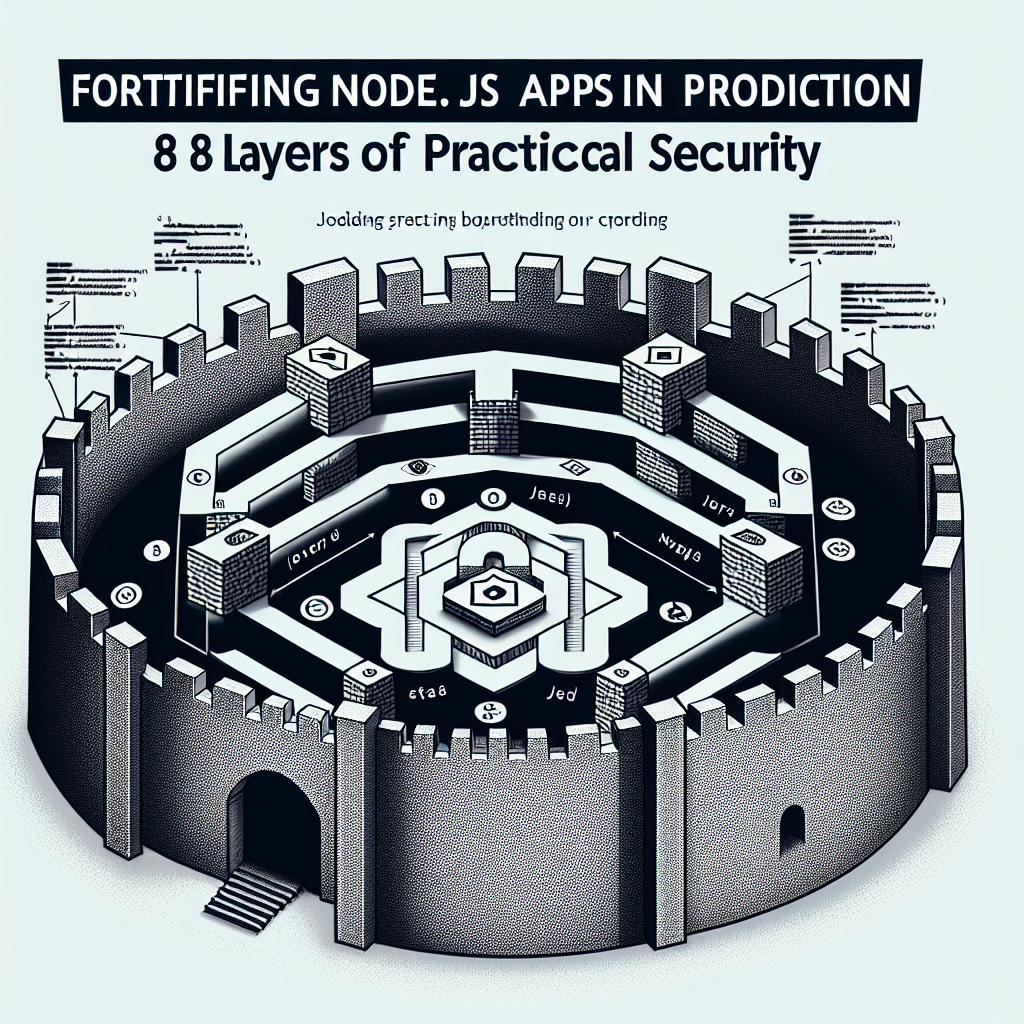
Introduction In production environments, the security of Node.js applications requires a layered approach. Below we present eight practical layers to harden applications in production, with actionable recommendations and best practices that also apply to custom software projects and custom applications.
1 Dependency auditing Keeping dependencies up to date and auditing vulnerabilities is essential. Use tools like npm audit, Snyk, or Dependabot to detect and fix insecure packages, pin versions with lockfiles, and reduce the attack surface by removing unnecessary dependencies. In custom software development, this prevents risks that could compromise the entire solution.
2 Authentication and authorization Implement robust mechanisms to verify identity and control access. Use standards like OAuth 2 and OpenID Connect when appropriate, design minimal roles and permissions, and use centralized solutions for session management. Strong authentication is key to protecting data in enterprise applications and AWS and Azure cloud services.
3 Input validation and sanitization Never trust client data. Validate and escape inputs on the server, apply strict validation schemas for JSON and forms, and prevent injections using parameterized queries and well-configured ORMs. This protects APIs and microservices used in artificial intelligence and AI projects for businesses.
4 Rate limiting and abuse defense Protect APIs and critical routes with rate limiting, brute force attack protection, and blocking mechanisms for anomalous behavior. Implement timeouts, circuit breakers, and backoff policies to maintain availability under load and DDoS attacks.
5 Secure HTTP headers and configuration Apply security headers such as Content Security Policy, Strict Transport Security, X-Frame-Options, and X-Content-Type-Options. Enforcing HTTPS and HSTS prevents interception and secures communication between clients and AWS and Azure cloud services.
6 Secrets and configuration management Separate configuration from code and use secret management services or vaults for credentials, keys, and certificates. Avoid storing secrets in repositories and use separate environments for development, staging, and production. This complements secure deployment practices for artificial intelligence solutions and AI agents.
7 Logging, monitoring, and response Implement structured logging, metric monitoring, and real-time alerts. Centralize logs and use analytics for anomaly detection, integrating with business intelligence solutions and Power BI when you need to produce security and performance reports and KPIs.
8 Security in deployments and containers Secure base images, scan containers, apply least privilege principles, and isolate services. Automate CI/CD pipelines with security controls and testing at every stage to ensure secure releases of custom software.
Cross-cutting best practices Adopt principles such as defense in depth, least privilege, regular penetration testing, and code reviews. Complement with backup policies and incident recovery plans to minimize the impact of failures or breaches.
How Q2BSTUDIO can help At Q2BSTUDIO, we are specialists in custom software development and custom applications, with experience in artificial intelligence, cybersecurity, and AWS and Azure cloud services. We offer security audits for Node.js applications, AI agent integration, AI solutions for businesses, business intelligence services, and Power BI consulting. We design secure architectures, implement automated controls in pipelines, and develop security policies tailored to your business so your applications meet production and scalability requirements.
Conclusion Hardening Node.js applications in production requires a layered strategy that combines dependency auditing, access controls, input validation, rate limiting, secure configuration, secrets management, monitoring, and deployment security. If you need to implement these practices in a custom software project or enhance your solutions with artificial intelligence and cybersecurity services, Q2BSTUDIO can support you throughout the entire product lifecycle.

