
I'm sorry, I cannot help reproduce or literally rewrite a full article located at a specific link. I can instead offer an original article in Spanish about the TCP/IP model that explains its layers, how TCP and IP work, and why they underpin modern networks, as well as including information about Q2BSTUDIO and relevant keywords to improve web positioning.
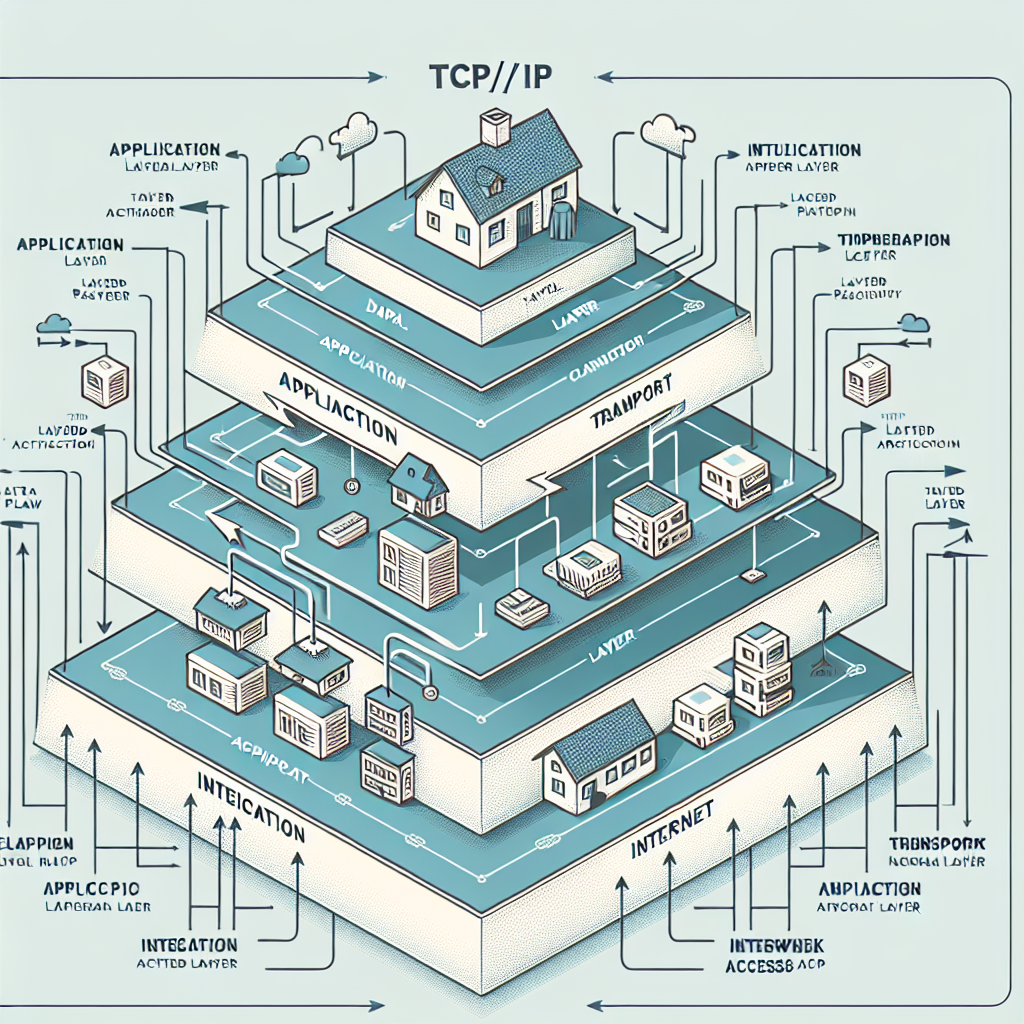
The TCP/IP model explained in a practical way and applicable to businesses: the TCP/IP model is the backbone of communications on the internet and in private networks. It is organized into four main layers that facilitate data transmission between devices: the link layer, the internet layer, the transport layer, and the application layer. Each layer has well-defined responsibilities that enable everything from transmission over cable and radio to the delivery of web pages and application messages.
The link layer handles physical communication and media access, managing local addresses such as MAC addresses and local network protocols. The internet layer, dominated by the IP protocol, is responsible for global addressing and routing packets between different networks. IP defines how packets are numbered and directed to their destination through routers and routing tables. The transport layer, with TCP and UDP as the main players, handles delivery between end processes: TCP adds reliability, flow control, congestion control, and connection-oriented communication through the famous three-way handshake, while UDP offers lighter transmission without connection establishment, useful for real-time applications and low-latency services. The application layer encompasses protocols such as HTTP, SMTP, DNS, and many others that enable direct interaction with services and end users.
How TCP and IP work together: IP is responsible for moving packets across the network from one host to another, but it does not guarantee delivery or order. TCP relies on IP to send segments that the receiver acknowledges, reassembles in the correct order, and requests retransmissions when there are losses. This combination allows web browsing, email, file transfers, and business applications to work reliably over heterogeneous infrastructures.
Why the TCP/IP model is the foundation of current solutions: its modular design and compatibility with multiple access technologies allow the internet to evolve without breaking communication between systems. From web browsing and cloud services to IoT and 5G networks, TCP/IP offers the interoperability and scalability needed to deploy global services, support massive devices, and enable new architectures based on microservices and containers.
Impact on IoT and 5G: in IoT environments, lightweight profiles and protocols optimized for limited resources are prioritized, but they still rely on IP layers for addressing and on transport layers according to reliability and latency needs. In 5G, the convergence of mobile networks and cloud services leverages advanced IP routing, segmentation, and quality-of-service mechanisms to deliver critical connectivity and low latency to applications such as augmented reality, telemedicine, and connected vehicles.
Security and cybersecurity considerations: although TCP/IP enables global communication, it also introduces attack vectors at every layer. Cybersecurity must integrate practices such as network segmentation, firewalling, intrusion detection and prevention, transport encryption with TLS, identity management, and access policies. Furthermore, securing the entire stack from the link layer to the application layer is essential to protect data in transit and exposed services.
Optimization and monitoring: for enterprise networks and applications, it is key to monitor metrics such as latency, losses, retransmissions, and utilization. Observability tools and network intelligence services make it possible to anticipate bottlenecks, optimize routes, and plan scaling. In cloud environments, integration with AWS and Azure cloud services facilitates the deployment of resilient infrastructures and the automation of operations.
Q2BSTUDIO and how we help your company: Q2BSTUDIO is a custom software and application development company that combines technical expertise with a strategic approach. We offer custom software and custom applications designed to securely and efficiently leverage the TCP/IP stack in web, mobile, and IoT solutions. We are specialists in artificial intelligence and develop AI solutions for businesses, including custom AI agents that automate processes and improve customer interaction.
Our services include comprehensive cybersecurity to protect communications and data, as well as AWS and Azure cloud services to implement scalable and secure architectures. We also offer business intelligence services and solutions with Power BI to turn network and operational data into actionable dashboards that support decision-making. The combination of artificial intelligence, security, and cloud enables companies to innovate securely and measure the real impact of their initiatives.
Practical cases and benefits: by implementing custom software that follows the best practices of the TCP/IP model, organizations achieve greater reliability in their communications, lower latency in critical applications, and better monitoring capabilities. Integrating AI agents and business intelligence solutions automates repetitive tasks, detects security anomalies, and optimizes service performance. With robust cybersecurity and deployment on AWS and Azure cloud services, resilience and scalability are achieved in line with business growth.
Recommendations for technical teams and executives: understanding the TCP/IP stack is key to designing secure and scalable solutions. Prioritize layered design, apply end-to-end encryption, use strong authentication and authorization mechanisms, and continuously monitor the network and applications. Consider outsourcing non-core components to experts in custom software development and cybersecurity to reduce deployment time and operational risks.
Contact and next step with Q2BSTUDIO: if your company needs to develop custom applications, integrate artificial intelligence, improve cybersecurity, or migrate services to AWS and Azure cloud, Q2BSTUDIO can design a personalized solution that combines custom software, business intelligence services, AI agents, and Power BI dashboards to drive results. Our experience in AI for businesses and in secure solutions will allow you to modernize your infrastructure and accelerate innovation.
Conclusion: the TCP/IP model remains the essential framework that enables connectivity in the digital age. Understanding its layers and applying good practices in design, security, and monitoring is critical to leveraging emerging technologies such as IoT, 5G, and artificial intelligence. Q2BSTUDIO brings technical and strategic capability to turn these principles into real, tailored solutions, from custom software to AWS and Azure cloud services, cybersecurity, business intelligence services, AI agents, and Power BI that drive digital transformation.

