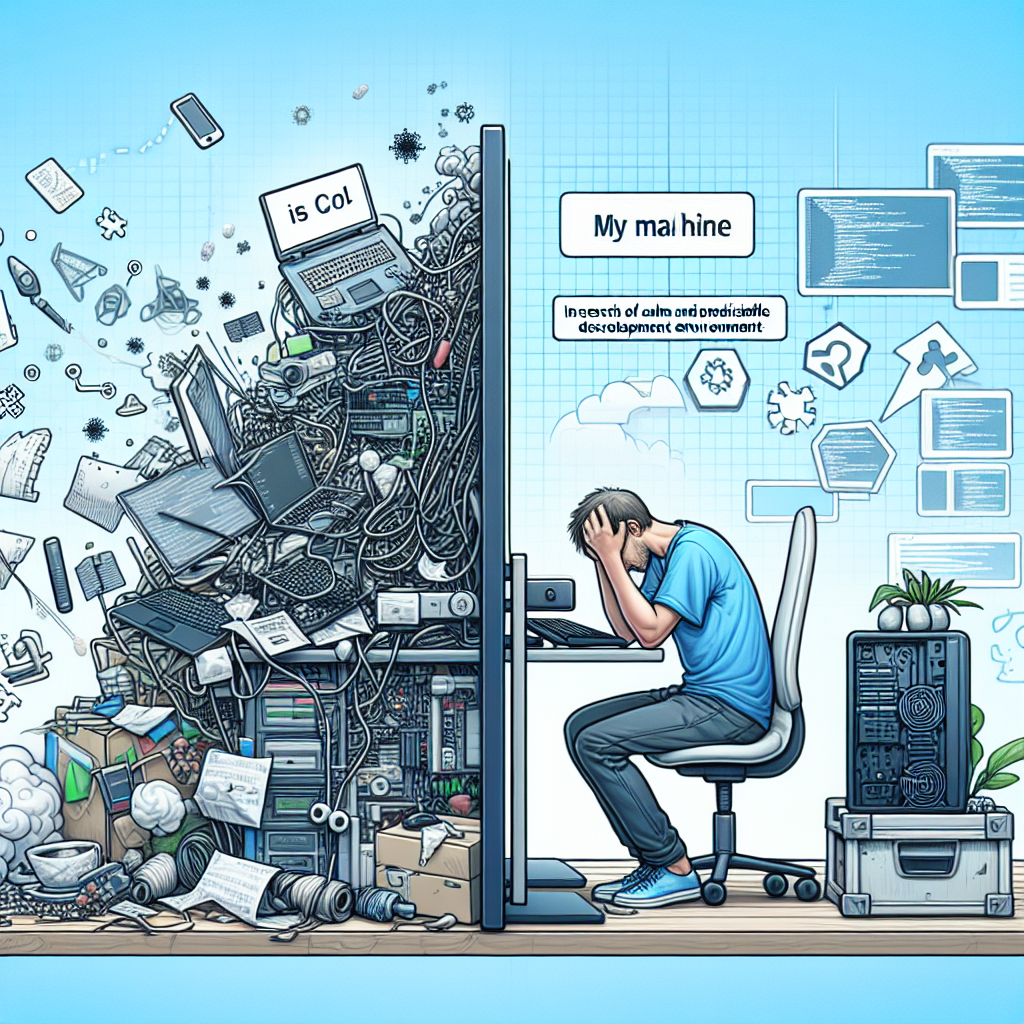
Have you ever heard of environmental determinism? It was an old geographical theory that held that climate and terrain determined human culture. Today that idea seems obsolete and problematic, but the metaphor is still useful for developers: instead of accepting that the environment dictates the behavior of our software, we should design deterministic environments that allow for predictability and creativity.
In computing, a deterministic system always produces the same output for a given input. That property makes errors reproducible, tests reliable, and deployments predictable. The enemy is non-determinism caused by subtle differences in library versions, operating systems, and network configurations that lead to the phrase we all fear: it works on my machine. The solution is not to limit creativity, but to offer a stable foundation that enhances it.
A key piece in this quest was Docker. Before containers, we spent hours debugging failures that only appeared on a specific machine due to discrepancies in libraries or configurations. Docker introduced the idea of packaging the application along with its environment: a Dockerfile that defines the system base, libraries, and runtime. The resulting image is a portable artifact that runs the same on a developer's laptop, on a continuous integration server, or in production. Docker solved the immediate problem of the runtime environment being unpredictable, creating a deterministic capsule for the application.
But predictability does not end with the container. A microservice needs a database, load balancer, access policies, and other external services. If those components are configured manually, the problem shifts: now it works in the development cluster but fails in staging. To achieve total environmental calm, you must also codify the ground where we plant the container.
That is where Infrastructure as Code comes in. Managing and provisioning infrastructure with definition files instead of manual processes allows you to apply software development discipline to infrastructure. There are imperative approaches, which describe how to execute steps, and declarative ones, which describe the desired state. The declarative approach, popularized by tools like Terraform, compares the current state with the desired one and applies a plan to make them match. This avoids configuration drift and makes infrastructure reproducible and auditable.
The combination of Docker and Terraform is powerful: a CI/CD pipeline builds deterministic Docker images and publishes them to a registry; the same pipeline runs terraform apply to provision clusters, databases, and network rules; finally, the new images are deployed as part of the plan. Thus, everything from network rules to application code is versioned code in Git and managed by a single, predictable workflow.
The benefits are real and measurable. Onboarding accelerates: a new developer clones the repository, runs docker compose up and terraform apply, and within a few hours works on a faithful replica of production. Consistency is maintained: you can create ephemeral environments for each pull request, recover old versions for debugging, or quickly recover in another region in case of disaster. Costs drop because orphaned resources are eliminated, non-production environments are scheduled to shut down outside working hours, and optimizations like spot instances are applied with a few code changes.
These practices are especially critical in artificial intelligence projects, where large models, specific GPU drivers, and Python dependencies complicate reproducibility. Docker and IaC practices allow you to create reproducible experimentation and production environments. Furthermore, an interesting new standard emerges, the Model Context Protocol MCP Toolkit, which facilitates connecting LLMs with tools and data through servers packaged as containers. By codifying these connections in YAML files, the Infrastructure as Code concept is extended to the AI stack, enabling reproducibility and reliable deployments for AI-based solutions.
In practice, all this translates into two different realities. For new projects, the approach is ideal: the first commits can be a Dockerfile and a main.tf that define the entire infrastructure before writing a single feature. Returning to a project after months is simple: clone the repository, start containers, and apply the infrastructure, and the entire environment reappears. In contrast, bringing IaC to existing enterprise systems requires a gradual transition, training, importing pre-existing resources into Terraform state, and managing the cultural adaptation toward a DevOps mindset where developers take on infrastructure and operations become platform enablers.
At Q2BSTUDIO we apply these ideas in real projects. We are a custom software and application development company specialized in artificial intelligence, cybersecurity, and AWS and Azure cloud services. We design custom software solutions and custom applications that integrate Docker and Terraform practices to guarantee deterministic environments from development to production. Our business intelligence and power bi services allow you to transform data into actionable decisions; our AI solutions for businesses include AI agents that automate workflows and improve productivity; and we combine all this with robust cybersecurity policies to protect APIs, data, and models.
We work with clients to create reproducible environments that accelerate custom software delivery and reduce costs. We implement CI/CD pipelines that build deterministic images, deploy declarative infrastructures, and generate ephemeral environments for each branch or pull request. We offer AWS and Azure cloud service management, cost optimization through scheduling and right sizing, and migrations where we import existing resources into IaC to eliminate drift and regain traceability.
We also provide business intelligence services with Power BI dashboards, integrations with AI agents, and AI architectures that facilitate reproducible experimentation and secure model deployment. Our cybersecurity offering ensures that IaC templates do not contain embedded secrets and that configurations comply with best practices, while automation and monitoring allow us to proactively detect and correct configuration deviations.
Adopting infrastructure as code and containers is not just a technical improvement; it is a commitment to the speed, quality, and sustainability of software development. For teams that want to leverage artificial intelligence while maintaining high standards of cybersecurity and cloud efficiency, Q2BSTUDIO offers practical experience in creating deterministic environments that allow technical creativity to thrive without surprises.
If you want to transform the way you develop and deploy custom software, optimize costs in AWS and Azure cloud services, or deploy artificial intelligence projects with reproducibility and security, at Q2BSTUDIO we can help you design the architecture, automate the infrastructure, and set up pipelines that guarantee predictability. Turning your environment into code is the most effective way to eliminate uncertainty and dedicate more time to building innovative solutions using artificial intelligence, AI agents, and tools like power bi to generate real value.
Your environment should be as reliable as your code. Let's treat it that way and build deterministic systems that allow your team to focus on what matters: creating custom software that drives the business. Contact Q2BSTUDIO to start turning your environments into code and make the most of the opportunities of artificial intelligence and cloud services.