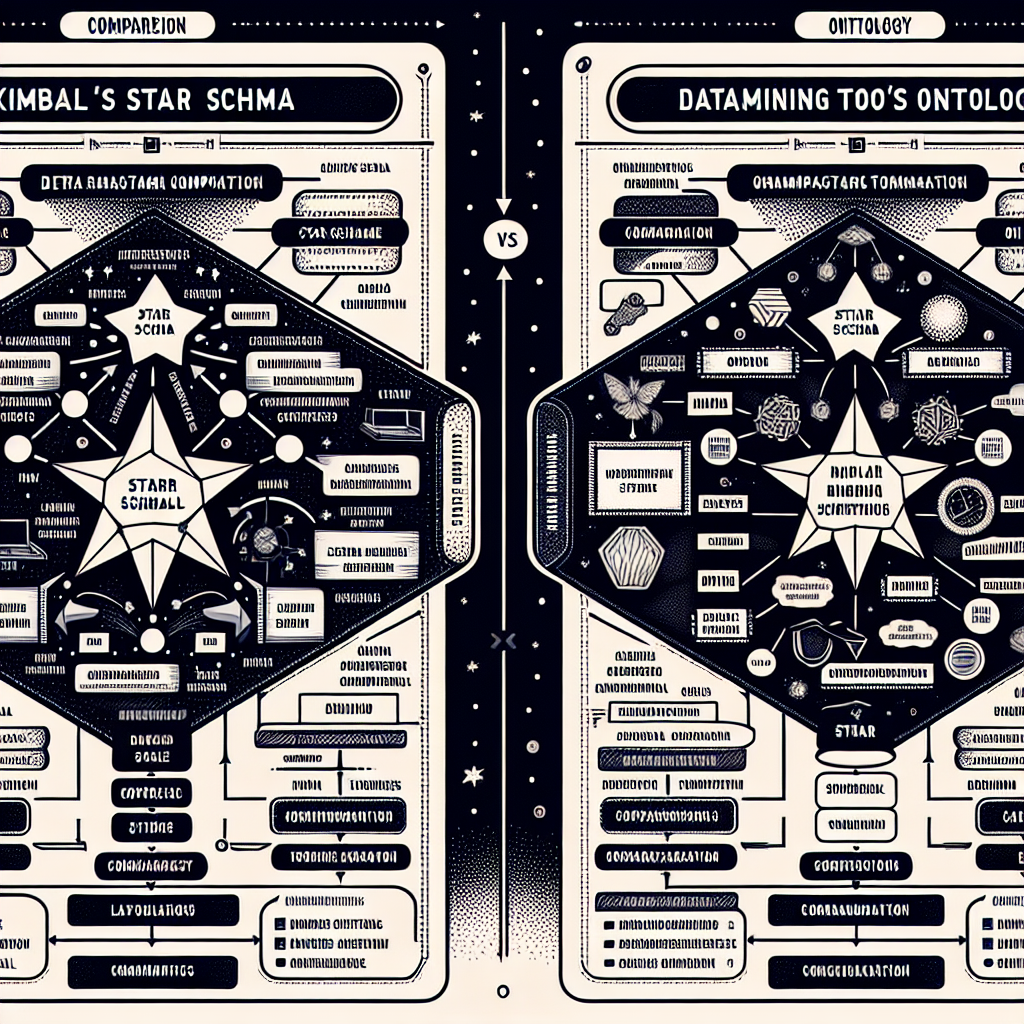
Here goes a joke that occurred to me Q: What does the father of data warehousing have in common with an analytics powerhouse valued at 300 billion and named after a spying device from The Lord of the Rings A: Both challenge the star schema paradigm and encourage you to model data top-down in a highly normalized format
You may not have found it funny in the classic sense, but it gave me that feeling of a glitch in the matrix
Today almost everyone in data uses a variant of the star schema popularized by Ralph Kimball If you work with data warehousing or business intelligence, you have surely seen fact tables and dimensions in your tools That dimensional approach is the industry standard for modeling data for BI purposes
Palantir, a large-scale analytics company, bases much of its proposition on ontology Ontology is a highly normalized model that represents business objects and their 1-to-1, 1-to-many, or many-to-many relationships It is a very intuitive way to view data from the user's perspective
The curious thing is that most of the industry does not adopt that approach Palantir's success in deploying specialized teams to build ontologies demonstrates the power of this technique But then why doesn't everyone do the same
The answer lies in an old debate between modeling titans: Bill Inmon and Ralph Kimball Inmon proposed a top-down approach from the start: normalized modeling as the single source of truth, integrating and consolidating data from the source and delaying joins until the end of the analytical process That strategy maximizes data availability and prevents valuable information from being lost through early aggregations
Kimball, on the other hand, popularized dimensional modeling or the star schema It is a bottom-up, incremental, and decentralized approach that allows delivering results quickly and with less initial effort Due to its practical properties, Kimball became the dominant trend in BI projects
So why does Palantir deviate from the norm It is not about gratuitous contrarianism Palantir sells business outcomes, and its contracts allow funding the high human cost and engineering work needed to create a consistent and fully comprehensive ontology
Most data teams do not have that budget or that dedicated approach That is why the star schema remains popular: it is cheaper and faster to implement, although it sacrifices data visibility and coverage for the business user Organizations often cover those limitations with complex dashboards and analysts on standby for ad hoc requests
The arrival of artificial intelligence is changing the rules of the game Today it is possible to automate much of the integration and normalization work that previously only companies with large teams could afford At Q2BSTUDIO, a software and custom application development company specializing in artificial intelligence and cybersecurity, we are applying AI agents and LLM models to drastically reduce the cost of ontology curation
Q2BSTUDIO offers custom software services and custom applications, business intelligence services, AI for companies, AI agents, Power BI, as well as AWS and Azure cloud services and cybersecurity solutions Our approach combines expertise in data engineering, AI models, and security practices to deliver a useful and maintainable ontology that allows companies to access reliable data without sacrificing speed
In practice, this means that companies that previously opted for star schema due to budget constraints can now consider top-down models with full coverage and traceability Q2BSTUDIO integrates sources, performs normalization, and applies AI agents to generate business relationships, metadata, and documentation that are easy for non-technical users to understand
If you are interested in exploring how to combine the best of dimensional modeling and ontology with artificial intelligence solutions, AI agents, Power BI, and AWS and Azure cloud services, at Q2BSTUDIO we design custom software and business intelligence strategies tailored to your case Contact us at support@q2bstudio.com to learn about our custom software services, custom applications, artificial intelligence, cybersecurity, and business intelligence services
In summary The Kimball versus Inmon debate is not just academic It is a practical decision that depends on budget, objectives, and appetite for complexity Artificial intelligence and solutions like those we develop at Q2BSTUDIO are lowering the barrier to entry for complete ontologies, allowing more organizations to benefit from more intuitive and powerful data models