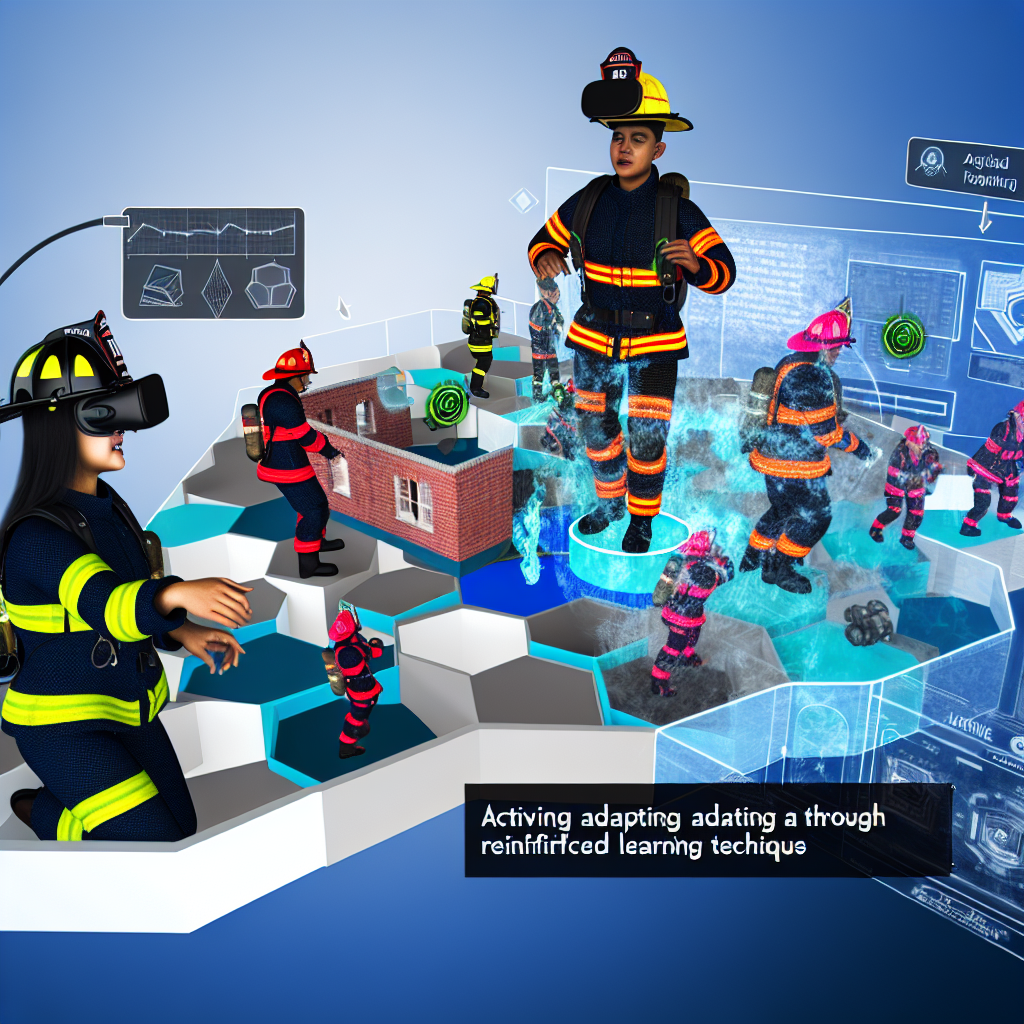
Abstract: This article presents an adaptive virtual reality training system for firefighters that uses reinforcement learning to dynamically adjust scenario difficulty and cognitive load. Unlike static VR simulations, the system continuously evaluates the firefighter's performance and physiological data to optimize training effectiveness and mitigate stress, with potential improvements in real response times of up to 30 percent and reduced professional burnout.
INTRODUCTION
High-stress environments such as firefighting demand exceptional cognitive and decision-making capacity. Traditional training methods often fail to reproduce the unpredictable and dynamic nature of real emergencies. Virtual reality offers a safe and controlled solution, but many current systems are static or rely on predefined scripts and do not scale difficulty based on user response. To close this gap, we present AVSG, Adaptive VR Scenario Generation, a platform that integrates physiological sensors and a reinforcement learning agent to adapt training complexity in real time.
THEORETICAL FOUNDATION
The AVSG system combines a VR environment with realistic simulations of smoke, structural collapses, and civilian rescues, a set of sensors that record heart rate variability HRV, electrodermal activity EDA, and eye tracking, and a reinforcement learning agent responsible for modulating scenario parameters to maintain a target cognitive load.
COGNITIVE LOAD ESTIMATION
Cognitive load is estimated through a fusion of HRV and EDA signals. RMSSD is used as an indicator of parasympathetic activity, inversely related to cognitive load. EDA reflects sympathetic activation. From these, a cognitive load index CLI is calculated using a previously learned weighting and refined with eye tracking data such as fixation duration and saccade frequency to improve estimation.
ADJUSTMENT POLICIES THROUGH REINFORCEMENT LEARNING
The core of AVSG is a DQN agent that observes the CLI, the firefighter's actions in VR, and the scenario state. Its possible adjustments include fire intensity I, civilian complexity C, structural hazards H, and communication blackouts K. The action space includes increasing or reducing each parameter, introducing or eliminating communication interference, and maintaining the state. The reward function prioritizes keeping cognitive load close to a target according to skill level, maximizing task completion rate, and reducing baseline stress, with weights optimized through Bayesian optimization.
EXPERIMENTAL DESIGN
The system was evaluated with active firefighters of different experience levels. After a baseline session with a fixed complexity scenario, participants completed 30 minutes of training with AVSG where the agent adjusted the scenario in real time. Subsequently, they completed a simulated real-world exercise measured by response time and error rate. Physiological data HRV, EDA, and eye tracking, VR performance metrics, and subjective ratings via NASA TLX were collected.
RESULTS
Preliminary results show statistically significant improvements in response times and reduced perceived load. Overall, adaptive training offered average response time reductions of around 12 percent in the first experimental iteration, with additional optimization potential that could lead to improvements of up to 30 percent in larger-scale deployments with more data. NASA TLX scores decreased, indicating better stress and workload management.
SIGNAL PROCESSING AND MATHEMATICAL CONSIDERATIONS
HRV signals are processed to extract RMSSD after band-pass filtering to capture high-frequency components. EDA is filtered and smoothed using moving averages to identify significant changes in skin conductance. The DQN update follows an adapted Bellman rule with learning rate and discount factor appropriate to the training session's time horizon. The reward function weights are fine-tuned using Bayesian optimization to balance challenge and safety.
SCALABILITY AND FUTURE
In the short term, the plan is to expand scenarios to structural fires, wildfires, and hazardous materials incidents. In the medium term, haptic feedback will be integrated to increase immersion, and the methodology will be transferred to other first responders such as EMTs and law enforcement. In the long term, a federated learning approach is proposed to share agent training among fire departments, increasing robustness and diversity of training profiles without compromising data privacy.
PRACTICAL IMPLICATIONS AND COMMERCIALIZATION
Q2BSTUDIO, a company specialized in custom software and application development, artificial intelligence, cybersecurity, and aws and azure cloud services, can offer this solution as a product and service adapted to each department. Our experience in custom software, business intelligence services, and implementation of AI agents and power bi facilitates the integration of AVSG into existing operational workflows, allowing scenario customization, data storage and analysis with BI tools, and deployment of the system in secure cloud architectures.
VERIFICATION AND TECHNICAL RELIABILITY
System verification is based on continuous CLI monitoring during adaptive training, statistical validation of the correlation between physiological signals and cognitive load, and filmed reviews of sessions to avoid training shortcuts. Reliability is ensured through robust signal preprocessing, artifact filtering, and extensive model training with representative datasets.
TECHNICAL CONTRIBUTION
The main contribution lies in integrating a cognitive load index into the reward function of an RL agent to adjust VR scenarios in real time. The combined use of reinforcement learning, physiological sensors, and Bayesian optimization to calibrate parameters offers a novel path toward personalized and measurable training. This approach complements artificial intelligence and AI services for businesses, enhancing solutions that reduce burnout and improve operational effectiveness.
CONCLUSION
Adaptive VR scenario generation through reinforcement learning and physiological feedback represents a significant advance in firefighter training. Keeping participants in an optimal cognitive load zone improves preparedness, reduces stress, and improves response times in real emergencies. Q2BSTUDIO is prepared to offer custom implementations of this technology, integrating custom software, cybersecurity, aws and azure cloud services, business intelligence services, AI agents, and power bi to maximize operational value and return on investment for fire departments and other first responder organizations.