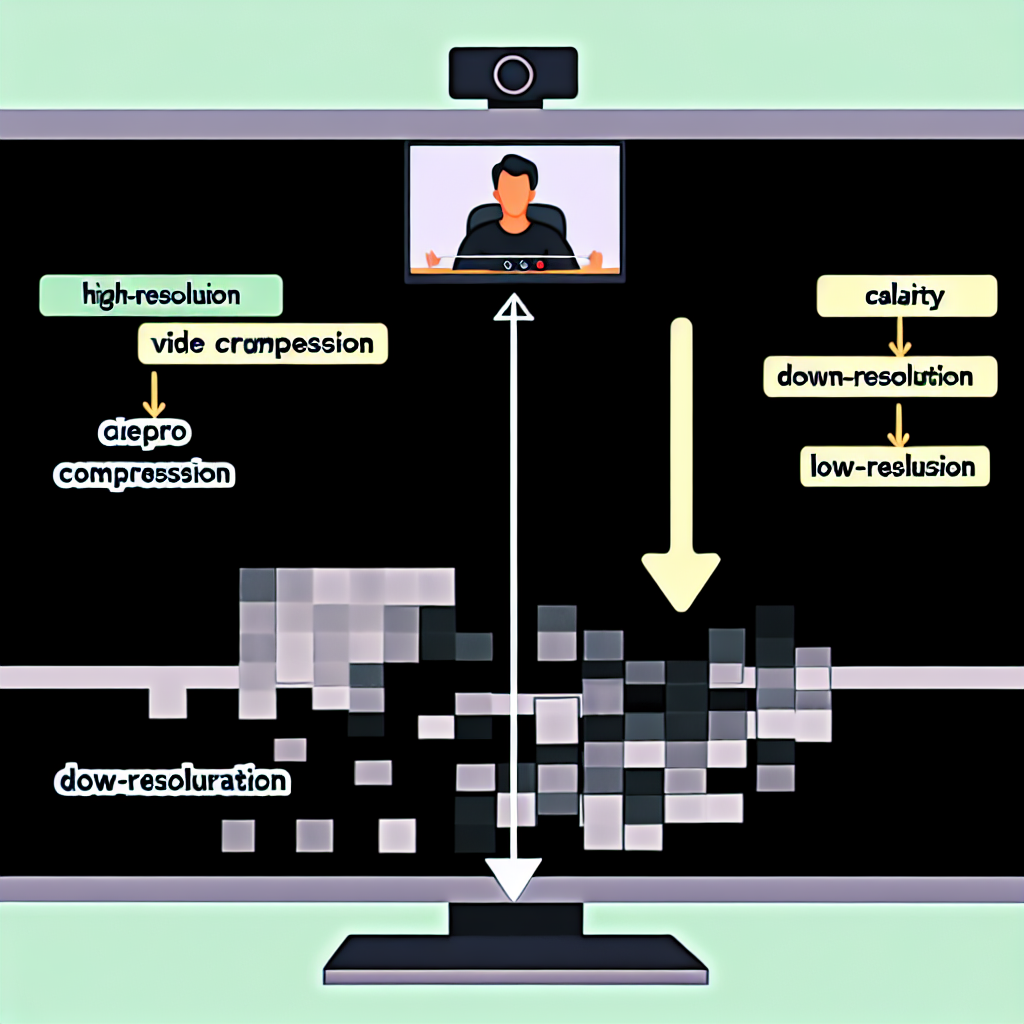
This technical appendix summarizes an experimental setup designed to compare webcam formats and the behavior of video conferencing platforms under bandwidth constraints, with special attention to Zoom and to resolution drops and video compression during real-time meetings.
Experimental setup and equipment used: an Acer laptop was used as a test station, a Samsung laptop acting as an attacking node or traffic generator, and a Nikon Z7 camera as a high-quality source to evaluate how the signal degrades when transmitted through video conferencing applications.
Analysis of Zoom behavior: Zoom applies adaptive bitrate strategies that prioritize audio over video and first reduce resolution and then frame rate when available bandwidth falls below certain thresholds, causing progressive drops from 720p or 1080p to much lower resolutions, macro-blocking, and the appearance of compression artifacts, as well as temporal jumps when the transmission cannot maintain real-time encoding.
Visual observations in Skype and Google Meet: Skype tends to maintain a continuous image but with greater pixelation and blockiness, while Google Meet shows more uniform degradation in resolution and sometimes better preserves smoothness at the cost of sharpness, evidencing different bitrate adaptation and prioritization policies between platforms.
Simple field-of-view model: to estimate when resolution drops are perceived, an elementary model is proposed that relates screen size, observer distance, and useful field of view, where the same resolution can be acceptable on small screens or at greater distances but unacceptable on large monitors or in projections, which is key to assessing the impact of compression in corporate environments and remote training.
Video quality control using bandwidth limiters: tools such as NetLimiter allow emulating degraded conditions and forcing the resolution drops observed in the laboratory, facilitating reproducible tests of adaptation policies, and also serve as an operational lever to manage bandwidth consumption in real deployments, recommending testing different upload and download limit profiles to find the balance between video quality and stability.
Practical recommendations: to minimize resolution loss, it is advisable to prioritize wired connections when possible, optimize the camera codec configuration (bitrate, keyframe, H264 profile), use cameras with clean output such as the Nikon Z7 or dedicated capture cards, evaluate traffic prioritization policies on the network, and perform tests with bandwidth limiting tools before critical deployments.
About Q2BSTUDIO: Q2BSTUDIO is a software development and custom applications company specialized in enterprise solutions, artificial intelligence, and cybersecurity, offering AWS and Azure cloud services, business intelligence services, and development of AI agents and AI solutions for companies, as well as Power BI integration for visualization and advanced analytics, ensuring custom software projects and custom applications aligned with security and scalability.
Keywords for positioning and reach: custom applications, custom software, artificial intelligence, cybersecurity, AWS and Azure cloud services, business intelligence services, AI for companies, AI agents, Power BI, applied artificial intelligence.
If you want Q2BSTUDIO to replicate this experiment in your environment with custom metrics, codec optimizations, and stress tests on corporate networks, or if you need to develop a video quality monitoring and control solution integrated with your cloud services and BI platforms, we can help design, implement, and automate those tests and their operational improvements.