
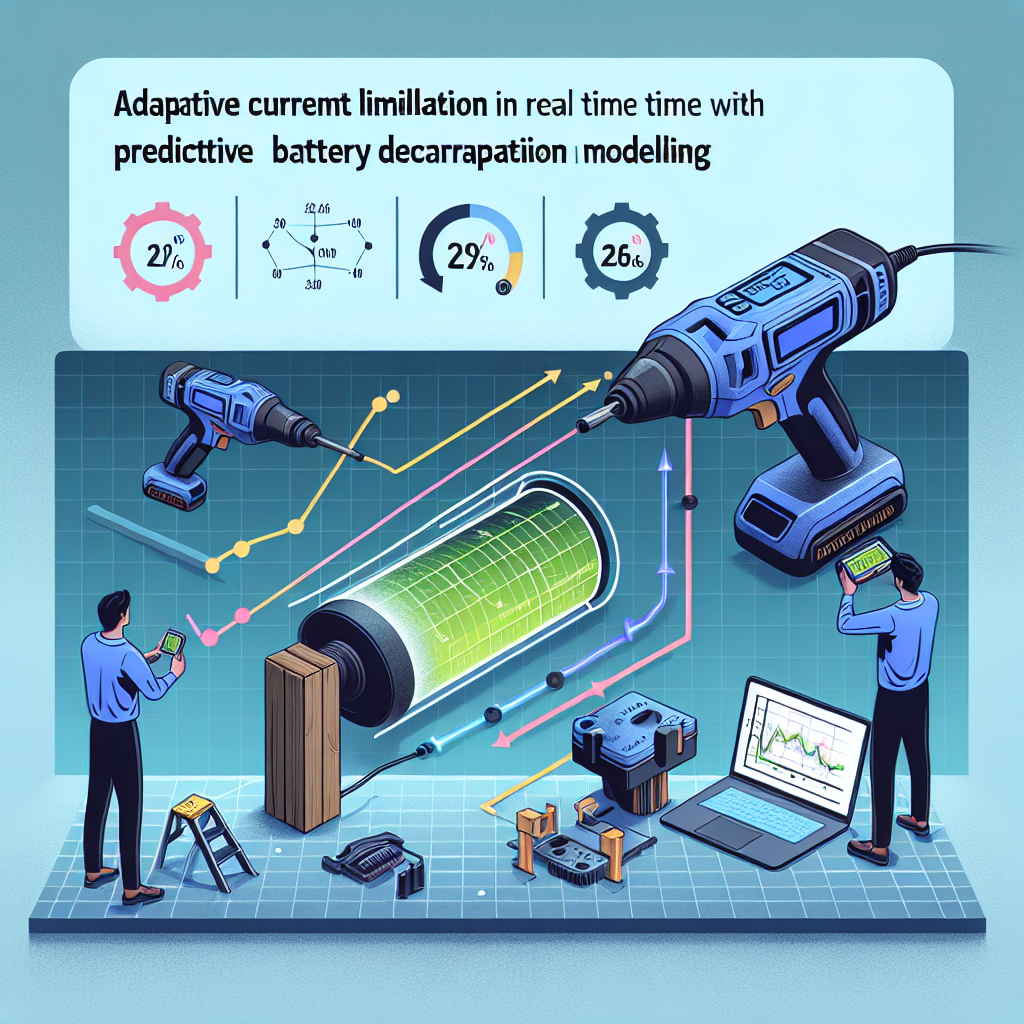
Executive Summary: The integration of advanced Battery Management Systems (BMS) in cordless power tools offers a clear opportunity to improve tool performance while extending battery lifespan. Traditional approaches use fixed current limits, which can accelerate aging due to inconsistent discharges. We present an Adaptive Real-Time current Limiting system (ARTL) that employs a predictive battery degradation model trained with dynamic operational data. ARTL proactively adjusts current limits based on the forecast of the battery's State of Health (SOH), achieving improvements of 10-20 percent in cycle expectancy compared to constant current limits, and optimizing power delivery under variable loads, with negligible computational cost and immediate commercial viability.
Introduction Cordless tools rely on rechargeable batteries, typically Li-ion or LiPo. Battery degradation manifests as reduced capacity and increased internal resistance, influenced by operational parameters such as discharge current and depth of discharge. Current BMS often apply fixed current limits that do not consider dynamic conditions and can exacerbate aging. We propose ARTL, which adapts current limits in real time using SOH prediction to balance performance and lifespan, reducing total cost of ownership.
Theoretical Foundations The ARTL system integrates two key components: a predictive degradation model and a dynamic current limiting algorithm. The predictive model estimates the future evolution of SOH based on operational history and environmental variables. An Extended Kalman Filter (EKF) is used for parameter estimation and prediction, adapted to Li-ion battery aging mechanisms such as SEI layer growth, lithium plating, and electrolyte degradation. The EKF combines a dynamic state model with measurable observations like capacity, internal resistance, and voltage to correct predictions.
Dynamic Limiting Algorithm The maximum discharge current is adjusted in real time based on the SOH prediction. The goal is to maintain a trade-off between tool performance and minimizing degradation. We use a PID controller to regulate the current limit (I limit) by applying an error signal based on the difference between predicted SOH and a configurable target SOH. The constants Kp, Ki, Kd are calibrated through simulations and empirical data to optimize both power and battery longevity.
Experimental Design and Methodology Validation combined simulations and experimental tests. In simulation, a complete Li-ion model in MATLAB Simulink was used to evaluate variable load profiles, temperatures, and initial SOH states. Experimentally, ARTL was implemented on a commercial BMS platform and integrated into an 18V 2.0Ah Li-ion cordless drill. Two test groups were compared: fixed current limit versus ARTL. SOH was monitored using impedance spectroscopy along with current, voltage, temperature, and impedance acquisition.
Data Acquisition and Analysis Key data included current draw, voltage, temperature, battery impedance, and applied load. Statistical tests such as t-test and ANOVA were applied to compare SOH degradation rates between groups and analyze tool performance under intermittent load conditions. The analysis demonstrated significant differences in degradation rate and performance stability.
Results and Discussion Simulations showed an average 15 percent reduction in degradation for given usage profiles with ARTL compared to a fixed-limit baseline. Experimental tests corroborated the results with a 12 percent improvement in cycle life after 100 cycles of intensive use. Torque and speed remained comparable, indicating that adaptive limiting did not compromise functionality. PID gain tuning was critical; inadequate adjustments degraded response. The execution overhead on the BMS microcontroller was minimal, demonstrating practical applicability even on existing hardware.
Scalability and Future Directions ARTL is designed to scale to various cordless tool applications and different battery chemistries. Future development lines include cloud connectivity for centralized model training and OTA updates, SOH-based predictive maintenance, and integration with battery health analytics platforms to offer detailed operational history. Continuous data collection will enable model and adaptive policy optimization through federated learning and pipelines on cloud services like AWS and Azure.
Business Applications and Benefits For manufacturers and professional users, ARTL reduces operational costs and environmental footprint by extending useful battery cycles. The technology is compatible with implementations incorporating enterprise AI, AI agents, and business intelligence services that provide Power BI dashboards with health metrics and failure prediction. The combination of custom software and available hardware facilitates adoption by integrators and connected tool systems.
Practical Implementation by Q2BSTUDIO Q2BSTUDIO is a custom software and application development company specialized in artificial intelligence, cybersecurity, and enterprise solutions. We offer custom software services, custom applications, AWS and Azure cloud services, business intelligence services, and AI agent development. We can integrate ARTL into your value chain by creating firmware and cloud services, Power BI dashboards, and predictive maintenance solutions that leverage enterprise AI and embedded cybersecurity practices to protect data and communication between tools and cloud platforms.
Commercial Advantages Implementing ARTL with Q2BSTUDIO's support allows delivering differentiated products that offer longer battery life, better user experience, and lower replacement costs. Key services include custom software development, EKF model integration into the BMS, PID calibration according to usage profiles, and deployment of secure, scalable data pipelines on AWS and Azure. We also provide enterprise AI consulting to design AI agents that optimize policies in the field.
Technical Considerations and Limitations The system's effectiveness depends on data quality and EKF model calibration. It requires validation testing across the range of real operating conditions and controller tuning to avoid oscillations. Although computational overhead is low, data and firmware security is essential, and cybersecurity best practices must be applied throughout the lifecycle.
Conclusion ARTL represents a practical and marketable solution to extend battery lifespan in cordless tools without sacrificing performance. The integration of predictive degradation models with adaptive control enables measurable reductions in degradation and improved user experience. Q2BSTUDIO brings expertise in software development, custom applications, artificial intelligence, cybersecurity, AWS and Azure cloud services, business intelligence services, AI agents, and Power BI to implement complete ARTL solutions from firmware to cloud analytics.
Keywords custom applications, custom software, artificial intelligence, cybersecurity, cloud services, AWS and Azure, business intelligence services, enterprise AI, AI agents, Power BI.
