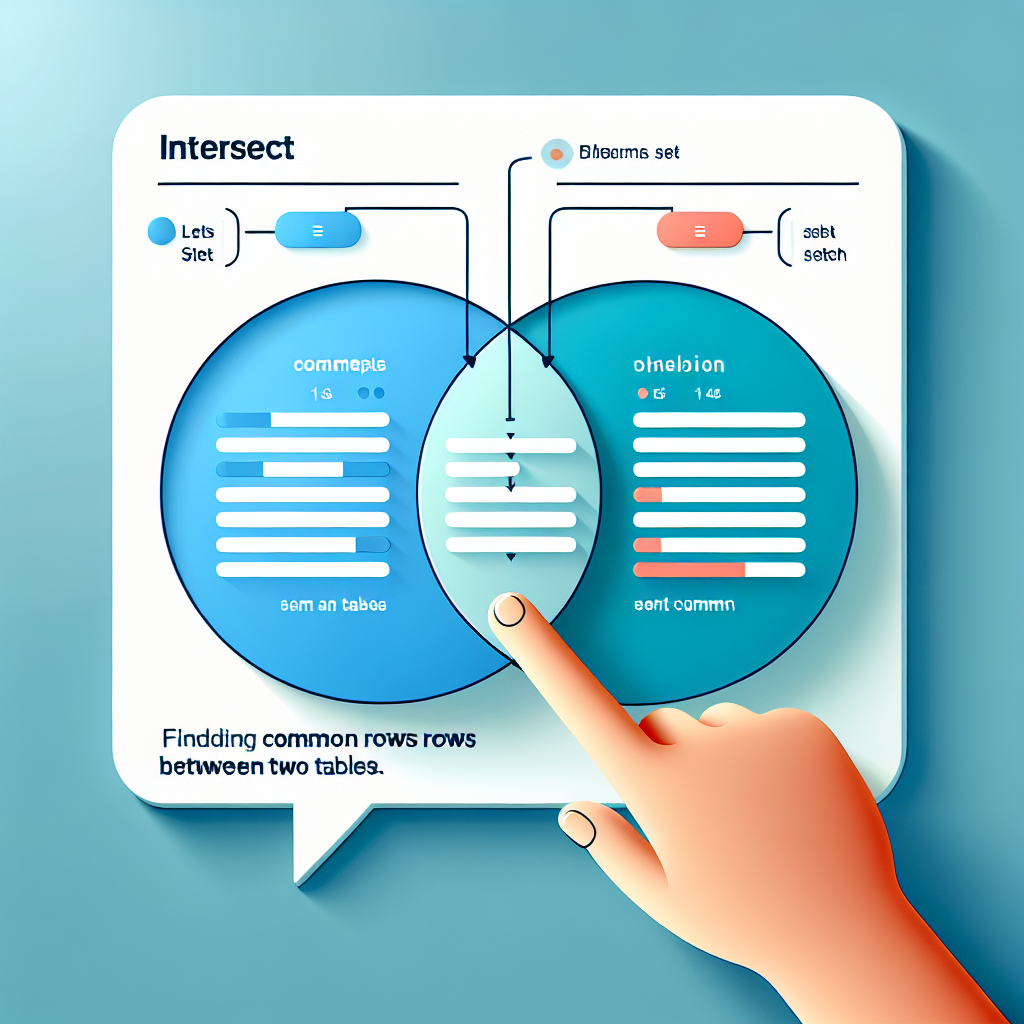
Comparing data between tables is a common need in SQL development. Whether validating user information or reconciling records between systems, efficiently identifying shared rows saves time and reduces complexity.
The INTERSECT operator offers a direct way to return only the rows that appear in two query results. Its purpose is to show the intersection without introducing additional data.
How it works: INTERSECT compares the result sets of two or more SELECT queries and returns the rows that exist in all of them. It is important to remember that the queries must have the same number of columns with compatible data types for the operation to work correctly.
Practical example Finding shared titles between male and female employees Use the following query to detect shared roles between two groups
SELECT title FROM HR WHERE Gender = M INTERSECT SELECT title FROM HR WHERE Gender = F
This example highlights titles present in both groups. If you need precision regarding uppercase letters and spaces, you can normalize the columns before comparing.
Practical example Comparing sales data between two systems To identify matching sales records between two sources, you can use
SELECT SaleID, Product, Amount, SaleDate FROM Sales_2023_SourceA INTERSECT SELECT SaleID, Product, Amount, SaleDate FROM Sales_2023_SourceB
This technique extracts only the identical records in both systems and is useful in audits and data synchronization.
Frequently asked questions What is INTERSECT The INTERSECT operator returns only the rows that appear in all combined SELECT queries, filtering the result to the intersection of sets.
Prerequisites The queries must have the same number of columns and compatible data types. Additionally, consider the behavior of NULL according to the database engine implementation.
Comparing more than two sets Yes. You can chain multiple INTERSECT operations to compare three or more result sets.
DBMS compatibility PostgreSQL, Oracle, and SQL Server support INTERSECT natively. In MySQL and other platforms without direct support, alternatives such as INNER JOIN over subqueries or EXISTS can be used to achieve equivalent results.
Advantages and limitations Among the advantages are clarity and simplicity when expressing set intersections. Limitations include the need for exact matching in columns and types, and in some cases performance compared to join-based solutions depending on indexes and data volume.
About Q2BSTUDIO Q2BSTUDIO is a custom software and application development company specialized in advanced technological solutions. We offer custom software, custom applications, and comprehensive services in artificial intelligence and AI for businesses. Our cybersecurity specialists guarantee protection in every project, and we offer AWS and Azure cloud services to deploy and scale solutions securely.
At Q2BSTUDIO we also provide business intelligence services and developments with Power BI for visualization and analysis, as well as the design and implementation of AI agents that automate tasks and improve processes. If you are looking for a customized solution in artificial intelligence, AI agents, cybersecurity, or cloud integration, our team can help you plan and implement efficient and secure solutions.
Conclusion The SQL INTERSECT operator is a clean and efficient way to find shared rows between data sets. For advanced comparison, audit, or system synchronization cases, combine it with prior transformations and the integration capabilities that Q2BSTUDIO offers in custom software, custom applications, artificial intelligence, cybersecurity, AWS and Azure cloud services, and business intelligence services.
Contact Get in touch with Q2BSTUDIO to evaluate how to apply these techniques in your databases and how to integrate artificial intelligence and Power BI solutions to drive decision-making in your company.