
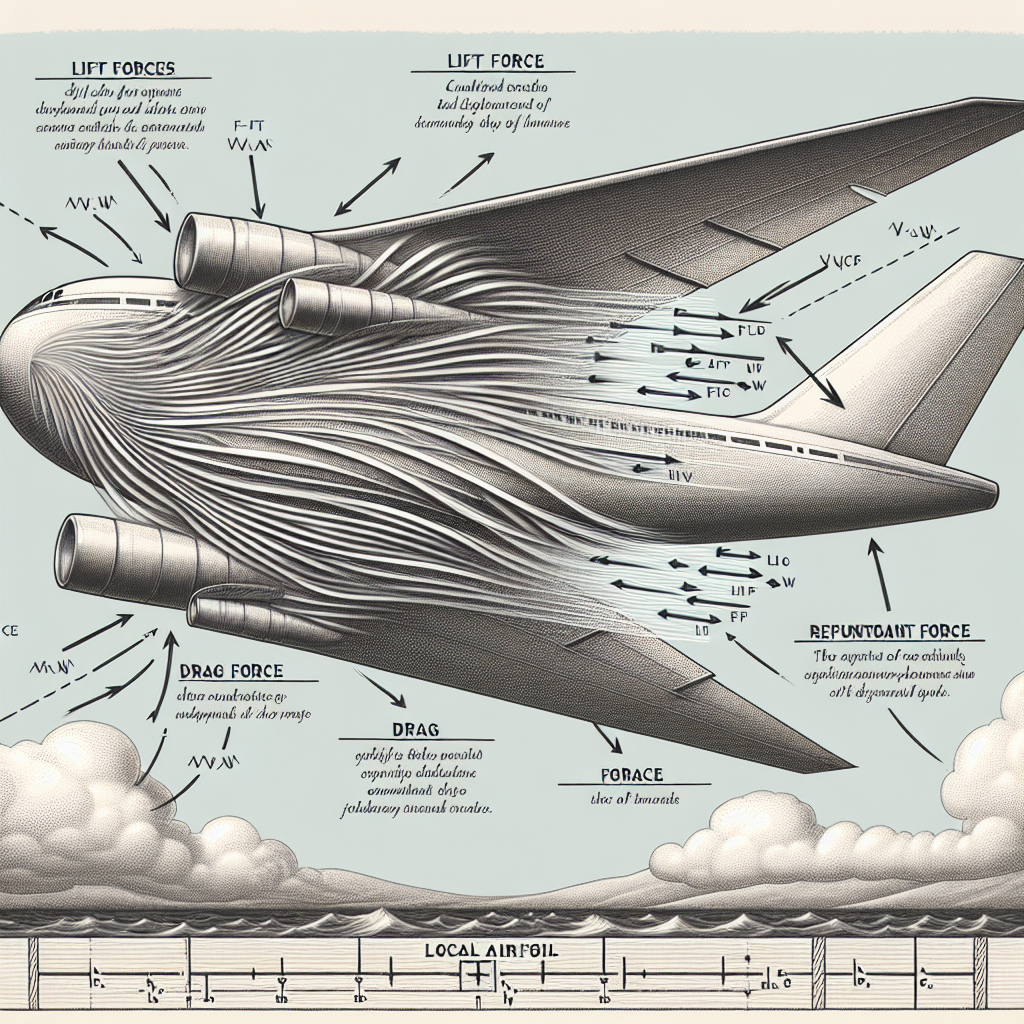
Background: in this text I explain in a practical way, translated into English, how to implement semi-realistic aerodynamic forces in a physics engine for an airplane simulator prototype and how to transform the coefficients to work in local airfoil coordinates.
Objective: to simulate the behavior of wings and control surfaces such as ailerons, elevators, and rudder so that each one is a rigid body with its own aerodynamics, capable of detaching and stalling independently. In games or simulators, this allows interesting mechanics and plausible realism, especially if implemented in custom software or custom applications for specific projects.
Main forces: there are two fundamental aerodynamic forces acting on an airfoil, lift and drag. In a simple and common form they are expressed as L = 1/2 x rho x v^2 x A x Cl for lift and D = 1/2 x rho x v^2 x A x Cd for aerodynamic drag, where rho is the fluid density, v the relative velocity of the wind to the airfoil, A the reference area, and Cl and Cd the lift and drag coefficients respectively.
Vector combination: the total force can be represented as a combination of directional components multiplied by their coefficients, for example F = 1/2 x rho x v^2 x A x (dl x Cl + dd x Cd), where dl is the unit vector of the lift direction, orthogonal to the wind, and dd is the unit vector of the drag direction, collinear with the wind. This expression is practical because it separates the common scale 1/2 x rho x v^2 x A from the set of coefficients and directions that determine the orientation of the force.
Practical problem: obtaining Cl and Cd for all angles of attack is not trivial. Many tables show Cl and Cd between 0 and 20-30 degrees around the stall angle, but in simulations 360 degrees or even 180 degrees are relevant if an object can flip over, fall, or be in extreme positions. An optimal resource is the study of NACA airfoils, for example the document Aerodynamic characteristics of NACA 0012 airfoil section at angles of attack from 0 to 180 degrees, which offers extensive experimental data for a symmetric airfoil.
From sample to function: in my case, I sampled the Cl and Cd values by hand and plotted them. The interesting characteristic is that, viewed from the airfoil coordinates, the component normal to the surface tends to follow a wave similar to a sinusoid except in pre-stall and violent stall zones, while the lateral component reflects drag variations and suction effects ahead of the stall. For a semi-realistic simulator, it is usually enough to emulate the normal component and slightly adjust the drag component.
Transforming to local coordinates: if the aerodynamics solver of a physics engine passes the relative velocity in local airfoil coordinates, it is convenient to transform the resulting coefficient vector to those coordinates and decompose it into a lateral X component and a normal Y component to the airfoil. This allows the aerodynamic response to be easily parameterized with few functions and facilitates adjustment during development time.
Emulation example: a practical approach is to model the effective lift coefficient in local coordinates as a combination of a main sinusoid plus small touches to reproduce pre-stall peaks and drag in extreme orientations. Conceptually, one can write Cl_emulated = k1 x sin(angle) + term_pre_stall + term_final, where term_pre_stall and term_final are clamp functions that add some local values around critical angles to simulate peaks and the behavior when the airfoil is almost edge-on. This approach makes it easy to adjust the response without relying on dense tables and makes it simple to modify the stall or lift intensity on each wing or control surface, ideal for custom software.
Advantages of the local representation: expressing the coefficients from the airfoil's point of view offers a smoother and more manageable curve that can be easily integrated into a game or simulator physics engine. It also allows independent elements such as a loose aileron to stop applying forces to the fuselage and each surface to stall separately, increasing the richness of the simulation and the playable possibilities.
Implementation in business projects: if you need to bring these ideas into production, Q2BSTUDIO is a custom software and application development company specialized in creating personalized solutions that integrate artificial intelligence, cybersecurity, and aws and azure cloud services. We can develop simulators, physics engines, and visualization tools that include business intelligence services and dashboards with power bi to analyze telemetry and performance. Our focus on custom software and custom applications allows us to adapt aerodynamic simulation to specific client and product requirements.
Services and capabilities: at Q2BSTUDIO we offer custom software development, artificial intelligence and AI integrations for businesses, AI agents for task automation, cybersecurity consulting, deployment and management in aws and azure cloud services, and business intelligence services to feed reports and dashboards with power bi. We combine physical and data knowledge to offer robust and scalable solutions.
Best practices and recommendations: use experimental data when possible for critical airfoils, but for prototypes and games, the local approach based on trigonometric functions and adjustment terms usually offers a good balance between realism and computational cost. If you need to cover 360 degrees of behavior, use reference experimental airfoils or CFD to validate the parameters and use controlled interpolation or parametric functions for real-time implementation.
Conclusions: transforming the lift and drag coefficients to the airfoil's perspective and decomposing the force into local components facilitates implementation in physics engines, reduces adjustment complexity, and is particularly useful for custom software and custom applications where realism and performance are to be combined. If you seek support to implement these ideas in a real project, Q2BSTUDIO can help with custom development, artificial intelligence integrations, deployment in aws and azure cloud services, security, and business intelligence dashboards with power bi.
Call to action: for simulation projects, technological partnerships, development of tools with AI agents, or cybersecurity implementations, contact Q2BSTUDIO for a tailored proposal that includes prototyping stages, data validation, and deployment in aws and azure cloud services with visibility through power bi and business intelligence services.

