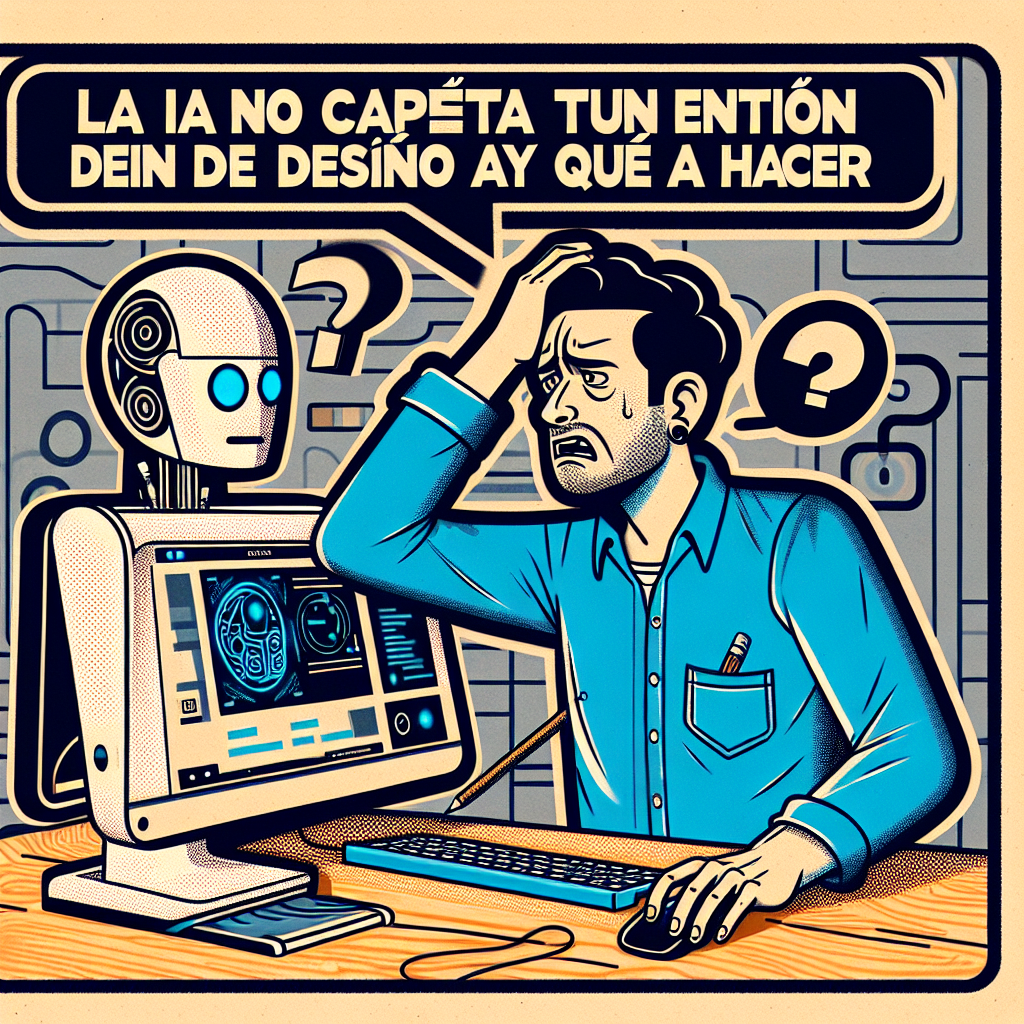
In the current era where artificial intelligence transforms creative fields, a key question arises: why your AI tools don't capture design intent and what you can do about it. As designers work with emotional nuances, cultural context, and intentional decisions, AI systems collide with limitations inherent to data-driven models. While human intuition generates unexpected associations, artificial intelligence learns statistical patterns that sometimes misinterpret the original vision.
The challenges are several. First, the hallucination phenomenon produces plausible but incorrect results. Second, the lack of high-quality data and the protection of proprietary information prevents training models that understand the granularity of design. Third, AI lacks true contextual and emotional awareness, distancing it from design decisions that depend on empathy, culture, and user experience.
Recent tools have shown useful advances. For example, models that foster individual creativity through visual variations help with idea generation. Multimodal profiling systems accelerate user research, and collaboration frameworks between AI-generated content and designers filter out low-feasibility proposals, allowing focus on high-potential ideas. However, these innovations do not eliminate the need for human oversight.
In practice, common misunderstandings arise that are worth clarifying. It is not true that AI fully understands human creativity. It is not true that its outputs are error-free. Nor does it interpret social and cultural context with the same depth as a person, and it does not think autonomously but rather reproduces patterns from previous data. Recognizing these limitations allows using AI as a tool and not as a replacement.
To improve alignment between AI and design intent, we propose concrete approaches. Implementing intent tagging helps translate creative goals into more specific instructions. Integrating multimodal interactions allows combining voice, image, and gestures so the machine receives signals more similar to human communication. Designing for co-creation facilitates iterations where humans correct and refine results in real time.
Additionally, applying responsible design principles is key. Creating systems that inform about their limits, allow controlling generative variability, and foster appropriate trust reduces risks. Accepting the imperfection of AI outputs and equipping users with tools to adjust and filter results improves adoption in creative processes.
At Q2BSTUDIO, a company specialized in custom software and application development, we work integrating artificial intelligence with human practices to close the gap between intent and outcome. We offer custom software services, custom applications, and AI projects for companies that combine multimodal models with expert domain knowledge. Our experience includes AI agents designed to understand specific workflows, Power BI implementation for visualization, and business intelligence services that translate data into design decisions.
We also provide cybersecurity as an integral part of any AI project, ensuring protection of intellectual property and secure handling of sensitive data. Our AWS and Azure cloud services allow deploying models with scalability and compliance, and our applied artificial intelligence solutions incorporate controls to minimize biases and hallucinations, and to maintain traceability in training sources.
Use cases show advantages and limitations. In automatically generated interfaces, AI can quickly create functional structures, but requires human adjustments to ensure accessibility and user context. In design recommendations, suggestions accelerate decisions but must adapt to brand identity. In generative imagery, controlling biases in datasets avoids inappropriate representations.
What can you do today to improve collaboration between your design team and AI tools: define clear and tagged intent goals, collect representative and anonymized datasets, integrate human checkpoints into workflows, use AI agents configured for your domain, and apply Power BI and business intelligence services to monitor results and KPIs. Additionally, incorporating cybersecurity from the design stage ensures that intellectual property and user data are protected.
In summary, artificial intelligence can amplify creativity but not replace human intuition. With practical strategies such as intent tagging, multimodal co-creation, implementation of adapted AI agents, and good governance practices, it is possible for your AI tools to better understand design intent. Q2BSTUDIO accompanies companies on that journey offering custom software development, custom applications, applied artificial intelligence, cybersecurity, AWS and Azure cloud services, business intelligence services, AI for companies, and solutions with AI agents and Power BI to drive informed decisions and designs consistent with the creative vision.
If you are looking to transform creative processes with responsible and effective technology, at Q2BSTUDIO we design custom solutions that balance the power of AI with human sensitivity to achieve innovative and secure results.