
Introduction
Circular dependencies in Spring applications occur when two or more beans need each other directly or indirectly, causing the container to fail to initialize them correctly when the application starts. In this article, we explain the problem when using constructor injection and offer practical solutions, as well as how Q2BSTUDIO, a company specialized in custom software development, artificial intelligence, and cybersecurity, can help resolve these issues in real-world architectures.
Understanding circular dependencies
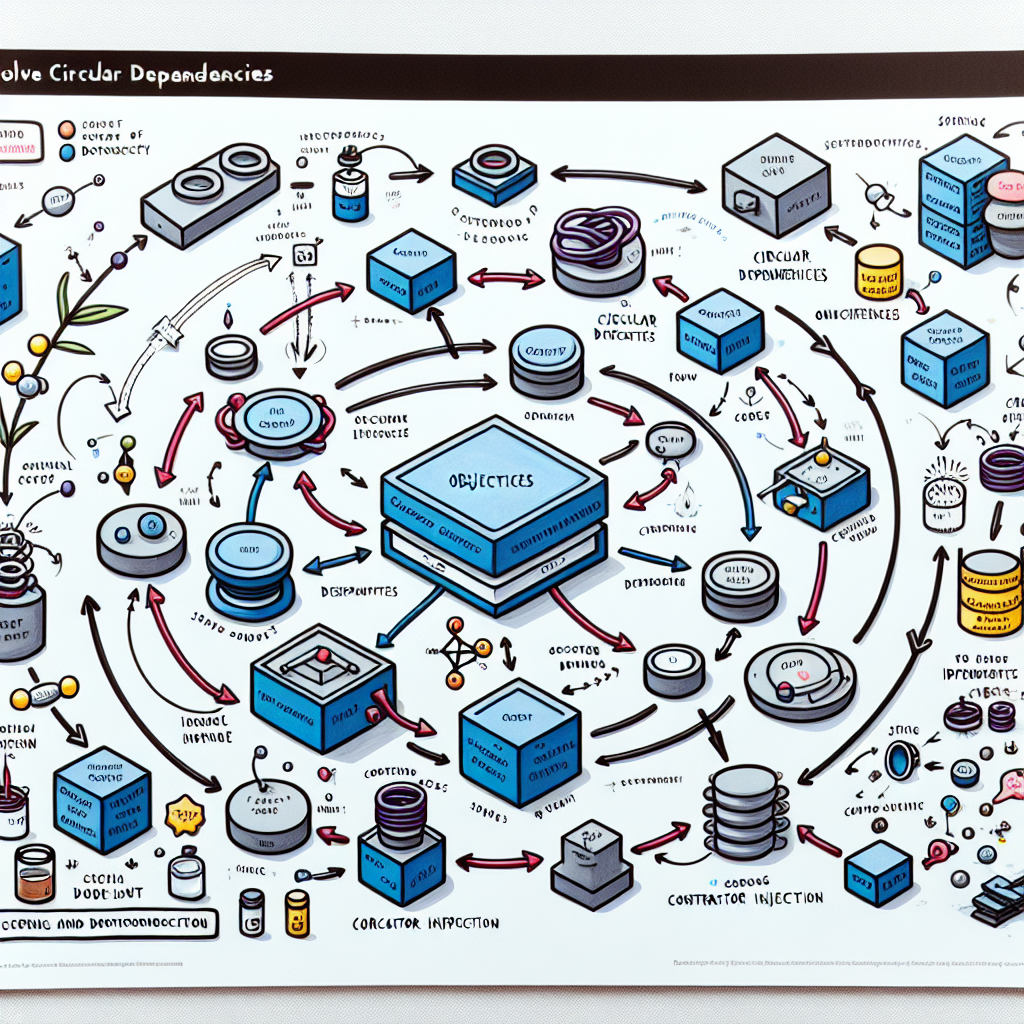
Imagine two classes, BeanA and BeanB, where BeanA needs an instance of BeanB to function and BeanB needs an instance of BeanA. With constructor injection, Spring tries to create one instance first, but to do so it needs the other, generating a loop that prevents the complete construction of both beans.
Problem with constructor injection
Constructor injection is the recommended practice for many situations because it makes dependencies explicit and immutable, but when faced with circular dependencies, it becomes an obstacle. Spring cannot fully construct either bean, and a BeanCurrentlyInCreationException is usually thrown during startup.
Why circular dependencies are harmful
Circular dependencies generate several significant problems. First, they can cause application startup failures because the container cannot resolve the dependencies. Second, if the application manages to start due to some configuration, the beans may not be fully initialized, leading to unexpected behavior. Third, they usually indicate a design problem that increases complexity and reduces code maintainability.
How to break the cycle: strategies and solutions
1 Rethink the design
The best solution is almost always to refactor to eliminate the circular dependency. Ask yourself whether the dependency is truly necessary, whether the shared functionality can be extracted into an independent service, or whether you can depend on an interface instead of a concrete implementation. For example, instead of BeanA and BeanB referring to each other directly, both can depend on a CommonInterface implemented by a CommonService that centralizes the shared logic. This separation reduces coupling and resolves the dependency loop.
2 Setter injection with caution
When refactoring is not immediately viable, setter injection can break the circular dependency because Spring creates the beans and then injects the dependencies. It is a practical solution but with side effects: it makes dependencies optional and increases object mutability, which can make reasoning about the system state more difficult. Use this technique only as a last resort and clearly document the implications.
3 Lazy annotation with care
The Lazy annotation allows deferring the initialization of a bean until it is actually needed, which can avoid the problem by initially creating only one of the beans. However, deferring creation can introduce a slight performance penalty when the bean is first accessed and shift initialization errors to runtime, making them harder to detect. Lazy does not solve the root cause; it only postpones it.
4 Accessing the ApplicationContext directly: avoid if possible
Obtaining dependencies from the container via ApplicationContext creates strong coupling with Spring and violates the inversion of control principle, complicating testing and reuse outside the container. This is a technique that should be avoided except in very specific and controlled cases, such as for one-off compatibility during migrations or special initializations.
Best practices
Always prioritize refactoring to eliminate circular dependencies. Keep constructor injection as the first option for declaring clear and immutable dependencies. Use setter injection or Lazy only when no other viable alternative exists and you understand the consequences. Avoid ApplicationContextAware and other techniques that violate inversion of control except in justified cases.
How Q2BSTUDIO can help
Q2BSTUDIO is a custom software development company specialized in modern and secure solutions. We offer services to design and refactor Java and Spring architectures, resolve circular dependencies, and improve software quality. Our services include custom applications, custom software, artificial intelligence, cybersecurity, aws and azure cloud services, business intelligence services, ai for businesses, AI agents, and power bi. We have experience applying best practices in dependency injection, architecture patterns, and automated testing to ensure robust and scalable systems.
Example of a practical approach
In a typical project, we review the design to extract common services, define clear interfaces, implement unit and integration tests, and propose alternatives such as introducing intermediary services or refactoring responsibility across layers. When necessary, we apply setter injection or Lazy with additional controls and document the tradeoffs to ensure long-term maintenance.
Conclusion
Circular dependencies are a warning sign about an application's design. The ideal solution is to refactor to eliminate coupling, but when that is not possible, alternative solutions can be used with full awareness of the cause. Q2BSTUDIO can help diagnose, design, and execute the best strategy for your project, bringing expertise in artificial intelligence, cybersecurity, aws and azure cloud services, business intelligence services, AI agents, and power bi so that your platform is efficient, secure, and easy to maintain.

