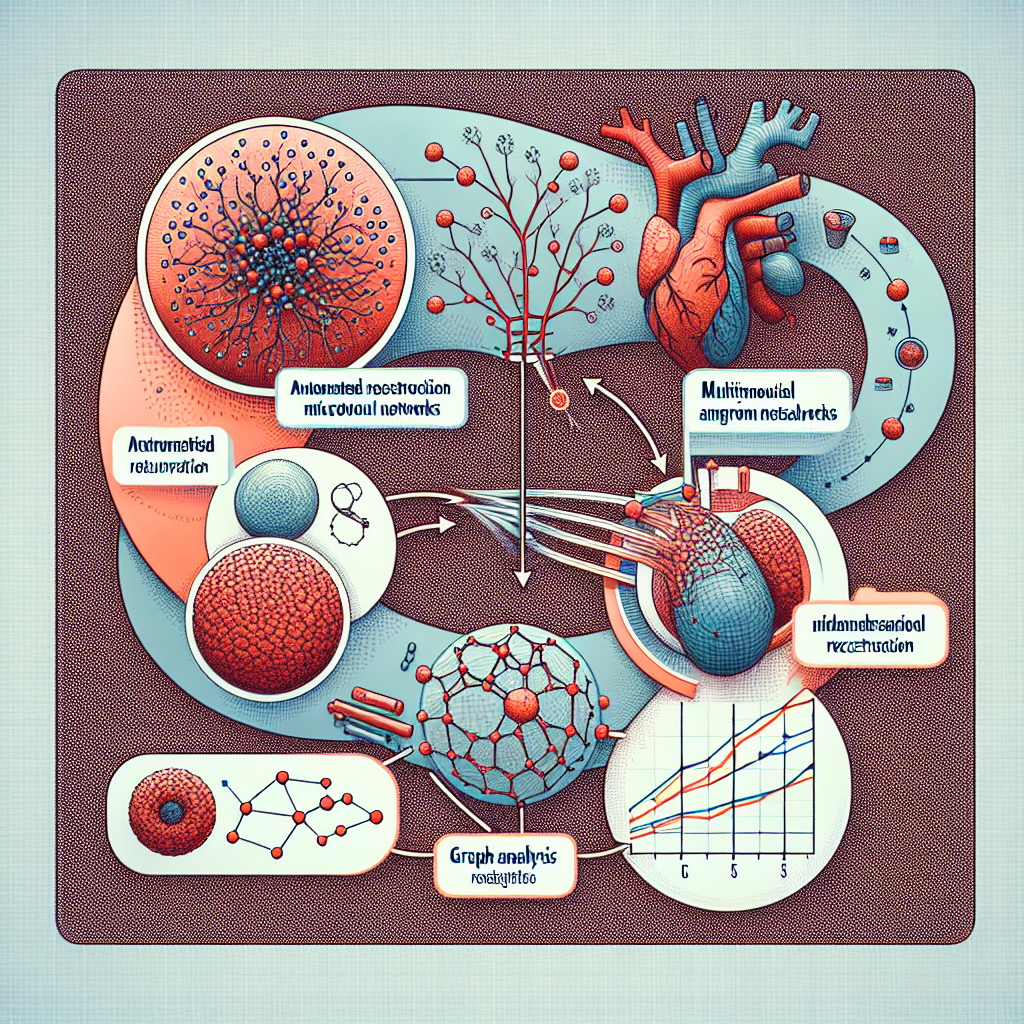
Abstract: We present MicroVascAnalyzer, an automated methodology for the reconstruction of microvascular networks from multimodal imaging data including optical coherence tomography OCT, micro-CT, and fluorescent angiography FA. The system combines advanced image processing techniques, multimodal fusion, deep learning-based semantic decomposition, and a graph-based analytical framework, achieving significant improvements in accuracy and reproducibility compared to manual and semi-automated methods.
Introduction: Microvascular networks are fundamental for tissue perfusion and organ function. Their accurate characterization is essential in diagnosis, surgical planning, and vascular graft design. Traditional approaches are time-consuming and subjective. MicroVascAnalyzer was created to automate and standardize this process, integrating image fusion algorithms, semantic segmentation, and graph representation that enable topological analysis and functional flow simulation.
Theoretical foundations: The system is built on four pillars: adaptive multimodal fusion that weights information from OCT, micro-CT, and FA to reduce noise and artifacts; graph representation where vascular segments and their interconnections are modeled as nodes and edges; semantic decomposition using deep learning models to separate vascular walls, blood cells, and surrounding tissue; and a multilevel evaluation pipeline that validates topological consistency, numerical verification, and reproducibility.
System architecture and methodology: MicroVascAnalyzer is organized into five main modules. Module 1: data ingestion and normalization with adaptive filters and equalization to homogenize the resolutions of OCT, micro-CT, and FA. Module 2: semantic parser trained with U-Net architecture and combined with Transformer blocks for fine segmentation and extraction of structural parameters such as diameter, branching angulation, and wall thickness. Module 3: multilevel evaluation pipeline that includes logical topological consistency verification, fluid dynamics simulation in the reconstructed network, centrality analysis, and clinical impact prediction using graph neural models. Module 4: self-evaluation loop incorporating recursive feedback to correct deviations and modulate weights. Module 5: score fusion with Bayesian calibration to obtain a robust final estimate.
Relevant technical details: Modality fusion employs adaptive weighted averages that adjust the influence of each source according to local signal quality. Graph representation facilitates calculations of advanced topology and centrality measures, allowing identification of critical nodes and connection patterns. Formal topology verification reduces reconstruction errors and ensures that structural properties meet basic biological constraints. Numerical finite element simulations validate that the modeled network reproduces experimentally measured flow patterns.
Dataset and experimental validation: The prototype was tested with 200 microvascular networks obtained from ex vivo murine kidneys, with ground truth derived from serial sections and fluorescent stains. Quantitative metrics show an average accuracy of 92.3 percent in segment reconstruction, a precision of 88.7 percent, a recall of 96.1 percent, and an F1 score of 92.4 percent. Compared to expert human analysts, the system reduced reconstruction time by 45 percent and increased accuracy by 15 percent.
Evaluation and robustness: The multilevel evaluation pipeline includes logical checks, code execution for physical simulation, novelty analysis against published atlases, and reproducibility assessment on independent subsets. A weight self-tuning module with Bayesian calibration ensures that the final score is stable against acquisition variability and noise.
Clinical and research applications: MicroVascAnalyzer is intended to support precision surgery planning, optimization of drug delivery strategies, design of vascular grafts for tissue engineering, and longitudinal studies of microvascular remodeling in diseases. The ability to generate rapid and reproducible vascular maps facilitates preoperative assessment and the development of personalized treatments.
Scalability and future directions: The system is designed to adapt to new imaging modalities and different species. Future plans include real-time reconstruction for minimally invasive procedures, integration with robotic systems for assisted anastomosis, incorporation of reinforcement learning algorithms to refine the semantic parser, and exploration of deployments on distributed infrastructure and aws and azure cloud services for scalable processing.
Technical considerations and limitations of the method: Performance depends on input quality; artifacts and biases in training data can affect segmentation. Multimodal integration requires precise synchronization and reliable spatiotemporal transformations. Model transparency and documentation of validations are essential for clinical adoption.
Conclusion: MicroVascAnalyzer offers a comprehensive solution for automated reconstruction of microvascular networks, combining image fusion, semantic decomposition, graph representation, and formal evaluation. Experimental results demonstrate relevant improvements in time and accuracy, opening possibilities for clinical and translational research applications.
About Q2BSTUDIO: Q2BSTUDIO is a software development company specialized in custom applications and custom software, with extensive expertise in artificial intelligence, cybersecurity, and aws and azure cloud services. We design personalized solutions for companies requiring business intelligence projects, power bi implementations, AI agents, and AI strategies for businesses. Our team integrates developers, data engineers, cybersecurity experts, and data scientists to deliver scalable, secure products optimized for specific objectives.
Services offered by Q2BSTUDIO: Development of custom applications and custom software for clinical and research workflows, integration of artificial intelligence models for segmentation and advanced analytics, deployment on aws and azure cloud services, implementation of business intelligence and power bi solutions for visualization and decision-making, cybersecurity consulting to protect sensitive data, and creation of AI agents for process automation.
Advantages of working with Q2BSTUDIO: We deliver turnkey solutions that combine experience in AI for businesses and security best practices, with iterative development methodologies and robust validation. We can collaborate on adapting MicroVascAnalyzer to specific clinical workflows, port it to the cloud with resilient architectures on aws and azure cloud services, and integrate dashboards with power bi for operational and clinical monitoring.
Keywords for positioning: custom applications, custom software, artificial intelligence, cybersecurity, aws and azure cloud services, business intelligence services, AI for businesses, AI agents, power bi.
Contact and call to action: If your organization requires a customized solution for microvascular reconstruction, artificial intelligence integration, or business intelligence and cybersecurity projects, Q2BSTUDIO offers technical consulting and functional prototypes. Contact our team to evaluate use cases, proof of concept, and scalable deployments.