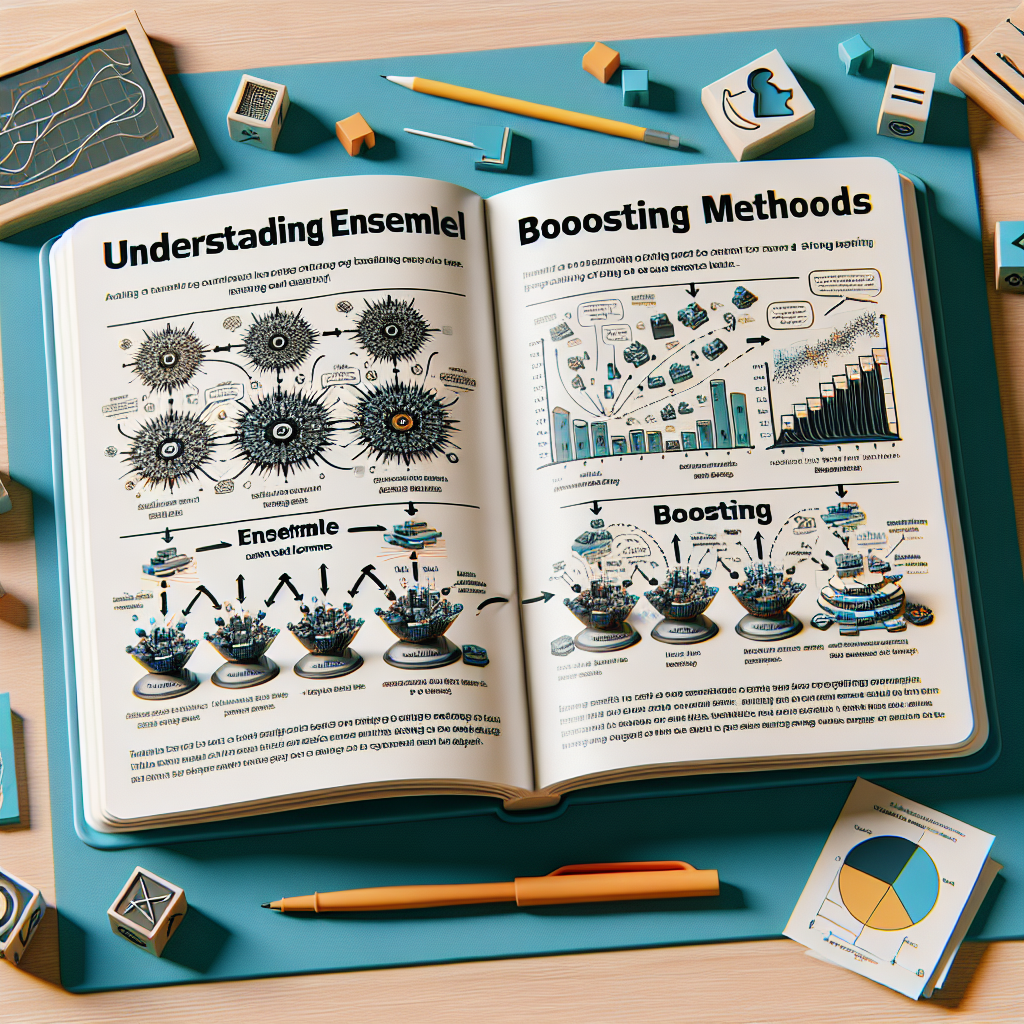
Introduction to ensemble and boosting methods
Imagine you want to predict the weather and you consult several meteorologists who observe different indicators. Instead of relying on a single expert, combining their predictions is usually more reliable. That is precisely what ensemble methods do in machine learning. Boosting is a family of ensemble techniques that transforms a collection of weak learners into a strong classifier, achieving significant improvements in accuracy and robustness.
In general terms, ensemble methods leverage the principle that many eyes see better than one. They combine predictions from several individual models to obtain greater accuracy and better generalization. Boosting works sequentially: one model is trained after another, and each new model focuses on correcting the errors of the previous ones. This iterative process steadily increases the predictive power of the ensemble.
AdaBoost explanation
AdaBoost, or Adaptive Boosting, is one of the pioneering boosting algorithms. The central idea is to assign weights to each training instance. Initially, all instances have the same weight. Each weak learner is trained with these weights, and its performance is evaluated. Correctly classified instances have their weight reduced, while misclassified ones have their weight increased, so that subsequent learners pay more attention to difficult examples. The final prediction combines the outputs of all learners through weighted voting, giving more influence to those that performed better.
AdaBoost key steps
1. Initialization: assign equal weights to the N training instances, for example, a weight equal to 1 divided by N.
2. Iterations: for each iteration t, a weak learner is trained with the weighted data. The weighted error rate is calculated, and from that rate a coefficient is obtained that represents the importance of that learner. Misclassified instances have their weight increased, and correctly classified ones have it decreased. The weight adjustment is normalized to maintain a probability distribution.
3. Final prediction: a weighted vote of all learners is carried out, where each one contributes according to its confidence coefficient.
Intuitive explanation of the formula
When a learner has a low error rate, its coefficient is higher, and its vote counts more. The weight update mechanism ensures that examples that were difficult in previous iterations receive more attention later.
Gradient Boosting explanation
Gradient Boosting approaches the problem from the minimization of a loss function. Instead of reweighting instances directly, each new model tries to correct the residual errors of the current ensemble. That is, the residual is calculated as the difference between the actual label and the current prediction, and a new learner is trained to approximate that residual. The direction and magnitude of the correction are guided by the gradient of the loss function; progress is made in the opposite direction of the gradient to reduce the error.
Gradient Boosting key steps
1. Initialization: start with a simple model, for example, the mean of the target in regression problems.
2. Iterations: at each step, calculate the residuals r i equal to y i minus predicted y. Train a learner to fit those residuals and update the prediction by adding a fraction of the new learner's contribution, controlled by the learning rate. This factor prevents steps that are too large and helps avoid overfitting.
Advantages and differences
AdaBoost emphasizes difficult examples by adjusting instance weights, while Gradient Boosting explicitly minimizes a loss function by adjusting residuals guided by gradients. Both can use simple learners such as small trees, and both achieve powerful models, although Gradient Boosting usually offers more flexibility for different loss functions and tasks.
Real-world applications and relevance
Boosting algorithms are applied across many sectors due to their high accuracy and adaptability. Some typical use cases include fraud detection, credit scoring, medical diagnosis, natural language processing for sentiment analysis and text classification, and computer vision for image classification and object detection.
Challenges and limitations
Among the main limitations are the risk of overfitting if too many iterations are allowed or if the learning rate is too high, the computational cost of training multiple models, and interpretability, since understanding the joint contribution of many models can be complex.
Future of boosting
Research continues to improve the efficiency, robustness, and interpretability of boosting techniques. Variations and hybrid methods are emerging that combine boosting with other techniques to offer greater performance and adaptability in industrial and business applications.
Q2BSTUDIO and how we can help you
At Q2BSTUDIO, we are a software development company specialized in creating custom applications and custom software for companies seeking real and scalable solutions. We have a team expert in artificial intelligence and AI for businesses that designs machine learning models and AI agent solutions tailored to specific processes. We also offer cybersecurity services to protect your data and AWS and Azure cloud services that guarantee robust and scalable deployments. We complement our solutions with business intelligence services and Power BI developments to turn data into strategic decisions.
Our services include artificial intelligence consulting, AI agent integration, custom application development, custom software implementation, cybersecurity audits, migrations and deployments on AWS and Azure cloud services, and business intelligence solutions with Power BI. We work with clients to define the most suitable architecture and deliver solutions that provide value from the first iteration.
Why choose Q2BSTUDIO
Because we combine technical knowledge and a business focus to deliver reliable and secure products. If you need artificial intelligence projects, AI for businesses, AI agents, custom applications, or custom software, or you want to improve visualization and analysis with Power BI, Q2BSTUDIO can help you. We also guarantee cybersecurity practices and optimized deployments on AWS and Azure cloud services, in addition to business intelligence services to transform data into a competitive advantage.
Contact and next step
Contact Q2BSTUDIO to evaluate how to implement boosting or other ensemble techniques in your projects, design custom applications, optimize processes with artificial intelligence, and secure your infrastructure with cybersecurity and cloud solutions. Our team will advise you on the best combination of technologies for your business objectives.