
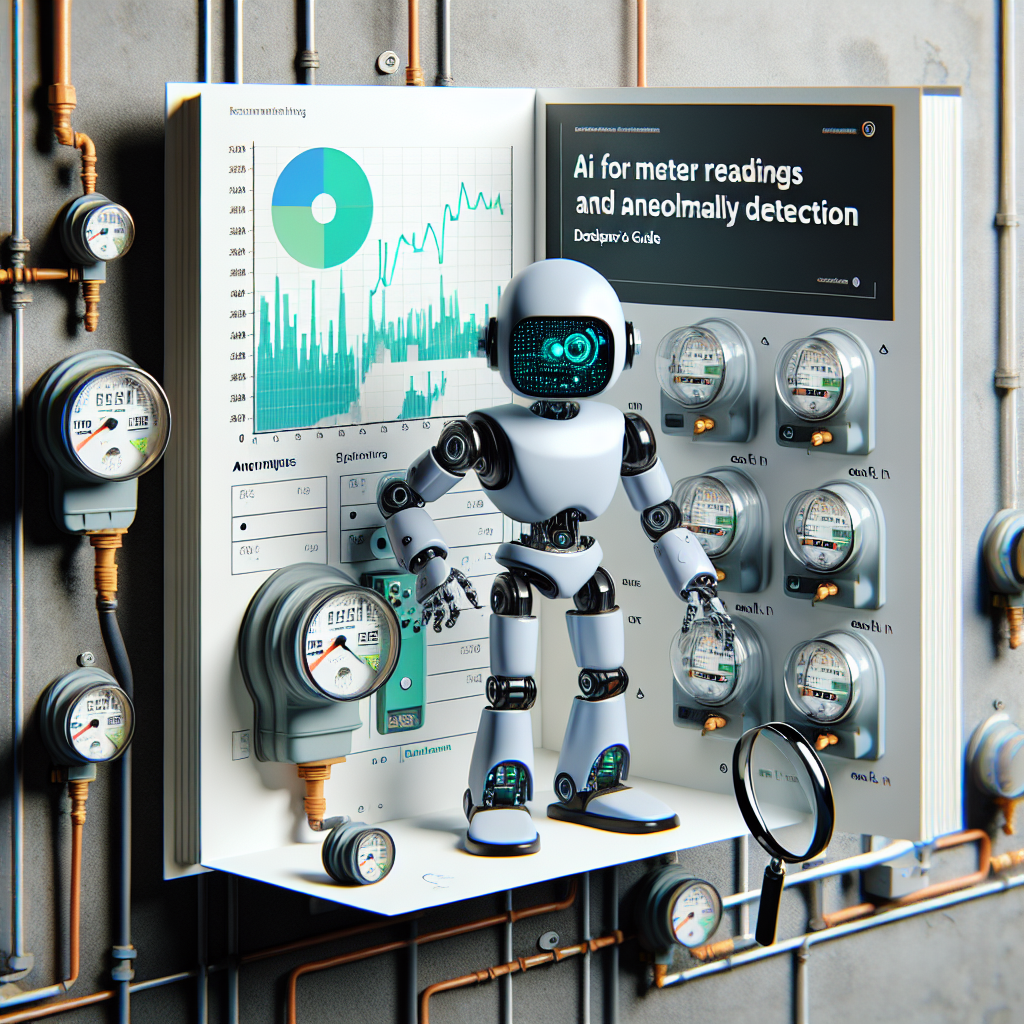
Introduction
Smart meters are transforming the way utility companies monitor and manage energy consumption by offering granular, real-time usage data. However, the volume of information creates new challenges: how to automatically detect anomalies such as sudden consumption spikes or faulty meters without constant human supervision. An effective solution is to implement autonomous AI agents that ingest data, analyze patterns, and execute proactive actions such as alerts or maintenance requests.
Why use AI agents in smart metering
AI agents stand out by operating independently, making contextual decisions based on data patterns, and scaling to manage thousands or millions of devices. For utility companies, this means faster detection of energy theft, equipment failures, or communication issues, reducing losses and improving service availability.
High-level architecture
A typical system includes real-time data collection from meters, preprocessing and normalization, anomaly detection engines, an agentic decision layer, and an action module that sends alerts, opens tickets, or schedules maintenance. This flow integrates with cloud services for storage and scaling, as well as business intelligence tools for visualization.
Data collection and preprocessing
Meters generate time series, for example hourly consumption in kWh. Before applying detection, it is crucial to clean and normalize the data.
Example of raw data for an hourly kWh meter: Hour Usage kWh 1 1.05 2 1.10 3 1.00 4 8.50 5 1.20 6 1.15
A spike is observed at hour 4. Common preprocessing steps: imputation of missing readings by interpolation, normalization relative to a seasonal baseline, and smoothing with moving averages or exponential smoothing.
Core logic for anomaly detection
1. Threshold-based spike detection
Simple method: flag readings that grow above a factor relative to the recent average. Pseudocode: def detect_spikes(readings, window=3, spike_factor=3.0): anomalies = [] for i in range(window, len(readings)): baseline = sum(readings[i-window:i]) / window if readings[i] > spike_factor * baseline: anomalies.append((i, readings[i], spike)) return anomalies
2. Flat line or zero detection
A meter that reports zero or near-zero values for a long time may be faulty. Pseudocode: def detect_flat_line(readings, flat_threshold=0.05): if all(abs(v) < flat_threshold for v in readings): return True return False
3. Seasonal or contextual detection using z-score
Incorporating hourly patterns, temperature, and day of the week improves accuracy. Pseudocode: def detect_zscore(readings, hist_mean, hist_std, threshold=3): anomalies = [] for i, v in enumerate(readings): z = (v - hist_mean[i]) / hist_std[i] if abs(z) > threshold: anomalies.append((i, v, seasonal_anomaly)) return anomalies
Complete agentic flow
A typical agent performs ingestion, preprocessing, analysis, and action. Simplified pseudocode: class MeterAgent: def init(self, spike_factor=3.0, flat_threshold=0.05): ... def ingest(self, meter_id): return get_data(meter_id) def preprocess(self, readings): return smooth(impute(readings)) def analyze(self, readings, hist_mean=None, hist_std=None): anomalies = detect_spikes(readings, spike_factor=self.spike_factor) if detect_flat_line(readings, flat_threshold=self.flat_threshold): anomalies.append((flat, 0, readings[0])) if hist_mean and hist_std: anomalies.extend(detect_zscore(readings, hist_mean, hist_std)) return anomalies def act(self, meter_id, anomalies): if not anomalies: log(meter_id, normal_reading) return for idx, val, type in anomalies: if type == spike: alert(spike detected for meter_id at idx val kWh) elif type == flat: schedule_maintenance(meter_id) elif type == seasonal_anomaly: alert(seasonal anomaly for meter_id at idx val kWh) def run(self, meter_id, hist_mean=None, hist_std=None): raw = self.ingest(meter_id) proc = self.preprocess(raw) anomalies = self.analyze(proc, hist_mean, hist_std) self.act(meter_id, anomalies)
Usage example
For meter 123 with raw readings [1.0, 1.1, 1.2, 10.5, 1.3, 1.1, 1.0], historical mean [1.05, 1.10, 1.15, 1.20, 1.15, 1.10, 1.05], and deviation [0.1, 0.1, 0.1, 0.15, 0.1, 0.1, 0.1], the agent detects a spike at index 3 with 10.5 kWh and automatically generates an alert.
Best practices and next steps
Use rolling windows to detect short-term anomalies. Integrate contextual data such as weather and holidays to reduce false positives. Consider machine learning models such as Isolation Forest or LSTM autoencoders for more advanced detections. Continuously adjust thresholds with operational feedback and build interactive dashboards for operators with tools like Power BI.
Advantages of integrating cloud and intelligence services
Leveraging cloud services such as AWS and Azure enables scaling, massive ingestion, and secure historical storage. Combining with business intelligence services facilitates traceability and data-driven decision making.
About Q2BSTUDIO
Q2BSTUDIO is a custom software and application development company specializing in artificial intelligence solutions, cybersecurity, and cloud services. We offer custom software, custom applications, and consulting to implement AI agents that automate anomaly detection in meter networks. Our team designs integrated solutions that combine advanced analytics, business intelligence services, and Power BI visualization so companies obtain actionable insights and improve operational efficiency.
Services we offer
Custom software development, AI agent integration, AWS and Azure cloud service implementation, cybersecurity solutions to protect telemetry and data, and business intelligence services for dashboards and reporting. We work with clients seeking to bring artificial intelligence to production and optimize operations with AI for businesses.
Operational considerations
To deploy AI agents in production, it is recommended to: monitor agent performance and false positive rates, instrument human feedback to improve models, secure communications and data with cybersecurity practices, and maintain training and evaluation pipelines for detection models.
Conclusion
Agentic AI agents offer a scalable and autonomous solution for anomaly detection in smart meters, reducing manual work and improving network resilience. The described proposal serves as a foundation for more advanced systems that integrate machine learning, contextual data, and secure cloud operations.
Keywords for SEO positioning
custom applications custom software artificial intelligence cybersecurity cloud services aws and azure business intelligence services ai for businesses AI agents power bi

