
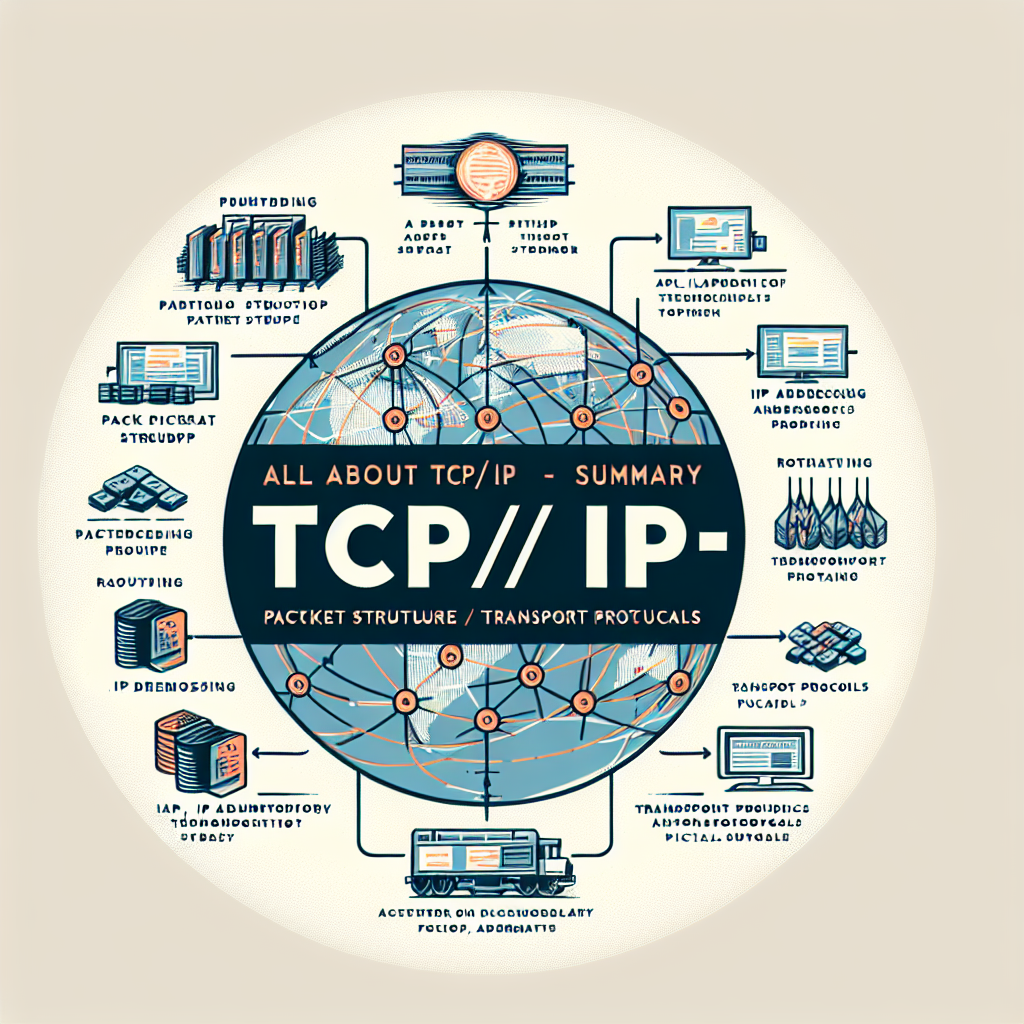
Complete summary about TCP/IP. Everything you need to understand about TCP/IP summary. This model is the foundation of network communication and describes the rules and methods for transferring data from source to destination across interconnected networks.
Application Layer. Main protocols: HTTP, FTP, DNS, SSH. In this layer, applications interact with the network. Data is formed and message formats are defined. It is responsible for identification and synchronization between software and lower layers, ideal for small data transmissions and services such as browsers, file transfers, name resolution, and remote connections.
Transport Layer. Main protocols: TCP, UDP. This layer establishes communication channels between processes on different hosts. It segments and reassembles data. It uses ports to address flows. It controls integrity, recovers errors, and in the case of TCP guarantees reliable data delivery, while UDP offers low latency for real-time applications.
Internet Layer. Main protocols: IPv4, IPv6, ICMP, ARP. Its responsibility is routing packets between different networks. It manages logical addressing through IP addresses and handles control and error messages via ICMP. Additionally, ARP associates IP addresses with physical addresses on the local network.
Link Layer. Main protocols: Ethernet, WLAN, PPP. It defines how information is encoded for physical transmission over media such as twisted pair, coaxial cable, and fiber optics. It performs encapsulation into frames, media access control, basic error detection and correction, and protection against interference, which are fundamental for communication within a local network.
Practical data flow. When a message from an application travels through the TCP/IP stack, it passes through the application layer that generates it, then the transport layer segments it and adds ports, the internet layer encapsulates it into packets with IP addresses, and the link layer places it into frames suitable for the physical medium. At the receiver, the process is reversed until the application receives the data.
Relationship with the OSI model. The TCP/IP model is more practical and consolidated on the Internet, while the OSI model offers a more detailed theoretical reference. Many functions are mapped between both models, and understanding the four layers of TCP/IP facilitates implementation and troubleshooting in real networks.
Security and best practices. To protect communications, use secure protocols such as HTTPS, SSH, and authentication and encryption mechanisms. Monitor and manage the network with tools that analyze traffic and events. Apply network segmentation, access control, and cybersecurity policies to reduce risks and improve availability and confidentiality.
How Q2BSTUDIO can help with your project. Q2BSTUDIO, a custom software and application development company, offers comprehensive solutions to leverage TCP/IP in enterprise environments. We design custom software and implement secure architectures that integrate artificial intelligence, cybersecurity, and cloud services such as AWS and Azure. Our services include custom application development, cloud service integrations, business intelligence services, and Power BI solutions for advanced data visualization. We also implement AI agents and AI for companies that automate processes and improve decision-making.
Featured Q2BSTUDIO services. Custom application development, custom software, secure architectures, cybersecurity, implementation of cloud services AWS and Azure, business intelligence services, Power BI, artificial intelligence solutions, AI agents for companies, consulting and system integration, and ongoing support.
Conclusion. Understanding the TCP/IP model and its four layers is essential for designing efficient and secure network systems. Q2BSTUDIO supports companies throughout the entire development lifecycle, from idea to operation, ensuring performance, security, and scalability. If you want to digitally transform your systems, bet on custom applications, custom software, artificial intelligence, cybersecurity, cloud services AWS and Azure, business intelligence services, AI agents, and Power BI implementation.
