
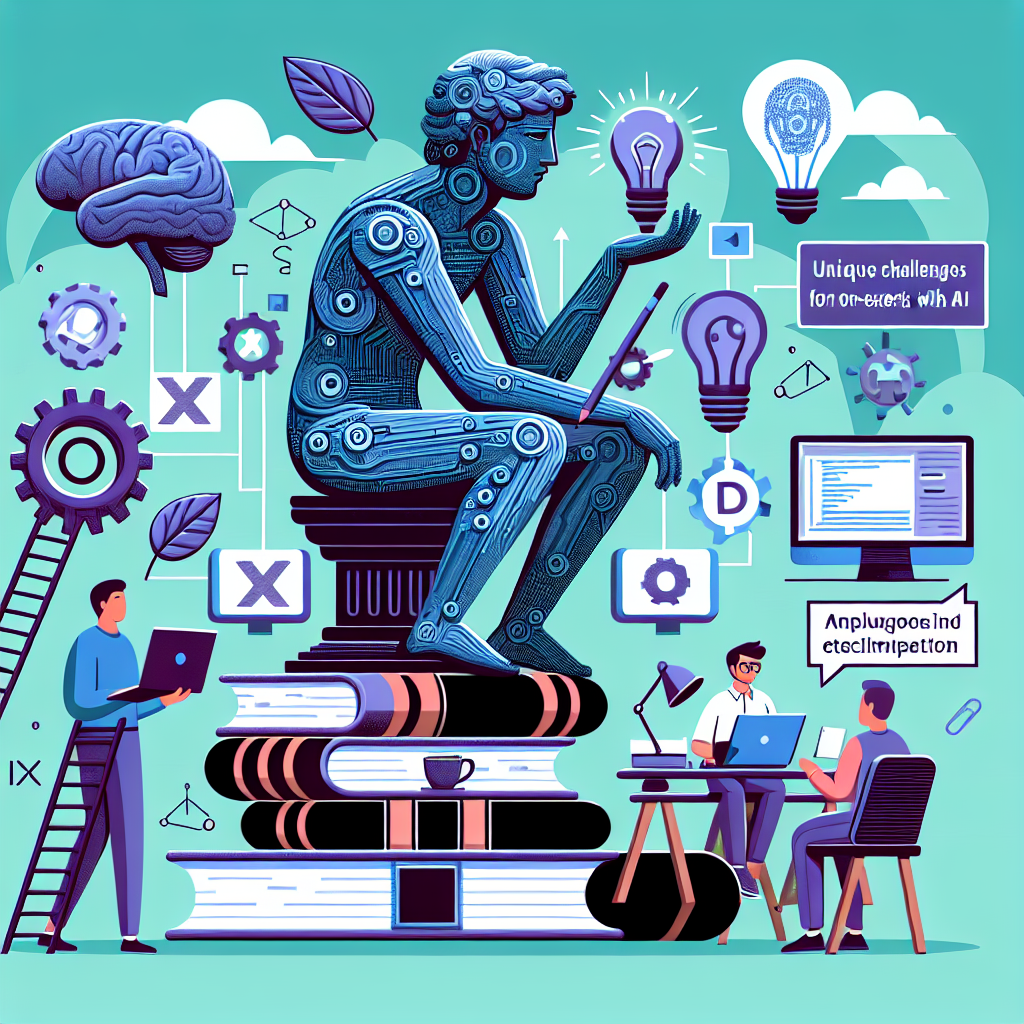
AI-powered coding tools could revolutionize the way non-expert users solve technical problems, but there is a real barrier between the promise and the practical experience. Applying large language models to programming for people without coding training presents unique challenges that require design, training, and technical support solutions.
First, the mental model gap hinders interaction. A non-expert user does not always understand concepts such as dependencies, environments, or runtime errors, so responses generated by an LLM can be incomprehensible or dangerous if applied without supervision. To close this gap, it is necessary to transform technical results into clear, visual, and actionable instructions.
Second, ambiguity in prompts leads to inconsistent results. Novice users often describe problems imprecisely, and models respond with solutions that appear to work but lack robustness. This makes it essential to use templates, guided assistants, and automatic validations that translate vague intentions into concrete specifications to generate reliable code.
Third, verification and debugging are more complex. Identifying why an auto-generated snippet fails requires tools that explain the model's reasoning, test the code in controlled environments, and suggest step-by-step corrections. Without these capabilities, the non-expert user is left unprotected against silent failures or unintentionally introduced vulnerabilities.
Fourth, security and privacy are a critical factor. Integrating generative models into real projects can expose sensitive data if there are no adequate cybersecurity controls. Therefore, any solution aimed at non-expert users must incorporate good data protection practices, code auditing, and isolation of execution environments.
Fifth, integration and deployment require knowledge that goes beyond generating snippets. Moving from a prototype to a production application involves decisions about architecture, cloud deployment, and managed services. Without support in AWS and Azure cloud services, CI CD pipelines, and security policies, many initiatives stall before delivering value.
Faced with these challenges, best practices include conversational interfaces with contextual validation, drag-and-drop visual assistants, sector-specific templates, and flows that turn requests into verifiable technical requirements. Complementing code generation with automated testing, security reviews, and monitoring reduces risk and facilitates adoption by non-technical users.
At Q2BSTUDIO, we specialize in turning the promise of artificial intelligence into tangible solutions for businesses. We develop custom applications and custom software designed for end users without a programming background, integrating AI agents that act as guided assistants and AI tools for businesses adapted to real processes. Our approach includes cybersecurity services to ensure that models and generated code comply with regulations and internal policies, as well as AWS and Azure cloud services for secure and scalable deployments.
We also offer business intelligence services and solutions with Power BI that facilitate the visualization and interpretation of data generated by intelligent applications. We combine artificial intelligence consulting with practical implementations so that automation and AI agents deliver value from day one, without exposing the organization to unnecessary risks.
If your goal is to leverage AI without leaving your teams disoriented, Q2BSTUDIO designs workflows, training, and custom tools that reduce friction: user-friendly interfaces, automatic validation, reproducible pipelines, and data governance. We build custom software that integrates AI, protects information, and facilitates decision-making with business intelligence services.
In summary, AI-assisted coding technology has enormous potential for non-expert users, but it will only be truly transformative when combined with expertise in user-centered design, cybersecurity, cloud deployment, and governance. Q2BSTUDIO brings that combination: custom applications, artificial intelligence solutions, AWS and Azure cloud services, AI agents, and Power BI so that your organization adopts AI with security and measurable results.


