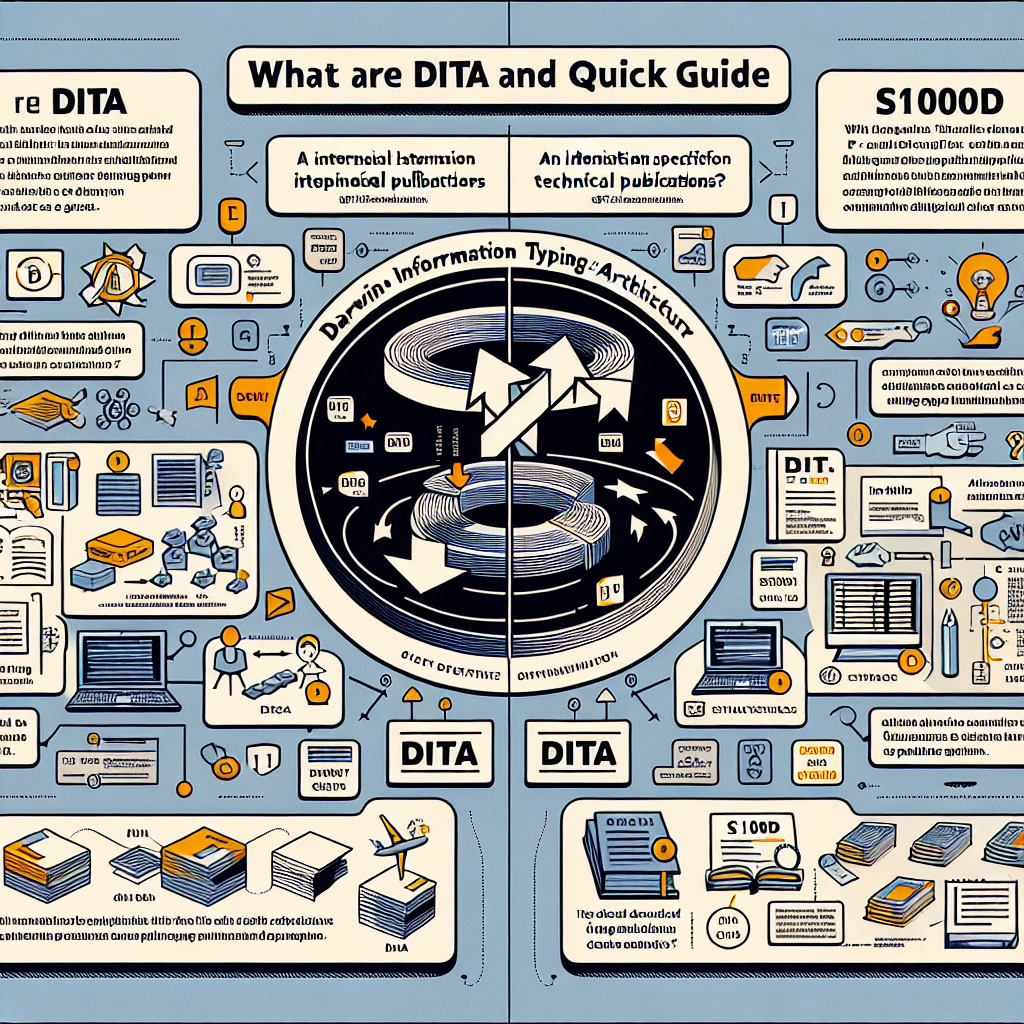
Quick summary of what DITA and S1000D are and why they matter in modern technical documentation
DITA is an XML-based standard created to produce, manage, and publish structured content in a modular way. DITA facilitates content reuse by dividing content into topics or reusable thematic units, supports specializations for domain needs, and enables publishing user manuals, training material, and support content with consistency and interoperability. History and adoption of DITA: it emerged in the 2000s at IBM to solve the complexity of modular documentation and in 2005 became an OASIS standard. Key features include topic-based authoring for concepts, tasks, and references, reuse through conref and maps, and specializations for sectors such as software, technology, manufacturing, and healthcare.
S1000D is an international specification for creating and managing technical publications with a focus on a Common Source Database. Born in the 1980s in the European aerospace and defense industry, S1000D evolved to cover civil aviation, defense, maritime, automotive, and heavy machinery. From early SGML versions, it moved to XML, and in recent versions it has been strengthened with XML schemas, an SVG profile for technical illustrations, and improvements in traceability, governance, and multimedia management.
Main differences and fields of application: DITA stands out for its modular flexibility and is widely used in software, custom applications, product documentation, and sectors where reuse and customization are priorities. S1000D prioritizes governance, traceability, and regulatory compliance, making it the logical choice in aerospace, defense, civil aviation, and sectors with strictly controlled documentation. In summary, DITA is more versatile and oriented toward reuse and editorial processes, while S1000D is more prescriptive and oriented toward common databases and strict technical control.
Key technical features: DITA offers topic-based authoring, reuse through conref references, content maps, and domain-specific specializations. S1000D offers a Common Source Database, version management and traceability, robust XML schemas, support for technical illustrations in CGM and SVG, and compatibility with multimedia and training formats such as SCORM.
Impact on documentation and digital transformation: both standards facilitate multichannel publishing and integration with structured content workflows, allowing organizations to automate the generation of manuals, maintenance guides, and training content. The choice between DITA and S1000D depends on the regulatory context, the need for governance, and the type of industry.
Q2BSTUDIO and how we help you: Q2BSTUDIO is a software development company specialized in custom applications and custom software with experience in artificial intelligence, cybersecurity, AWS and Azure cloud services, and business intelligence services. We offer comprehensive solutions to implement documentation standards such as DITA and S1000D, integrating them with CI/CD pipelines, document management systems, and publishing platforms. Our services include developing custom applications to manage a Common Source Database, integrating AI agents to automate metadata and classification, and deployment on cloud infrastructures such as AWS and Azure.
Key services connected to structured documentation: custom software development to manage structured content, migration to DITA or S1000D, information governance consulting, implementation of artificial intelligence for automatic extraction of entities and metadata, cybersecurity solutions to protect documentation repositories, and business intelligence services with Power BI to analyze content usage and quality metrics. We also develop AI agents and AI solutions for companies that automate documentation maintenance tasks, summary generation, and reuse recommendations, improving editorial efficiency.
Frequent use cases: manufacturing and aviation companies that require S1000D for regulatory compliance, software manufacturers that leverage DITA to create reusable content libraries, and organizations that combine both approaches as needed. Q2BSTUDIO can design hybrid workflows that leverage the best of DITA and S1000D, integrated with AWS and Azure cloud services and Power BI dashboards for data-driven decision making.
Conclusion: both DITA and S1000D are powerful tools for structured technical documentation. The choice depends on governance, reuse, and regulatory requirements. If you are looking to implement structured documentation, integrate artificial intelligence, improve the security of your repositories, or develop custom applications to manage content, Q2BSTUDIO offers expertise in custom software, custom applications, artificial intelligence, cybersecurity, AWS and Azure cloud services, business intelligence services, AI for companies, AI agents, and Power BI to support your digital transformation and optimize your technical documentation processes.