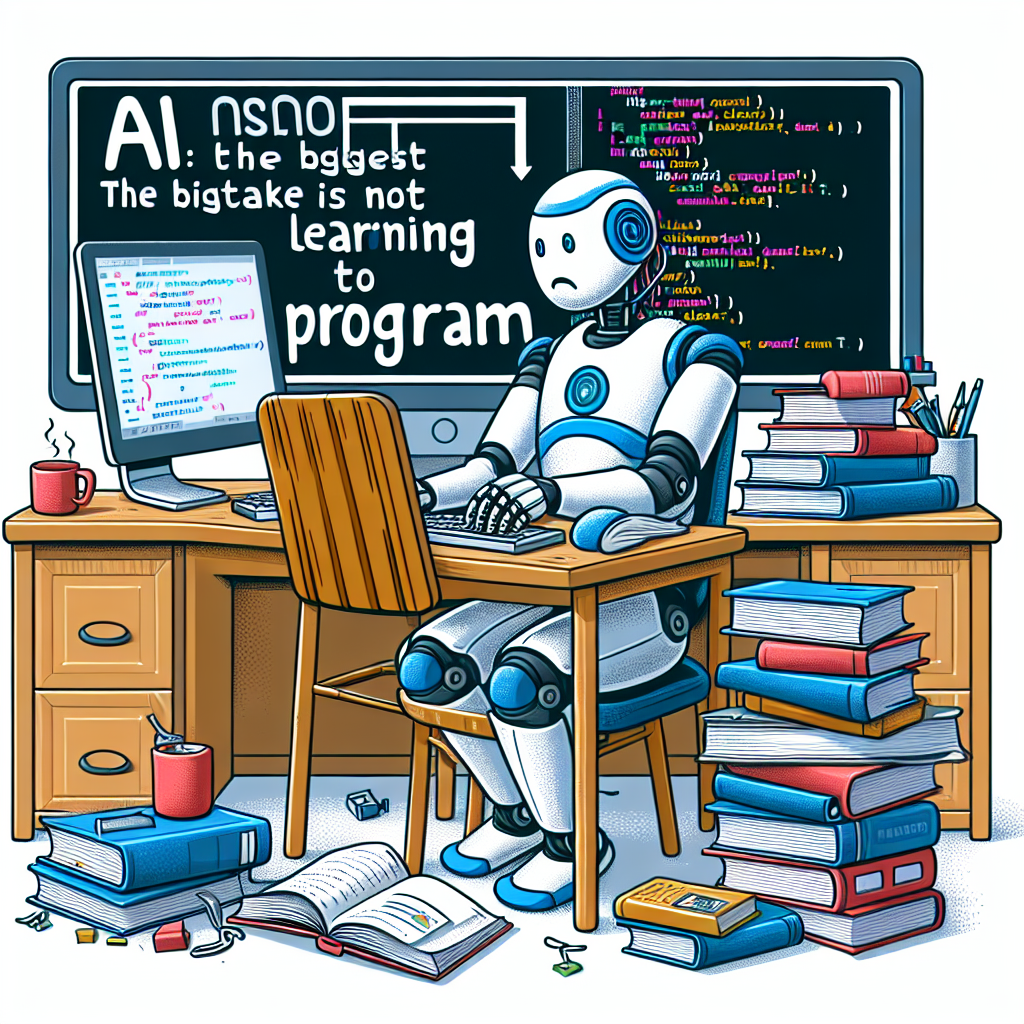
In an era of increasing automation and artificial intelligence tools that generate code, it makes sense to wonder how this will affect the craft of programming. The key lies in the difference between generating software and knowing how to program, and that distinction, which revalues the role of education and the way we learn, will determine professional success in the coming years.
We are entering a period in which software creation will be accessible to many more people, including those without deep technical training. Designers, analysts, and other professionals will be able to use advanced tools to turn their ideas into functional code without writing every line manually. Far from being a threat, this democratization is an opportunity: it increases the perceived value of software and of the work of those who build it, and it generates a growing demand for specialists. Low-code, no-code tools, and so-called vibe coding have something in common: they produce code, and the golden rule of software engineering still applies: the more code, the more bugs. Those who debug, optimize, and solve complex problems will be the programmers who understand the fundamentals. The future is not less work; it is more specialized and higher-value work.
For years it has been said that a diploma is not necessary to be a successful programmer, and indeed, it is not an essential requirement to enter the market. However, my experience leads me to recognize a deep value in the fundamentals acquired through formal education. In my postgraduate studies, an artificial intelligence course forced me to implement a neural network with backpropagation from scratch in Java based on a book. It was a tough process that required interpreting complex mathematical concepts and translating them into programming logic. At the time it seemed like an academic exercise; today I see that that experience built a solid foundation that allows me to navigate current tech hype more easily, whether it is AI, blockchain, or other novelties. Surface technology changes; fundamental principles remain.
Today there is an illusion of easy learning thanks to the Internet, but it is a trap if it remains passive consumption. Watching a podcast or a video about a complex concept is not the same as reading a paper or a technical book and making the effort to implement that knowledge. The first approach informs; the second forms. The university offers a structured curriculum that forces you to study fundamental topics that many would consider boring or far from immediate practice, such as network theory, compilers, or computer architecture. Without that obligation, it is easy to jump from topic to topic and accumulate superficial knowledge that fades quickly. Formal education forces you to build the foundation, brick by brick.
The goal of this reflection is not to claim that university is the only path, but to highlight the importance of active and deep learning of the fundamentals of computing. The programmer of the future will not be the one who only knows how to use the latest tool to generate code; it will be the one who understands what happens under the hood. The invitation is to a mindset shift: immerse yourself in books, implement algorithms from scratch, understand the theory behind practice. Whether through a university degree or disciplined self-study, investing in a solid foundation is the best strategy.
At Q2BSTUDIO we complement that vision with practical, results-oriented solutions. We are a custom software and application development company specialized in custom software, artificial intelligence, and cybersecurity. We offer AWS and Azure cloud services, business intelligence services, and Power BI projects to turn data into decisions. We design AI agents and AI solutions for companies that integrate advanced models with good security and scalability practices. Our team builds custom applications, implements cybersecurity strategies, and manages migrations and operations on AWS and Azure cloud services, always focused on code quality and the fundamentals that ensure maintainability and performance.
If you are looking to transform ideas into robust and secure products, Q2BSTUDIO can help you adopt best practices, from custom software and custom applications to applied artificial intelligence, AI agents, and business intelligence services with Power BI. Investing in fundamentals and in the talent that masters them is the key to making the most of the opportunities that the AI era brings.