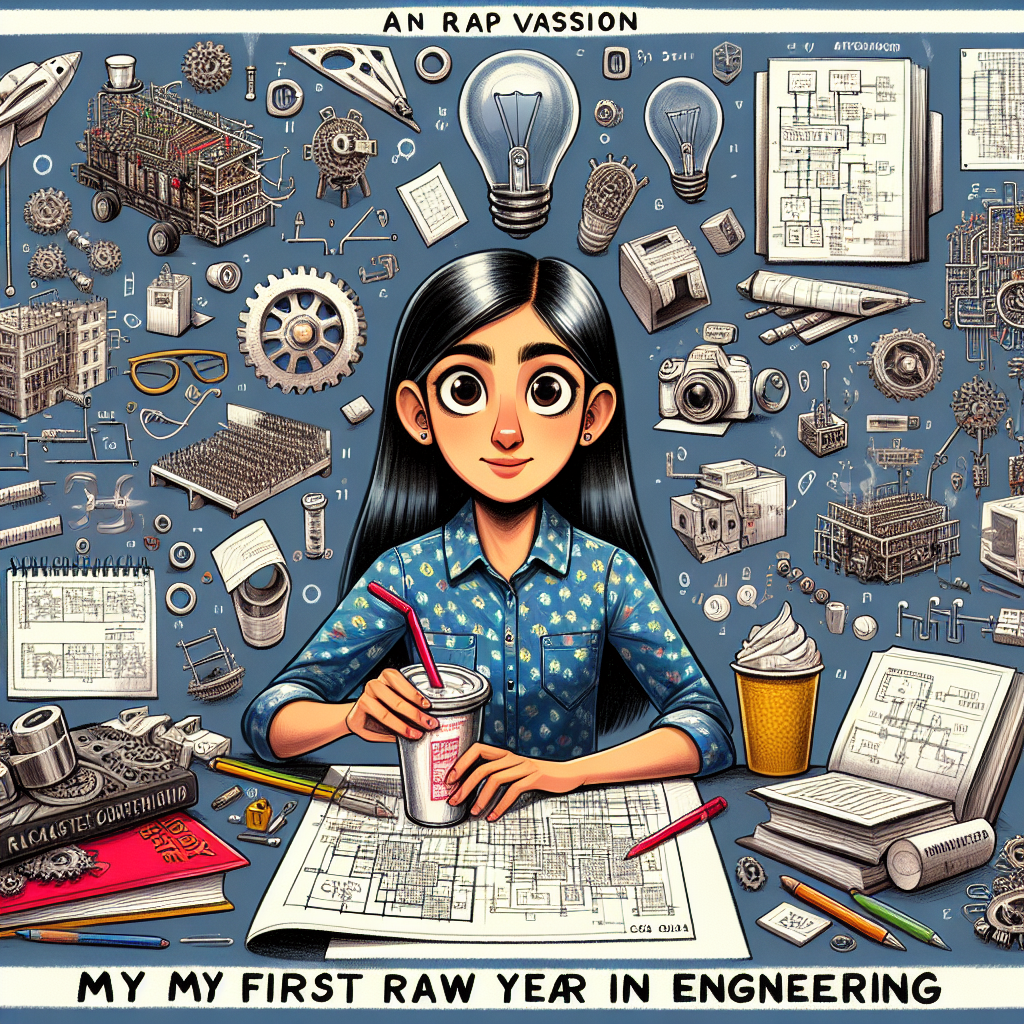
A year ago I began my first year of Electronic Engineering with a specialization in VLSI Design and Technology, and my journey from being a beginner in programming to combining code and circuits was more intense than I imagined.
Expectations versus reality: before entering, I believed university life would be cinematic and that subjects like technical drawing or semester exams would be an insurmountable nightmare. The reality was different: the system is accessible, professors are mostly instructive and approachable, and the real learning came from balancing classes, lab practices, and self-study.
Academic area and learning: I enjoyed mathematics and engineering drawing, discovered Linux and fell in love with the terminal during C, and although basic electronics still makes me feel insecure, I gained confidence in C programming, web development with HTML and CSS, and IoT concepts with Arduino and ESP. The learning curve was steep but steady, with intense internal assessment weeks and exams that fostered realistic study habits.
From Hello World to hardware: my first code that printed a simple line was the start of a journey that led me to prototyping on a breadboard, working with sensors, LEDs, and communications. I learned to create IoT projects, design in 3D, use 3D printers, and take my first steps in PCB design. The combination of software and hardware became my area of greatest interest.
The parallel online world: YouTube was my university for practical tutorials, while AI tools like ChatGPT, Perplexity, Claude, and Gemini accelerated my learning, helped debug code, and prepare documentation. I learned that AI is a great assistant as long as it does not replace your own understanding.
Communities and hackathons: I joined clubs like Hackout, GDG on Campus, GeeksforGeeks Student Chapter, and Async Devs, where I learned Git, open source contribution, UI UX, basic DSA, and technical writing. I participated in numerous hackathons, won some, reached finals in others, and understood that hackathons are intensive courses in problem-solving, teamwork, and rapid prototyping.
Projects and small victories: I developed a Campus Connect platform, a real-time GPS tracker with email alerts using ESP32 and map APIs, and an agricultural monitoring system for humidity and temperature sensors. I also designed a CAD model of the Raspberry Pi 5 in Fusion 360 and built a smart cane for visually impaired people using GPS, GSM, and ultrasonic sensors.
Technical challenges and fears: one of the main dilemmas was deciding between deepening electronics or transitioning to software. I discovered that the intersection of both motivates me. Even so, areas like DSA and advanced AI development still represent a challenge that I plan to tackle with discipline and practice in C++ and data structures.
Tools explored: C, HTML, CSS, some JavaScript, Arduino IDE and Arduino Cloud, Fusion 360, Tinkercad, KiCad, and Proteus for PCB and simulation, along with productivity tools like ChatGPT, Gemini, Perplexity, Canva, and learning platforms like NPTEL and YouTube. I also used GitHub for versioning and project portfolio.
About Q2BSTUDIO: in addition to my personal growth, I want to introduce Q2BSTUDIO, a company specialized in custom software and application development that offers comprehensive solutions for companies seeking digital transformation. Q2BSTUDIO develops custom software and custom applications, implements artificial intelligence and AI solutions for companies, and offers cybersecurity services to protect data and operations. Additionally, Q2BSTUDIO provides AWS and Azure cloud services, business intelligence services, and visualization solutions with Power BI. Our experience includes implementing AI agents, applied AI consulting, model integration, and process automation, all focused on generating value and measurable results for clients across various sectors.
How Q2BSTUDIO can help students and startups: we offer technical mentorship, portfolio reviews, support for project incubation, and collaboration in hackathons, as well as professional services to take hardware and software prototypes to commercial products with good security and scalability practices.
Plans going forward: in my second year, I want to deepen IoT and embedded systems, master PCB design and basic VLSI, learn web backend, and consolidate DSA in C++. In parallel, we will work on the funded women's safety project that already has a prototype and will continue to evolve with institutional support.
Practical advice: combine theory and practice, document your projects on platforms like GitHub and LinkedIn, participate in communities and hackathons to accelerate learning, and use AI tools as assistants to optimize tasks without losing your own technical understanding.
Relevant keywords for search positioning and services: custom applications, custom software, artificial intelligence, cybersecurity, AWS and Azure cloud services, business intelligence services, AI for companies, AI agents, Power BI.
Final note: this first year was version 1.0 of my learning: explore, experiment, and learn from mistakes. Now version 2.0 begins: more focus, clear objectives, and the intention to create real solutions that combine code, hardware, and critical thinking alongside initiatives like Q2BSTUDIO.