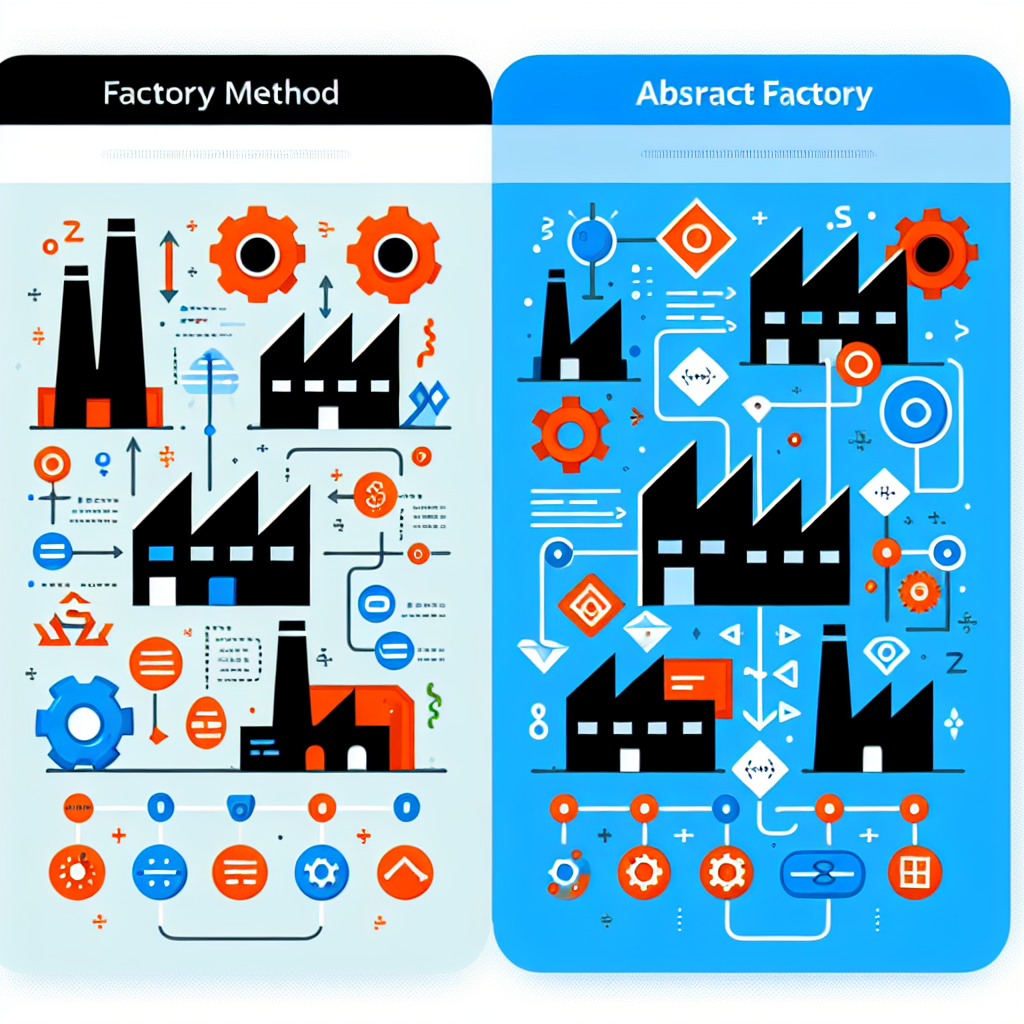
Factory Method vs Abstract Factory — What is the difference?
In software development, it is common to face the problem of creating objects without coupling client code to concrete classes. Two common patterns to solve this are Factory Method and Abstract Factory. Although they sound similar, their purpose and structure differ, and choosing the right one improves the scalability and maintenance of custom applications and custom software.
Factory Method
Idea The Factory Method pattern defines a factory class that decides which object to create, usually based on a parameter such as an identifier, a string, or an enum. It is a centralized and simple solution when the set of products is small.
Advantages Simple and centralized. Easy to understand. Ideal for small catalogs in custom software projects.
Disadvantages Adding new products requires modifying the factory and adding more if or else conditionals. It can become a bottleneck when the variety of products grows.
Practical example coffee shop With a single CoffeeFactory that has the makeCoffee method, which receives a type and returns the corresponding instance. The client asks for espresso or latte, and the factory creates the appropriate object. Pseudocode interface Coffee { void prepare(); } class Espresso implements Coffee { void prepare() { System.out.println(Grinding beans, brewing strong espresso...); } } class Latte implements Coffee { void prepare() { System.out.println(Brewing coffee, adding steamed milk...); } } class CoffeeFactory { Coffee makeCoffee(tipo) { if tipo is espresso return new Espresso(); else if tipo is latte return new Latte(); else throw IllegalArgumentException unknown type } } Client creates CoffeeFactory and requests types as needed.
Abstract Factory
Idea Instead of a single factory with conditionals, Abstract Factory defines an abstract factory interface and multiple concrete factories. Each concrete factory produces a family or a specific type of products. The client selects the factory it wants to use, and there are no internal conditionals in the factory.
Advantages Eliminates heavy conditional logic. Makes it easy to add new types by creating new factories. Allows producing families of related products consistently, for example, sets for coffee and tea or combinations of interfaces and adapters in enterprise solutions.
Disadvantages More classes and code to maintain. It can be excessive for very small projects or when there is a very limited number of products.
Practical example coffee shop With concrete factories EspressoFactory and LatteFactory that implement the interface or abstract class CoffeeFactory. Each factory always returns its concrete type. Pseudocode abstract class CoffeeFactory { abstract Coffee createCoffee(); } class EspressoFactory extends CoffeeFactory { Coffee createCoffee() { return new Espresso(); } } class LatteFactory extends CoffeeFactory { Coffee createCoffee() { return new Latte(); } } The client decides which factory to instantiate and then requests the product without additional conditionals.
When to use each pattern
Use Factory Method when a simple and centralized solution is needed and the number of types is limited. Use Abstract Factory when you want to avoid conditionals, add families of related products, or when the application requires high scalability and extensibility, such as in platforms with multiple modules or microservices.
Benefits for real projects
Both patterns help decouple object creation from the rest of the system, which facilitates unit testing, dependency injection, and future migrations. In projects that combine custom application development and artificial intelligence components, it is common to use Abstract Factory to supply concrete implementations of algorithms or AI agents according to the deployment environment.
About Q2BSTUDIO
Q2BSTUDIO is a software development company specialized in custom applications and custom software. We offer solutions that integrate artificial intelligence and AI agents for businesses, cybersecurity, and cloud services aws and azure. We also provide business intelligence services and dashboards with power bi that allow organizations to make data-driven decisions. Our experience in ai for businesses and in creating AI agents allows us to design clean architectures and appropriate design patterns such as Factory Method and Abstract Factory to ensure maintainable and scalable code.
If your project requires integrating artificial intelligence models into a custom application or needs to ensure security and compliance through cybersecurity services, Q2BSTUDIO can help choose the appropriate architecture and patterns. We offer consulting in cloud services aws and azure, business intelligence implementations, and solutions based on power bi for advanced data visualization.
Conclusion
Factory Method is ideal for simple and centralized solutions. Abstract Factory shines when you need to produce families of products or avoid conditionals in complex systems. At Q2BSTUDIO, we combine these patterns with good engineering practices to build robust custom software that integrates artificial intelligence, cybersecurity, cloud services aws and azure, business intelligence services, AI agents, and power bi according to each client's needs.
Contact Q2BSTUDIO to design your custom solution and take advantage of custom software with artificial intelligence, cybersecurity, and cloud services aws and azure that drive your business.