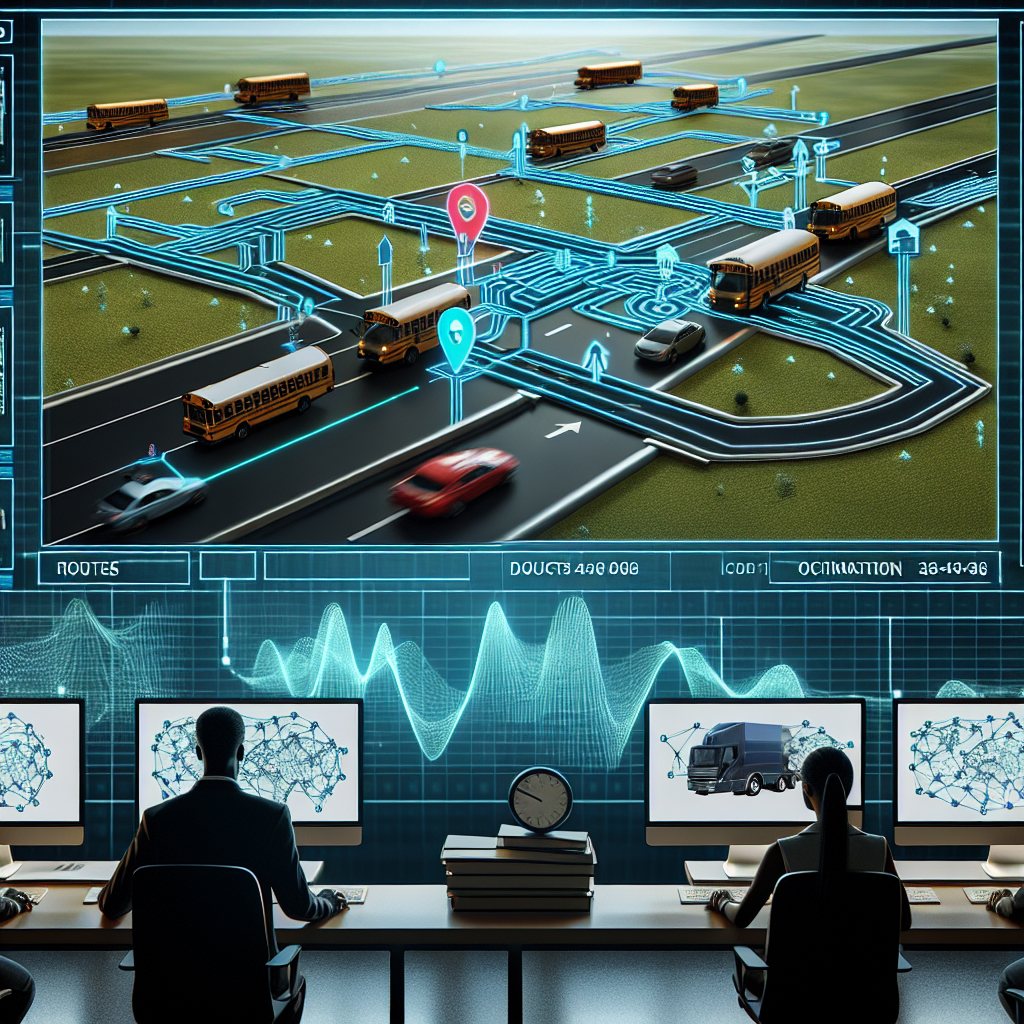
Managing school or corporate transportation is more complex than it seems. Traditional methods such as spreadsheets, manual planning, and paper routes consume time, cause errors, and increase operational costs.
In this article, we explain how we designed RouteBot, a SaaS product for school bus tracking, route optimization, and fleet management, including our technology stack, optimization challenges, and lessons learned.
The challenge School and staff transportation faces common problems: inefficient routes that increase fuel and time, lack of real-time tracking that creates uncertainty for parents and managers, delays in communication via SMS or calls, and poor data management when handling hundreds of students or employees. Our goal was to solve all these points in a single system.
Our solution: RouteBot RouteBot is a transportation management platform that combines route optimization, real-time tracking, multi-role access, and automatic notifications. It integrates route planning with Google Maps API and proprietary algorithms, live GPS data from the driver app, dashboards for administrators, drivers, and families, and SMS alerts for arrivals, delays, and route changes. The architecture is scalable to support thousands of vehicles and designed to minimize onboarding time.
Technology stack We chose a JavaScript-first strategy for agility and maintainability. On the frontend, we use React and Material UI. On the backend, Node.js with Express and Mongoose. MongoDB as the database. For mapping and optimization, we use Google Maps APIs such as Directions, Distance Matrix, and Geocoding. We currently host on Heroku with migration plans to Vercel and containerized services. This combination facilitates the development of custom applications and custom software designed for integrations with AWS and Azure cloud services.
Architecture vision Although RouteBot seems simple to the end user, internally it is designed for high scalability, maintainability, and performance. The system is organized in layers: a client with responsive dashboards and map rendering, an API gateway and backend services that expose REST and WebSocket, a data layer in MongoDB with geospatial indexes and time-series storage for GPS logs, and external services such as Google Maps, SMS providers, push notifications, and analytics and monitoring tools. The data flow enables real-time updates, fast queries, and historical route playback.
Route optimization at scale One of the challenges was assigning complex routes for multiple vehicles and dozens or hundreds of pickup points. Instead of solving a simple TSP problem, we used the multiple salesman problem (mTSP) formulation, suitable when there are multiple transport units with different capacities and schedule constraints.
Approach Inputs: list of students or employees with GPS coordinates, vehicle capacities, and pickup restrictions. Process: we group people by proximity and capacity, assign groups to efficient vehicles, and generate the stop sequence minimizing travel times. Output: optimized routes with stop order, ETA per stop, and balanced loads among vehicles.
Google Maps API and custom clustering We use the Distance Matrix API to obtain accurate travel times between points, but exhaustive queries between all pairs are costly. To reduce calls, we implemented custom clustering that groups nearby stops, heuristics that allow generating routes in near real-time, and distance caching for recurring stops. These techniques reduce costs and speed up route generation, especially useful when integrating business intelligence services and AI agents that require consistent and fast data.
Real-time tracking Drivers use a lightweight app that sends GPS updates every few seconds. Families and managers see the live position on their dashboards. Key optimizations include compressing location payloads to reduce data usage, WebSocket updates for immediate map refresh, and inactivity detection to pause transmissions when the vehicle is stopped, saving battery and data.
Automated notifications Communication is critical. We integrated an SMS system for alerts and confirmations: morning reminders, delay notices due to traffic or incidents, and drop-off confirmations. A backend event system avoids redundant messages, controls API costs, and ensures precise, real-time triggers.
Scalability and performance RouteBot was designed from the start to scale: modular services for authentication, routing, notifications, and tracking, database indexes for fast location queries, and asynchronous work queues for notifications and heavy processing. All this allows managing thousands of vehicles and passengers without performance degradation.
Algorithms and operational balance To solve the mTSP, we combine initial clustering, greedy assignment adjusted by capacity, and local route optimizations. In refinement phases, we apply 2-opt and other heuristics to reduce times. The balance between solution quality and computation time is key to offering routes in short planning windows and supporting hot changes during daily operations.
Security and compliance The platform incorporates cybersecurity practices from design, with robust authentication, role-based access control, encryption of data in transit and at rest, and event monitoring. These measures allow sensitive clients such as schools or companies to trust the management of personal data and routes.
About Q2BSTUDIO Q2BSTUDIO is a software development company specialized in custom applications and custom software. We offer complete solutions including mobile and web application development, artificial intelligence and AI integration for businesses, cybersecurity services, migration and administration on AWS and Azure cloud services, and business intelligence services with tools like Power BI. We are specialists in AI agents, automation, and projects where security and scalability are paramount. Our experience allows us to create products like RouteBot and adapt them to the real needs of schools, corporations, and transportation providers.
Key benefits Organizations that adopt RouteBot and custom solutions developed by Q2BSTUDIO obtain more efficient routes, reduced operational costs, greater real-time visibility, improved communication with families and employees, and compliance with security standards. Additionally, integration with business intelligence services and Power BI facilitates data-driven decision-making.
Want to know more If you work in route optimization, fleet management, or real-time tracking and are looking for a solution with advanced artificial intelligence capabilities, AI agents, and cybersecurity, we can help you design a custom solution. Contact Q2BSTUDIO to explore how to bring your project to production, integrate AWS and Azure cloud services, and leverage business intelligence tools and Power BI to maximize the value of your data.
Visit our website to see use cases, demos, and technical articles on route optimization, real-time tracking, and custom application development with artificial intelligence. We are open to collaborating, exchanging ideas, and building scalable and secure solutions for school and corporate transportation.