
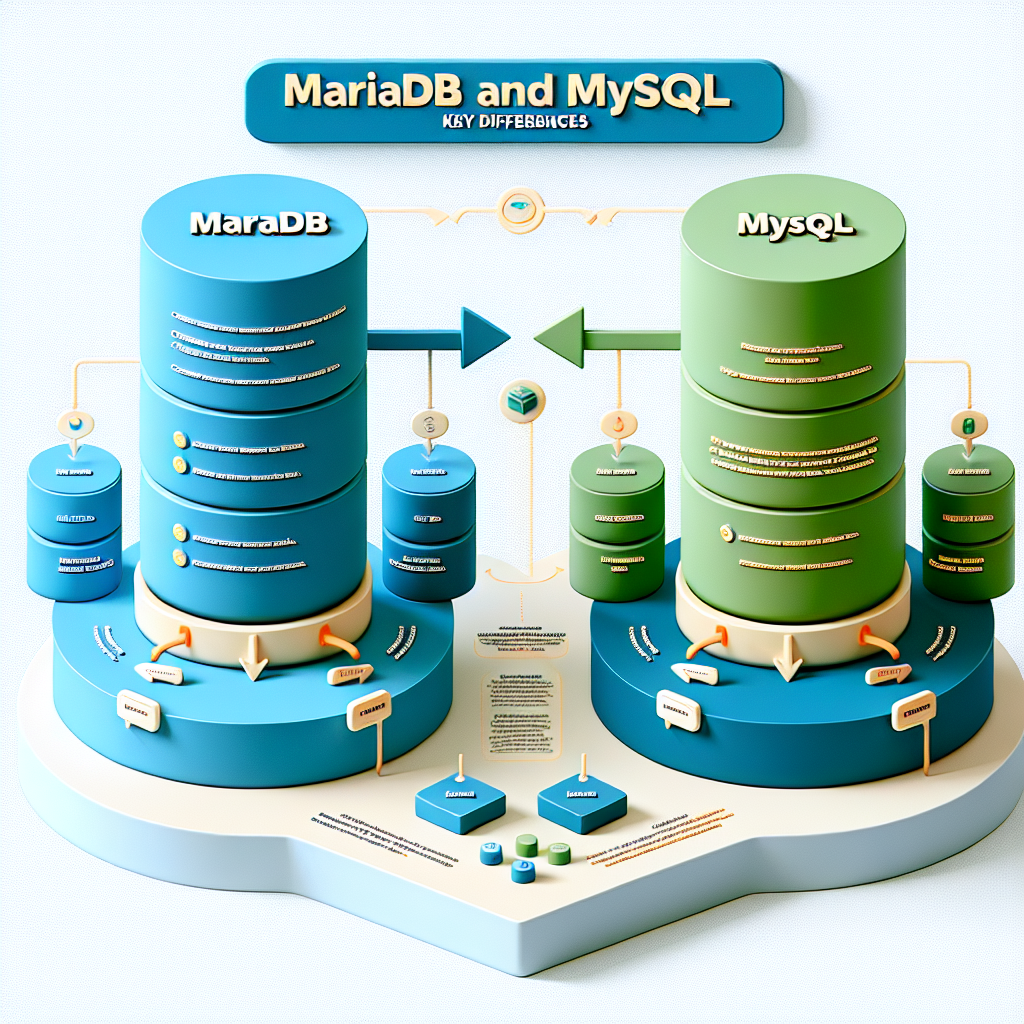
If you have ever set up a website, hosted an application, or managed a server even in a basic way, you have surely come across two well-known names in relational databases: MariaDB and MySQL. At first glance they seem the same, but when you delve into their origins, licenses, features, and communities, they show different paths.
What is the real difference between MariaDB and MySQL, and which one should you use for your project? Here is a clear and practical guide to help you decide.
At the basic level, both are relational database management systems or RDBMS that organize data in tables to store customers, orders, items, and more. Both are fast, reliable, and widely used on the web; many popular applications such as WordPress, Joomla, and Drupal run on them.
History and context: MySQL was born in 1995 from the Swedish company MySQL AB and became very popular for being open source. Over time, it went through acquisitions, and its main development is now under the umbrella of Oracle. MariaDB emerged as a fork of MySQL driven by the community and by Monty Widenius after the acquisition of MySQL, with the goal of ensuring a more open and community-driven project.
Licenses and development model: MySQL has community and commercial versions managed by Oracle, which implies centralized patches and decisions. MariaDB is developed with strong community participation and is available under open licenses that seek to preserve freedom of use and external contribution.
Compatibility and migrations: MariaDB was designed as a direct replacement for MySQL and is usually compatible at the client and command level in many versions, but over time functional divergences have emerged. Migrating between the two is usually feasible, but it is advisable to evaluate versions, engine types, and specific functions before moving data in critical environments.
Storage engines and performance: MySQL uses InnoDB as the default engine and offers other engines such as MyISAM and NDB in specific environments. MariaDB incorporates additional engines and optimizations such as Aria, ColumnStore, and improvements in MyRocks in some distributions. In terms of performance, there is no universal winner: depending on the type of workload, queries, and chosen engine, one may perform better than the other.
Modern features and differentiation: Both have incorporated features in recent years such as views, window functions, and JSON support, but the implementation and speed of innovation vary. MariaDB often includes integrations and experimental engines earlier, while MySQL offers stability and consolidated enterprise support.
High availability and replication: Both systems support traditional replication and advanced implementations. MariaDB integrates options such as Galera cluster in many distributions for synchronous replication, while MySQL offers robust solutions backed by Oracle, as well as managed cloud services.
Security and support: MySQL has commercial support from Oracle, updates, and enterprise services. MariaDB has corporate and community support, and both require good hardening practices, user management, and encryption for production environments.
Recommended use cases: If you need maximum compatibility with ecosystems already oriented toward Oracle or are looking for consolidated enterprise support, MySQL may be the right choice. If you prefer a community-driven, flexible solution with alternative engines and room for experimentation, MariaDB usually fits better. For custom applications with specific performance requirements or columnar engines for analytics, MariaDB can offer advantages.
How Q2BSTUDIO can help: At Q2BSTUDIO, we are specialists in custom software development and custom applications, with experience in artificial intelligence, cybersecurity, and cloud architectures. We help design and implement optimized MySQL or MariaDB databases, secure migrations between platforms, performance tuning, and deployments on AWS and Azure cloud services. We also integrate this data with business intelligence services and Power BI to create useful reports and dashboards for decision-making.
Our services include security and cybersecurity audits for databases, implementation of backups and high availability plans, custom software development that leverages specific MariaDB or MySQL engines, and AI solutions for companies that use AI agents and models to automate processes and data analysis.
If your project requires a managed cloud environment, we can deploy MySQL on RDS or Aurora in AWS, or solutions on Azure Database, as well as optimize infrastructure for business intelligence services. We also connect sources to Power BI and develop ETL pipelines to feed dashboards with reliable and secure data.
Practical recommendation: Evaluate functional requirements, licensing, support, and storage engine before choosing. For prototypes and rapid development, MariaDB is usually very convenient due to its flexibility. For regulated environments with a need for extreme enterprise support, MySQL with Oracle support or managed services may be the best option. In any case, Q2BSTUDIO can advise you on selection, implementation, and maintenance, as well as integration with advanced artificial intelligence solutions and AI agents.
Contact and next step: If you are looking for consulting for migration, custom software development, AWS and Azure cloud services, security, or artificial intelligence projects, cybersecurity, and business intelligence services with Power BI, at Q2BSTUDIO we offer comprehensive solutions that combine databases, analytics, and automation with AI agents. Get in touch for a free technical assessment and a proposal tailored to your needs.

