
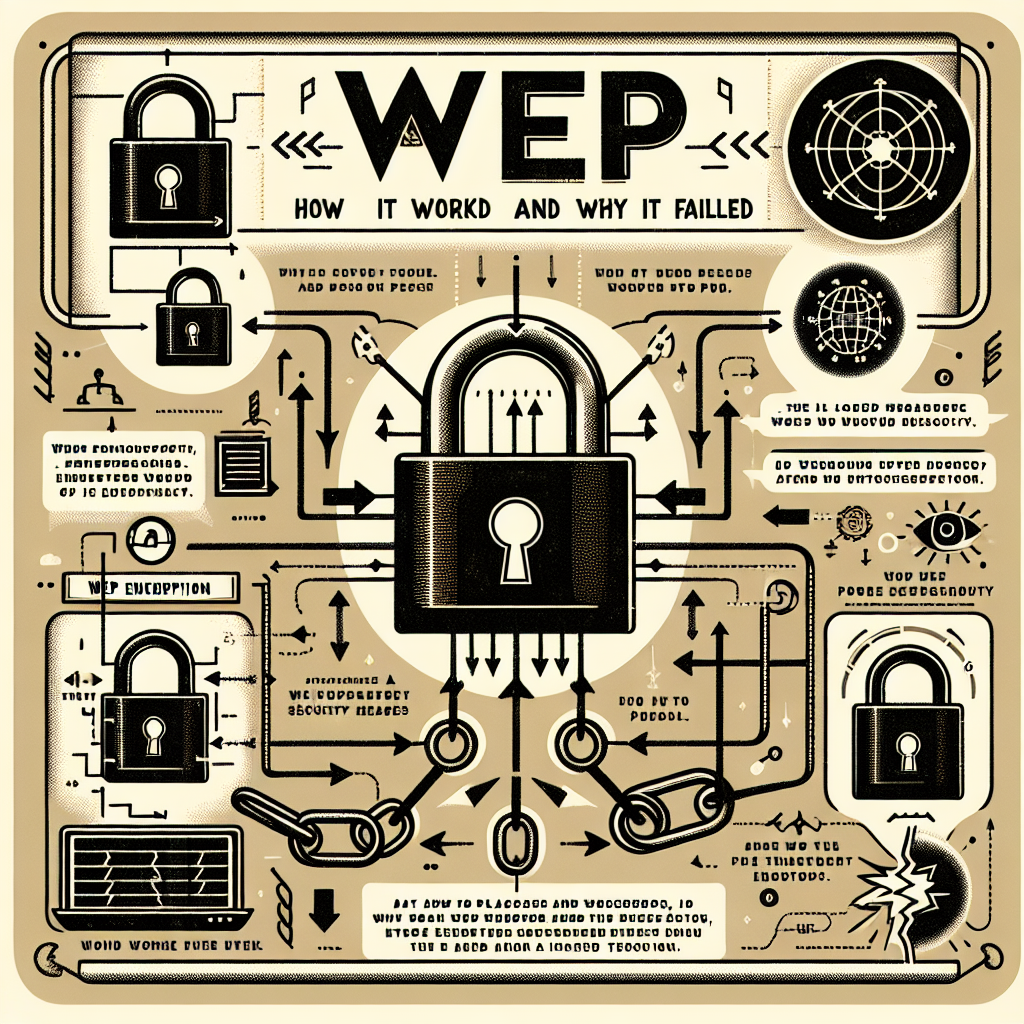
WEP explained: how it worked and why it failed
Before WPA2 and WPA3 became the WiFi security standards, there was WEP, short for Wired Equivalent Privacy. In the late 1990s and early 2000s, WEP was the default protection for wireless networks and promised to offer privacy equivalent to that of a wired network. That was the intention, but in practice WEP did not age well and is now considered obsolete.
Quick summary Encryption used RC4 as a stream cipher. Goal to prevent third parties from intercepting and reading data. Reality is that it can be easily broken using public tools and statistical attacks.
How WEP worked The basic process was simple: the client encrypted data using a shared key, the encrypted packet traveled through the air, and the router received it and decrypted it with the same key. Behind the scenes, each packet used a key sequence derived from the network password and a 24-bit initialization vector IV. Simplified formula IV + password -> key sequence -> encrypted packet. The critical problem was that the IV was short and was sent in plain text in each packet.
Why WEP fails The main vulnerabilities are clear: the 24-bit IV produces around 16 million possible combinations that repeat very quickly on busy networks; the IV travels in plain text and any listener can see it; IV repetition weakens the randomness of the encryption and allows an attacker to apply statistical attacks to recover the key sequence and finally the shared key.
How WEP is broken Breaking WEP is surprisingly simple if you have the right tools. The typical attack involves capturing a large number of packets and their IVs using tools like airodump-ng, and then analyzing those IVs to recover the key with tools like aircrack-ng. With enough captured traffic, the shared key can be found in minutes.
Conclusion and recommendations WEP was created with good intentions but is an example of a design that failed in practice. It has been officially deprecated for years. If you still have a router configured with WEP, you should reconfigure or replace it immediately and migrate to WPA2 or WPA3 to protect your data.
At Q2BSTUDIO we are a custom software and application development company specialized in modern cybersecurity and artificial intelligence solutions. We offer custom software, custom applications, and comprehensive services that include AWS and Azure cloud services, business intelligence services, and Power BI solutions to obtain actionable insights. We implement AI for businesses, develop custom AI agents, and apply artificial intelligence techniques to strengthen protection and detection in wireless networks and cloud environments.
If you are concerned about the security of your networks or need to migrate legacy infrastructures such as those that still use WEP, at Q2BSTUDIO we can audit, redesign, and deploy secure and scalable solutions. Our specialties include cybersecurity, artificial intelligence, AWS and Azure cloud services, business intelligence services, custom software development, and custom applications that accelerate innovation in your company.
Contact Q2BSTUDIO to modernize your systems, implement better security practices, and leverage AI agents and business intelligence tools such as Power BI to make data-driven decisions. Migrating from WEP to current standards and applying secure cloud architectures is critical, and we help you do it quickly and robustly.

