
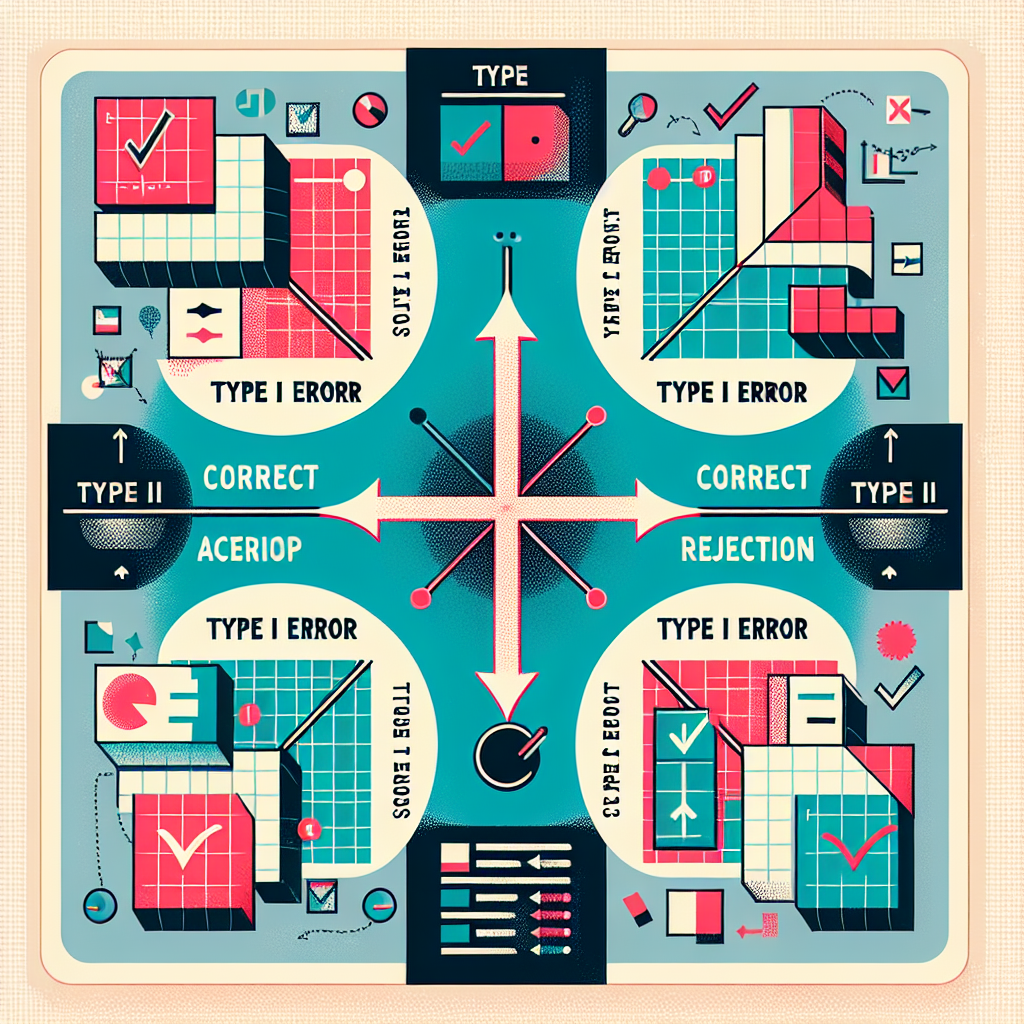
Crossing the street without traffic lights is a good image for understanding decision-making in statistics: you have to weigh the risk of acting too soon against the risk of waiting too long. In hypothesis testing, these risks are called Type I error and Type II error, and it is impossible to eliminate them completely.
Type I Error false positive occurs when the null hypothesis is rejected when it is actually true; in medicine, this would be diagnosing a disease the patient does not have. Type II Error false negative occurs when the null hypothesis is not rejected when it is actually false; in medicine, this would be failing to detect a disease that is present.
Both errors work like opposite sides of a seesaw; reducing one usually increases the other.
Imagine a clinic in a malaria-endemic area. A patient arrives with fever, chills, and body aches. If a Type I error is committed, they are told they have malaria when they do not, they receive unnecessary medication and may experience side effects while the real cause goes untreated. If a Type II error is committed, they are told they do not have malaria when they actually do, and without treatment the disease can progress rapidly and, in severe cases, become life-threatening.
In this context, Type II errors are usually more dangerous because malaria progresses quickly, antimalarial treatment is usually relatively safe and inexpensive, and missing a real case can have much worse consequences than treating a false one. That is why some clinics treat strong clinical suspicions even with negative tests: it is better to risk a false positive than to lose a life.
The effect of a test's sensitivity and specificity can be simulated to see how false positives and false negatives appear. Higher sensitivity reduces false negatives; higher specificity reduces false positives. By adjusting the test or the clinical strategy, one consciously decides which type of error is more tolerable depending on the consequences.
The choice between minimizing Type I or Type II error depends on the context and the cost associated with each error. If the cost of a false positive is high, for example invasive surgery or expensive treatments, reducing Type I errors is prioritized. If the cost of a false negative is high, for example rapidly progressing diseases, reducing Type II errors is prioritized. In study design, alpha levels are set to control Type I error and power to control Type II error depending on what is at stake.
At Q2BSTUDIO we help organizations make these technological decisions with a focus on practical solutions. We are specialists in software development and custom applications, custom software for critical processes, artificial intelligence projects, and cybersecurity solutions. We also offer AWS and Azure cloud services, business intelligence services, and tools like Power BI to transform data into decisions. We develop AI for businesses, AI agents adapted to workflows, and systems that balance sensitivity and specificity according to business risk.
Our teams combine expertise in artificial intelligence and cybersecurity to create secure and effective solutions that minimize the impact of errors according to clinical, operational, or commercial priorities. If you need a custom application, integration with AWS and Azure cloud services, or dashboards with Power BI and business intelligence services, Q2BSTUDIO can design the strategy and build the custom software your company needs.
Choosing between Type I and Type II error is not about seeking perfection but about defining priorities and tolerances. In medicine, the priority may be saving lives; in other sectors, avoiding costs or reputational risks may take precedence. Which error can we live with, and which one can we not afford to commit? At Q2BSTUDIO we help you answer that question through custom software, artificial intelligence, AI agents, cybersecurity, and cloud services that align technology and business risks.

