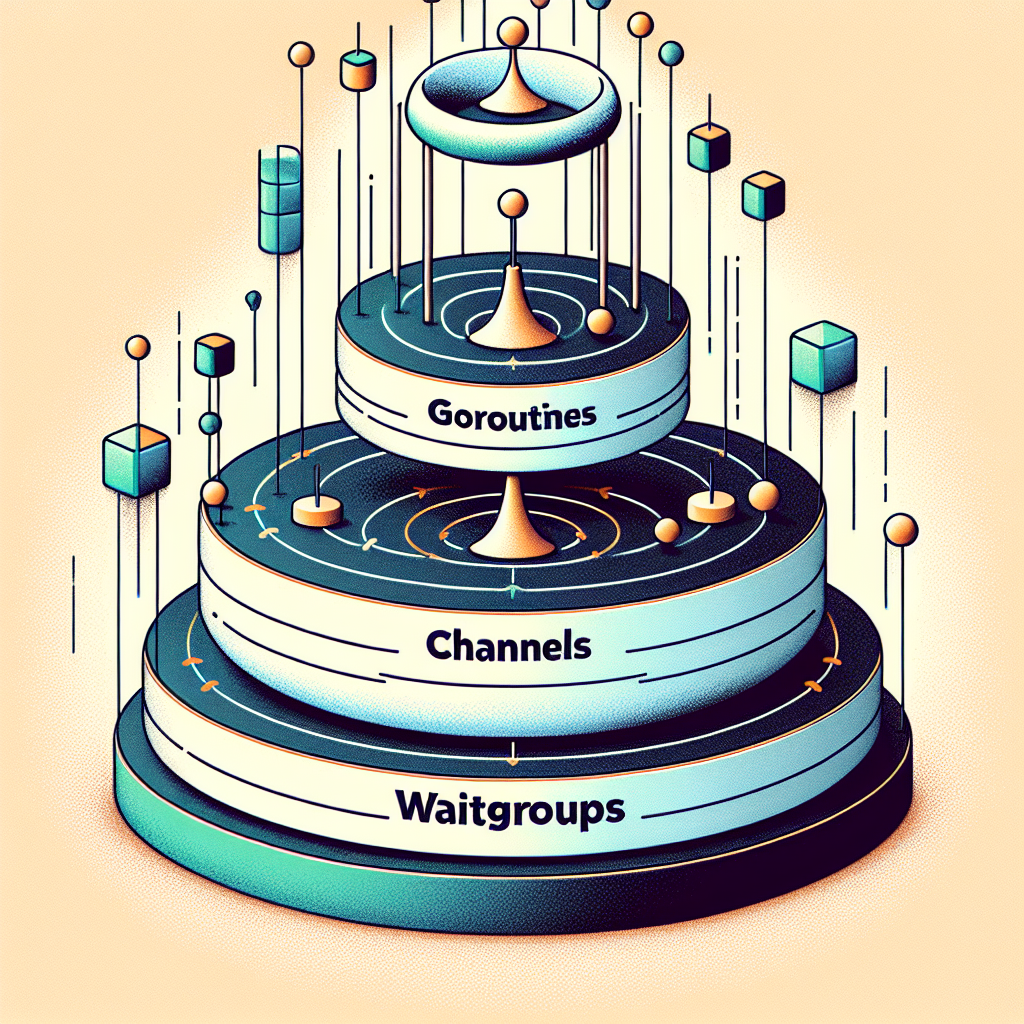
In Go we can run multiple tasks at the same time thanks to concurrency, a technique that allows us to make better use of hardware and reduce response times in custom applications and custom software.
Imagine you are preparing dinner: while the pasta boils, you chop the vegetables. In programming, that means starting different tasks without waiting for each one to finish before starting the next.
Goroutines are lightweight workers that Go launches with the keyword go. Creating thousands of goroutines is cheap and practical when you want to parallelize independent tasks and improve performance in AWS and Azure cloud services or in artificial intelligence processes for businesses.
Conceptual example without concurrency: run cookPasta, then makeSalad, then bakeBread, and add up the times. With goroutines you start go cookPasta, go makeSalad, go bakeBread, and they all advance in parallel, reducing the total time.
The problem is knowing when those tasks finish. Using time.Sleep is an unreliable estimate. To coordinate, there are two common tools in Go: WaitGroups and Channels.
WaitGroups act as a worker counter. It is incremented for each task started and decremented when each goroutine signals that it has finished. It is ideal for fire-and-forget scenarios where you only need to wait for everything to finish, for example when processing batches in custom applications without needing to return individual results.
Channels are the communication system between goroutines. They work like walkie-talkies that allow sending data or completion signals. They are useful when workers must return results, coordinate, or control the workflow, for example in processing pipelines or in artificial intelligence solutions that integrate AI agents and analysis with Power BI.
To process multiple files at once, you can combine goroutines with WaitGroups to launch N tasks and wait for all of them to finish, or use channels to collect results in a buffered channel. With many CPU cores, this drastically reduces total time compared to sequential execution.
A common pattern is the worker pool: create a jobs channel, start a fixed number of workers that read from the channel and process each job until the channel is closed. This allows limiting concurrency and scaling in a controlled way in cloud environments, ideal for ETL pipelines, business intelligence services, and batch tasks.
When to use each: goroutines for parallelism and independent tasks; WaitGroups when there is a known number of tasks and you only need to wait; channels when you need communication, returning results, or coordinating process stages. These decisions influence the efficiency of cybersecurity solutions and AWS and Azure cloud service deployments.
At Q2BSTUDIO we are a software development company specialized in custom applications and custom software. We offer artificial intelligence services, AI for businesses, AI agents, Power BI, and integration with cloud platforms such as AWS and Azure. We also provide consulting and cybersecurity solutions and business intelligence services to secure and accelerate your organization's digital transformation.
Our approach combines good concurrency practices in Go with scalable architecture, optimized pipelines, and security by design. If you need to create a custom solution that leverages goroutines, channels, and WaitGroups to process data, integrate artificial intelligence models, or deploy on AWS and Azure cloud services, Q2BSTUDIO can help you design, develop, and implement the right solution.
Relevant keywords for positioning: custom applications, custom software, artificial intelligence, cybersecurity, AWS and Azure cloud services, business intelligence services, AI for businesses, AI agents, Power BI.
Contact Q2BSTUDIO to transform your ideas into robust and secure products that leverage concurrency in Go and the best current technologies.