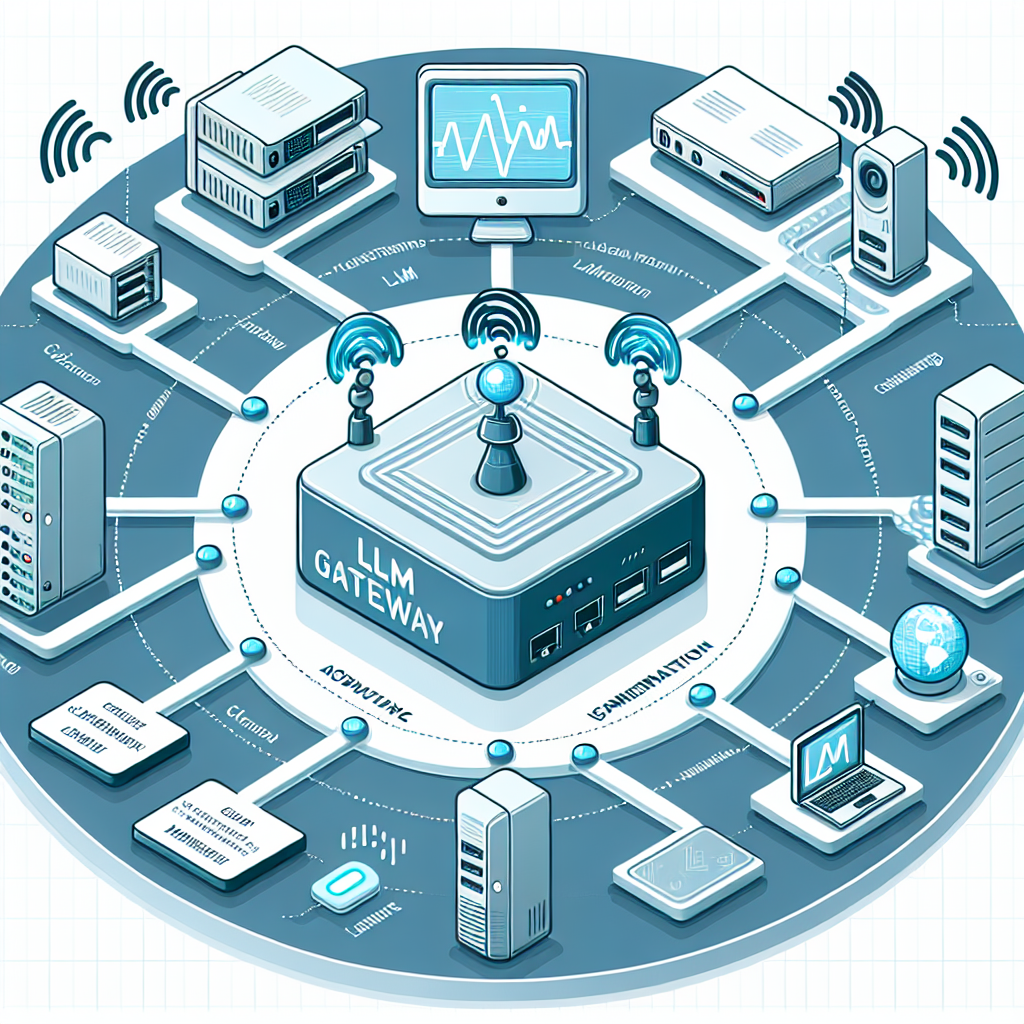
An LLM gateway is the central point that simplifies how applications consume language models. Instead of dealing with separate keys, different APIs, changing quotas, and billing dashboards per provider, the gateway acts as a single control tower that routes, protects, monitors, and optimizes calls to models like GPT, Claude, Mistral, or self-hosted instances.
Large models are demanding: they consume tokens, require GPUs, have variable latencies, and heterogeneous call formats. Switching from one provider to another or adding a self-hosted LLM can feel like reconfiguring an airplane mid-flight. The gateway eliminates that pain by centralizing authentication, limits, and metrics.
What a gateway does A single endpoint for all applications; a set of credentials per team; central monitoring of cost, latency, success rate, and guardrails. If API gateways solve microservices, LLM gateways solve prompts and models.
Key features Unified API that accepts a chat completions-style call and translates to the appropriate backend; intelligent routing by price, speed, or failover rules; security and compliance with central key vault, roles, automatic PII redaction, and audit logs; usage analytics for tokens, cost, and p95 latency; prompt caching and deduplication; cost controls per team; prompt management with versioning and A/B testing; and extensibility to add guardrail libraries, evaluation suites, or agents as middleware.
Why does the gateway model win? Faster feature releases because engineers don't learn five different APIs; flexibility to switch models when new competitors appear; greater reliability by being able to failover between providers; centralized budget control; and a better security posture by reducing scattered keys.
Anatomy of a request A client sends a prompt to the gateway endpoint with the chosen model; the gateway validates the user's token, logs metadata, and filters prohibited content; the routing engine selects the provider according to SLAs; the provider responds, the gateway applies post-response guards and caches the output; finally, the gateway transmits the response to the client including cost and latency metrics. All this adds only a few milliseconds on top of the model's compute time.
Real-world use cases Ecommerce support where product questions are routed to a cheap open-source model and escalations to premium models; multilingual support with language detection at the gateway and automatic switching to the model trained for that region; RAG pipelines where the retrieval logic only calls the gateway and underneath, self-hosted models and embeddings are mixed; enterprise search with centralized redaction and logging for compliance audits.
BiFrost by Maxim AI BiFrost is a proven gateway that connects to catalogs of commercial models and Hugging Face checkpoints; it offers a simple model catalog, billing without per-step markup, live analytics of token burn down and latency maps, encrypted secret store with rotation, toxicity filters and PII scrubbing, parity with OpenAI-style SDKs to point to base_url, and deployment in VPC or on Maxim's cloud. BiFrost allows changing models via a single parameter without touching application logic.
Purchasing criteria Verify the roster of providers supported today and tomorrow; check real latencies with representative loads; demand cost transparency in tokens, requests, and egress; review certifications and security posture such as SOC 2 and ISO 27001; look for customization capability to inject validators or observability agents; consider the self-hosting option for regulated industries; and prefer active communities and direct support from engineers.
Pitfalls to avoid Avoid lock-in with the gateway, review possible hidden markups on each request, measure the latency penalty from additional hops, and don't assume that a security label means compliance for your legal team.
Where gateways are heading They increasingly resemble load balancers for the AI world: model benchmarking marketplaces, on-device fallback with lightweight local models, dynamic hot fine-tuning, and federated privacy layers that encrypt prompts client-side to route to models with FHE capabilities.
Summary An LLM gateway is not just another piece of infrastructure; it is the seatbelt, the dashboard, and the cruise control for applications that consume language models. Implementing it accelerates deliveries, improves security, and optimizes costs, while not doing so causes continuous patches to each provider's peculiarities.
About Q2BSTUDIO Q2BSTUDIO is a custom software and application development company specialized in artificial intelligence, custom software, and cybersecurity. We offer AWS and Azure cloud services, business intelligence service solutions, and AI consulting for companies. We design AI agents and develop integrations with Power BI for advanced analytics. If you need custom applications, custom software, or AI projects for companies with compliance and security, our team combines expertise in cybersecurity, AWS and Azure cloud services, and business intelligence solutions to deliver scalable and secure projects.
Contact and call to action If you want to standardize the way your company consumes artificial intelligence, reduce costs, and increase the reliability of your services, consider deploying a managed or self-hosted LLM gateway and talk to Q2BSTUDIO to evaluate the appropriate architecture, include AI agents, and connect your Power BI dashboards.