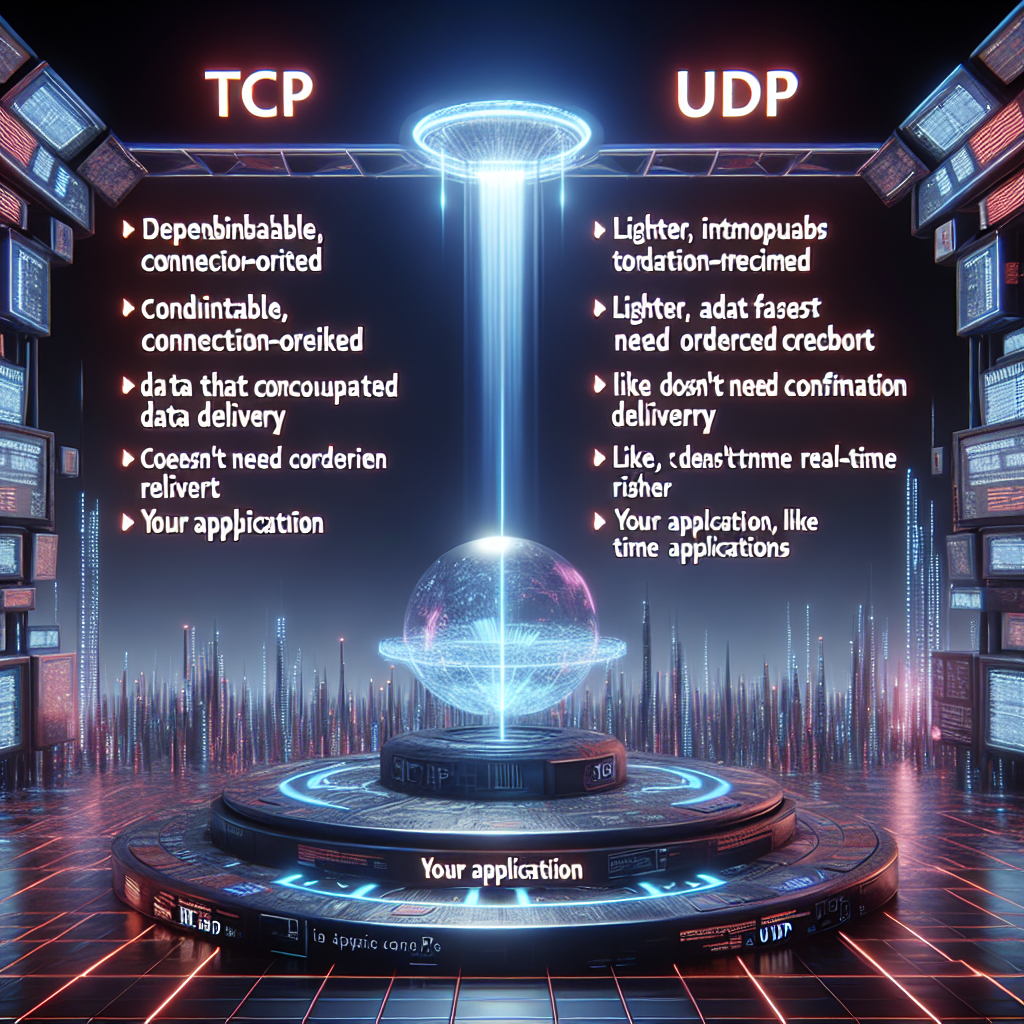
If you have ever wondered why a video call freezes or why a multiplayer game lags, the answer is usually in the choice between two key Internet protocols: TCP and UDP. These protocols move data between devices worldwide, and the way they do it largely defines the user experience.
By 2025, both remain relevant because their trade-offs still make the difference between precision and speed in applications such as web browsing, live streaming, and real-time communications.
At its core, the central difference is simple: TCP prioritizes reliability by establishing connections, checking for errors, resending lost packets, and maintaining order; UDP works like a postcard sent instantly without confirmation or resends, guaranteeing low latency at the cost of possible losses.
Choosing between TCP and UDP depends on what the application values most: accuracy or immediacy.
TCP stands out when data integrity is essential. It is the foundation of secure web browsing, email, file transfers, and financial transactions where every byte counts. Its reliability adds extra latency due to connection establishment and retransmission management.
UDP excels in real-time experiences such as online gaming, live streaming, and video calls, where speed and smoothness matter more than receiving every packet. UDP reduces latency and avoids pauses from retries, although it accepts a margin of data loss that applications must handle.
Today, it is not always a binary decision. Modern protocols and hybrid architectures combine the best of both worlds: for example, protocols over UDP that add error control for HTTP/3, or services that use UDP for the main transmission and TCP for critical messages or data recovery.
Under ideal network conditions, TCP delays are manageable, but on congested networks, its retransmission system can slow down the flow. UDP keeps sending data, allowing the application to tolerate gaps and prioritize real-time interaction.
At Q2BSTUDIO, as a custom software and application development company, we evaluate these decisions in every project. For custom software solutions and custom applications, we determine when to use TCP or UDP based on integrity, latency, and scalability requirements. We implement AI agents and AI for businesses that combine protocols and application logic to optimize the final experience.
Additionally, Q2BSTUDIO offers AWS and Azure cloud services, integrating cybersecurity practices and business intelligence services to ensure data travels efficiently and securely. For analysis and visualization, we use Power BI and other business intelligence tools that rely on reliable transfers when necessary and efficient streaming when immediacy is a priority.
Videoconferencing or live streaming projects developed by Q2BSTUDIO typically use UDP-based transports with additional correction and control layers, while billing or file transfer systems use TCP to guarantee integrity. This combination is common in enterprise solutions that require both performance and security.
If your company needs custom software or wants to incorporate artificial intelligence, AI agents, cybersecurity services, or migrations to AWS and Azure cloud services, we can design the right architecture. Our approach integrates network strategies, protocol selection, and the use of tools like Power BI to obtain actionable insights with optimal security and performance.
In summary, choose TCP when accuracy, order, and integrity are paramount; choose UDP when latency and real-time experience prevail; or mix approaches to get the best of both. Q2BSTUDIO combines expertise in custom software, artificial intelligence, cybersecurity, AWS and Azure cloud services, business intelligence services, AI agents, and Power BI to design solutions that maximize user experience and system resilience.
Contact Q2BSTUDIO for a personalized assessment and discover how a proper choice of protocols and architectures can transform your application in 2025 and beyond.