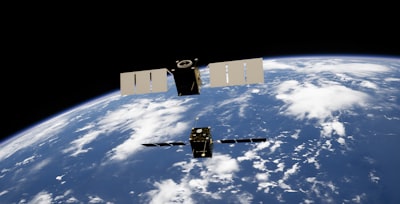
Attitude control during atmospheric reentry is one of the most complex challenges in aerospace engineering. Spacecraft must maintain precise orientation while facing extreme conditions: high temperatures, air density variations, mass changes due to fuel consumption, and potential actuator failures. Traditionally, PID controllers with gain scheduling have been the standard solution, but their performance degrades in the face of nonlinearities and scenarios outside the design range. In this context, deep reinforcement learning emerges as a promising alternative, capable of handling nonlinear dynamics and adapting to uncertainties through policies learned in simulation.
To apply reinforcement learning to attitude control during reentry, it is necessary to formalize the problem as a Markov decision process. The state includes current orientation, angular velocities, position, and variable parameters such as mass and inertia tensor. Actions correspond to commands sent to actuators (ailerons, flaps, thrust). The reward penalizes deviation from the desired angle of attack and rewards stability. Continuous off-policy algorithms such as SAC or TD3 allow learning robust policies without requiring an explicit dynamic model. However, generalization outside the training distribution is a weak point. To mitigate this, domain randomization is used: during training, parameters such as mass, inertia, or actuator bandwidth are varied, forcing the agent to cover a predefined operational envelope. Results show that hybrid controllers—combining a reference PID with an RL-based correction—achieve superior angle-of-attack tracking and greater robustness against parametric variations than purely classical controllers.
This methodology is not only relevant to the space sector but can also be transferred to other domains where adaptive control is critical: drones, underwater robotics, or autonomous ground systems. The implementation of artificial intelligence solutions for companies such as those offered by Q2BSTUDIO enables the development of AI agents capable of learning control policies from simulations and real data. The company also provides custom applications to integrate these models into industrial platforms, leveraging AWS and Azure cloud services to scale training and inference. Furthermore, given the need to protect critical systems, its cybersecurity services ensure the integrity of data and communication between the controller and the plant.
For projects requiring process optimization through intelligent control, combining reinforcement learning with business intelligence tools such as Power BI allows real-time monitoring of controller performance and detection of deviations. Likewise, process automation through AI agents can reduce human intervention in repetitive parameter tuning tasks. In short, attitude control during atmospheric reentry illustrates how the fusion of classical and modern methods, supported by custom software development, opens new frontiers in autonomous systems engineering.