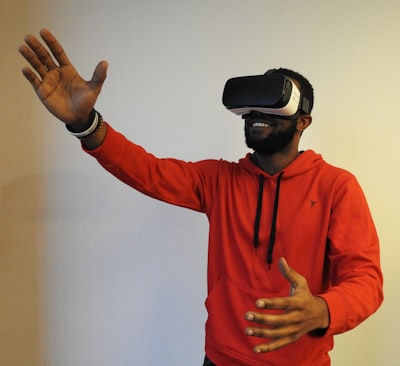
Authentication in virtual and augmented reality environments represents one of the most complex challenges for the current technology industry. Traditional methods such as passwords, PINs, or device-based logins completely break user immersion and rely on external hardware that limits the experience. Faced with this problem, an innovative solution emerges: the signature in the air, an interface that allows users to authenticate themselves through natural signature gestures in three-dimensional space, combining familiarity, personalization, and reproducibility. This approach leverages point-voxel cross-attention networks (PV-Net) to model both the local dynamics of movement and the global spatial structure of 3D trajectories, achieving equal error rates of 2.5% on public datasets and a classification accuracy of 76% in immersive VR environments. The technology represents a significant advance towards secure, intuitive behavioral authentication interfaces compatible with embodied interaction, without the need for specialized sensors or movement restrictions.
For companies seeking to integrate cutting-edge authentication solutions into their digital ecosystems, the development of AI for businesses becomes a strategic pillar. At Q2BSTUDIO, we understand that implementing systems like air signatures requires not only advanced artificial intelligence algorithms but also a robust architecture that guarantees performance and scalability. Therefore, we offer custom applications and custom software services that allow adapting these technologies to the specific needs of each organization, whether in sectors such as healthcare, education, or interactive entertainment.
The technical foundation of this interface lies in deep learning models that process point clouds and voxels to extract unique biometric patterns from the signature gesture. The combination of cross-attention networks allows the system to focus on the most relevant regions of the trajectory, improving accuracy even in noisy environments or with speed variations. From a business perspective, this type of development relies on modern infrastructures such as cloud services aws and azure, which provide the computing power needed to train and deploy large-scale artificial intelligence models. Additionally, cybersecurity plays a crucial role: behavioral biometric authentication must be resistant to spoofing attacks and ensure user data privacy, something Q2BSTUDIO addresses through customized audits and pentesting solutions.
Beyond authentication, the same technology can be extended to fields such as business intelligence services and behavior analysis in virtual environments. The data generated by 3D interactions, when processed with power bi tools, allows companies to understand usage patterns, optimize experiences, and make informed decisions. Similarly, process automation benefits from AI agents that can learn from air signatures to adapt dynamic interfaces or control access without human intervention. Ultimately, the signature in the air is not just a new authentication method; it is a gateway to safer, more natural, and user-centered VR/AR ecosystems, whose development requires the comprehensive expertise that Q2BSTUDIO offers in artificial intelligence, custom software development, and cloud services.