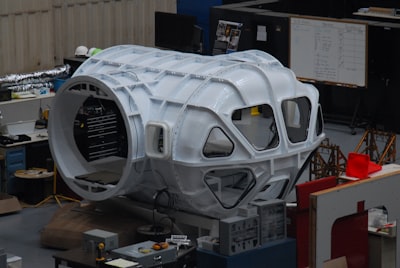
The energy demand of data centers is growing exponentially, driven by artificial intelligence, streaming, and global digitalization. In this context, a US startup has presented a 3D-printed nuclear reactor module that promises to supply emission-free electricity in a scalable manner. The device, based on thorium and with a silicon carbide core manufactured using additive manufacturing, is designed to operate for up to 30 years without refueling. This subcritical, solid-state technology eliminates meltdown risks, making it especially attractive for critical infrastructures such as data centers, military bases, or remote sites.
From a technical standpoint, the reactor uses TRISO particles that encapsulate the thorium fuel in ceramic and carbon layers, ensuring high thermal and chemical resistance. The gyroid geometry of the core maximizes the heat exchange surface, a design impossible to achieve with conventional methods that only 3D printing can materialize. The company expects the first generation unit to be available in 2027 and the complete nuclear module by 2030, subject to regulatory approvals. For data centers, which require constant and predictable energy, this solution could reduce dependence on the electrical grid and carbon emissions.
Behind these advances lies an ecosystem of software engineering and digital systems that enable reactor simulation, control, and monitoring. Companies like Q2BSTUDIO, specialized in technology development, offer custom applications to manage complex processes, from AI-assisted design to real-time sensor data analysis. The integration of AWS and Azure cloud services allows scaling the IT infrastructure needed to operate these systems, while artificial intelligence applied to fault prediction and proactive maintenance becomes a key ally in ensuring the reliability of modular nuclear plants.
Cybersecurity also plays a fundamental role: protecting control networks and operational data from cyberattacks is a priority in critical facilities. Therefore, cybersecurity and pentesting solutions help validate the robustness of these environments. Likewise, business intelligence services based on Power BI enable visualization of energy metrics, operational efficiency, and costs, facilitating strategic decision-making. The implementation of AI agents for automating responses to anomalous events raises the resilience level of infrastructures.
In short, the convergence of additive manufacturing of nuclear components and advanced software opens a new era for clean and decentralized energy. Companies like Q2BSTUDIO, with their expertise in custom software, artificial intelligence for businesses, and process automation, are well-equipped to accompany organizations in sectors such as energy in their digital transformation, ensuring that innovations like this 3D-printed nuclear reactor are integrated safely and efficiently into today's digital ecosystem.