
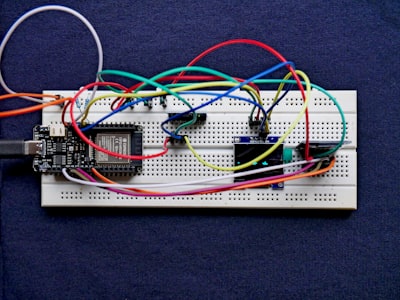
In a world where climatic and domestic unforeseen events are becoming more and more frequent, preparing the home with accessible technology has become a priority. The ESP32 microcontroller, thanks to its integrated WiFi and Bluetooth connectivity, low power and versatility, has positioned itself as the heart of countless home automation projects. But beyond mere automation, these systems can save lives, protect assets, and offer peace of mind. Below, we explore five projects with sensors that, using the ESP32, will allow you to anticipate the unexpected. Each of them not only demonstrates the power of this chip, but also opens the door to professional solutions where companies such as Q2BSTUDIO offer custom software development to integrate these sensors into more complex ecosystems.
The first project is a water leak detector. A humidity or conductivity sensor, connected to the ESP32, can be placed in critical areas such as basements, near washing machines or pipes. When an abnormal level is detected, the ESP32 sends an alert to the mobile and, if integrated with a motorized valve, automatically shuts off the water flow. This type of system, while simple, requires robust programming and efficient battery management. For professional applications, Q2BSTUDIO custom designs applications that not only notify, but store history in the cloud and allow complex rules to be configured. Artificial intelligence can even predict possible breakages by analyzing consumption patterns. All this runs on infrastructures such as AWS and Azure cloud services, guaranteeing high availability and security.
The second project is an indoor air quality monitor. Particulate matter (PM2.5, PM10), CO2, volatile organic compounds (VOCs) and temperature/humidity sensors, combined with ESP32, generate a real-time map of the health of the home. This is vital for people with allergies or asthma, and also for detecting ventilation problems. Data can be visualized in dashboards with Power BI or custom dashboards, which is a perfect example of business intelligence services. Q2BSTUDIO knows how to transform that raw data into actionable insights, creating AI agents that send personalized recommendations, such as opening windows when CO2 levels rise. In addition, cybersecurity is essential: these devices are entry points to the home network, so all communication must be encrypted and authenticated.
The third project addresses the early detection of fires. Ionic or photoelectric smoke sensors, along with carbon monoxide detectors, connect to the ESP32. In the event of an alarm, the system can turn off the boiler, turn on emergency lights, and send messages to multiple contacts. The advantage over commercial detectors is the possibility of integrating cheap thermal cameras that, through AI for companies, distinguish between cooking smoke and a real fire, reducing false alarms. Q2BSTUDIO has developed solutions where the ESP32 acts as a gateway to emergency response platforms, using AWS and Azure cloud services to scale without limits. Process automation here saves seconds that can be critical.
The fourth project is a natural gas and LPG sensor. With modules such as the MQ-2 or MQ-5, the ESP32 alerts you to flammable leaks. The interesting thing is that, in addition to the alarm, you can activate a relay to cut off the electricity supply (avoiding sparks) and open motorized windows. In industrial or commercial environments, these facilities are integrated with centralized management systems. Custom software allows the ESP32 itself to communicate with protocols such as MQTT or Modbus, and data to flow into business intelligence platforms. Q2BSTUDIO offers consulting to design these flows, ensuring that the information reaches those responsible in the right format, either in a mobile app or in a real-time dashboard.
The fifth project is a home weather station that measures barometric pressure, wind speed, rainfall and UV radiation. With this information, the ESP32 can automatically activate awnings, close blinds or water the garden before a storm. Local forecasting, combined with cloud-based weather models, enables advanced preparation. This is where AI agents come into play, which, by learning the weather patterns of the area, make autonomous decisions. Q2BSTUDIO implements these systems using bespoke applications that integrate sensor data with external APIs, all orchestrated under a robust cybersecurity umbrella. Scalability is key: what starts as a hobby can become a critical infrastructure control system for a company.
The key to taking these projects to the next level is not just in the hardware, but in the software layer that surrounds it. Q2BSTUDIO, with its expertise in AWS and Azure cloud services, artificial intelligence, and cross-platform application development, turns ideas into production-ready solutions. Whether it's for a smart home or an industrial facility, preparing for the unexpected starts with a reliable technological foundation. ESP32 sensors are the ear and eyes, but the brain and memory are in the software that governs them. Investing in professional development ensures that data is not only collected, but transformed into automated decisions that protect what matters most.
