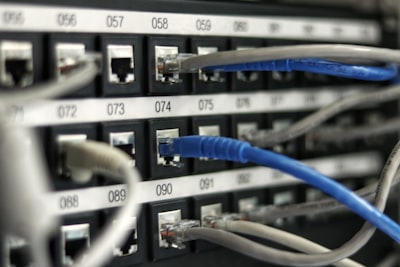
When we think of Ethernet, most of us associate it directly with an internet connection. It's true: plugging in a cable and having access to the global network is its most basic and well-known function. However, limiting Ethernet to that sole purpose is like using a smartphone just for calls. Behind that RJ45 connector lies an infrastructure capable of transforming the way businesses, industrial environments, and smart homes operate. In this article, we'll explore much deeper and more strategic uses of Ethernet cabling, from optimizing internal networks to integrating with cloud services, artificial intelligence, and cybersecurity. And, of course, we'll see how we Q2BSTUDIO leverage this technology to develop AWS and Azure cloud services that boost the performance of any organization.
The first major alternative use of Ethernet is the creation of high-speed local networks for massive data transfers. In many companies, internal traffic between servers, workstations, and storage devices far exceeds traffic to the Internet. Here, Ethernet enables speeds of 1 Gbps, 10 Gbps, or even more, without the interference or variable latency of Wi-Fi. This is crucial for applications that require low latency, such as real-time video editing, 3D simulation, or industrial control systems. In addition, by segmenting the network with VLANs, critical traffic can be isolated and security improved. For example, a surveillance system with multiple IP cameras may use a dedicated Ethernet subnet, preventing video from saturating the overall network. In this context, the custom applications we develop in Q2BSTUDIO integrate seamlessly with these topologies, allowing data flows to be managed efficiently and securely.
Another area where Ethernet shines beyond the internet is the industrial Internet of Things (IoT). Sensors, actuators, programmable logic controllers (PLCs), and robots communicate via industrial Ethernet (such as Profinet or EtherCAT) to ensure precise synchronization and reliability that Wi-Fi cannot offer. In a smart factory, every millisecond counts, and a wired network eliminates signal dropouts and fluctuations. Here, the combination of Ethernet with artificial intelligence makes it possible to analyse production data in real time, predict failures and optimise processes. Q2BSTUDIO develops custom software for these platforms, incorporating enterprise AI that runs both at the edge (edge computing) and in the cloud. In fact, our AI agents can be deployed on local servers connected by Ethernet, processing data without relying on internet latency.
Cybersecurity is another fundamental pillar. A well-designed Ethernet network allows for much more granular segmentation and access control policies than wireless networks. For example, separate networks can be created for guests, IoT devices, and critical systems, minimizing the attack surface. In addition, tools such as 802.1X (port-based authentication) ensure that only authorized devices can connect. At Q2BSTUDIO we offer cybersecurity and pentesting services to audit these configurations, identifying vulnerabilities in the wired infrastructure and in the applications that run on it. End-to-end security is key when handling sensitive data or integrating cloud services.
Precisely, connecting to the cloud is another strategic use of Ethernet. Although it may seem counterintuitive, many companies maintain direct links from their offices to cloud providers such as AWS or Azure using dedicated Ethernet connections (e.g., AWS Direct Connect or Azure ExpressRoute). This offers consistent bandwidth, low latency, and greater reliability than a standard internet connection. At Q2BSTUDIO, we design hybrid architectures that combine Ethernet on-premises networks with AWS and Azure cloud services, enabling custom applications to communicate seamlessly with databases, AI services, or cloud storage. In addition, we integrate business intelligence services such as Power BI so that real-time data feeds corporate dashboards accessible from any Ethernet-connected workstation.
Case in point: In a logistics company, we installed an Ethernet network with managed switches connecting sorting sensors, on-premises servers, and a dedicated connection to Azure. On top of this infrastructure, we deployed a custom software system that uses artificial intelligence to optimize routes and predict demand. Data is processed at the edge using AI agents and then synced to the cloud for historical analysis. All of this runs on top of Ethernet, ensuring that there are no packet losses or delays. Integration with Power BI allows managers to visualize key indicators in real-time, all from the same wired network.
Another lesser-known use is desktop virtualization (VDI). With Ethernet, thin clients can connect to remote servers with a near-native experience, ideal for environments where mobility is needed within a building but with the security of a wired connection. Here, the low latency of Ethernet is vital for smooth interaction with the virtual desktop. Q2BSTUDIO has developed virtualization solutions that combine Azure cloud services with on-premises Ethernet networks, offering virtual desktops with Power BI and other productivity tools.
We cannot forget the field of home automation and smart buildings. HVAC systems, lighting, access control and environmental sensors are increasingly connected via Ethernet Power over Ethernet (PoE), which transmits data and electricity over the same cable. This simplifies installation and allows devices such as cameras, Wi-Fi access points, or sensors to be powered directly. In addition, being on a wired network makes control and monitoring safer and more reliable. At Q2BSTUDIO we design management platforms for these systems, incorporating artificial intelligence to optimize energy consumption and safety.
Finally, Ethernet is also the foundation of storage networks (SANs) and high-performance computing clusters. While Fibre Channel has been traditional, Ethernet with protocols such as iSCSI or NVMe-oF allows you to build high-speed shared storage at a lower cost. This is essential for AI applications that need large volumes of data that are quickly accessible. Q2BSTUDIO deploys server clusters with 25 Gbps or 100 Gbps Ethernet connections, on which we deploy AI agents for model training and massive processing.
In short, Ethernet is much more than just an internet cable. It is the backbone of modern connectivity, capable of supporting everything from IoT applications to cloud services, including cybersecurity, artificial intelligence and business intelligence. At Q2BSTUDIO we understand this versatility and leverage it to offer end-to-end solutions: from custom applications to AWS and Azure cloud services, enterprise AI and cybersecurity. If you want to take your Ethernet infrastructure to the next level, we invite you to explore how we can help you transform your network into a platform for innovation.