
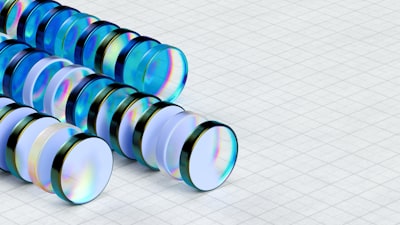
The design of multilayer optical coatings has historically been a craft process, where expert engineers manually adjust thicknesses and materials to achieve specific spectral properties. However, the growing demand for customized optical devices—from color filters to solar reflectors—has driven the search for more efficient automated methods. In this context, a new generation of techniques based on artificial intelligence has emerged that promises to revolutionize the sector: reverse design through discrete-continuous flow.
Recently, researchers have developed a framework called IrisFlow, capable of generating optical coating architectures from specifications given at the time of consultation. Unlike traditional machine learning methods, which operate on fixed vocabularies and predefined grids, IrisFlow allows the user to define on the spot both the target spectrum and the list of candidate materials, the number of layers and even the base of wavelengths. This makes it an open-ended vocabulary tool that does not require retraining for new materials or conditions.
The approach combines two types of flow: a discrete flow to select the sequence of materials from a candidate bank, and a continuous flow to determine the thicknesses of each layer without the need for prior discretization. In this way, one of the most common limitations in sequential models is eliminated, where continuous variables are converted into discrete tokens losing precision. The model, with only 136 million parameters, is capable of designing from 2 to 100 layers, covering a range of applications ranging from precision optics to architectural coatings.
The experimental results are promising: the system faithfully reconstructs targets within the training distribution, maintains accuracy on a bank of 15 materials not seen during learning, and extends its capability up to 1100 nm wavelengths outside its training envelope. What's more, when optical indices are calibrated with a true deposition process, IrisFlow designs four color devices—made by ion-assisted evaporation—that achieve color errors CIEDE2000 between 3.1 and 5.2, while retaining 93% to 95% reflectance in the solar near-infrared.
This breakthrough not only demonstrates the viability of discrete-continuous flow reverse design, but also opens the door to a new way of understanding artificial intelligence for companies in the optical and materials industry. The ability to adapt the model to new materials and specifications without retraining drastically reduces development times and allows you to explore configurations that were previously unthinkable.
However, the practical implementation of these solutions requires a robust and scalable software infrastructure. This is where companies like Q2BSTUDIO add value. With expertise in custom applications, they offer the technology support needed to integrate AI models like IrisFlow into industrial workflows. From creating collaborative design platforms to optimizing manufacturing processes, custom software becomes the bridge between academic research and actual production.
In addition, the computationally intensive nature of these models demands AWS and Azure cloud services to train and deploy flows efficiently. Q2BSTUDIO has experience in cloud architectures that guarantee scalability, security and low operating cost. Cybersecurity also plays a crucial role, especially when handling sensitive intellectual property data or technical specifications; therefore, protection measures are implemented at each layer of the system.
Beyond optical design, the discrete-continuous flow methodology can be applied to other domains where categorical and continuous variables are combined, such as the selection of composite materials or the configuration of electronic devices. AI agents learning to navigate these design spaces autonomously are transforming research and development across multiple industries.
For companies that want to take advantage of these technologies, having a technological ally that offers business intelligence and data analysis services is essential. Tools such as Power BI allow you to visualize the results of inverse designs, monitor model performance, and make data-driven decisions. Q2BSTUDIO integrates these capabilities into complete solutions ranging from data capture to executive reporting.
In conclusion, the reverse design of discrete-continuous flow optical coatings represents a milestone in the application of artificial intelligence to materials engineering. Its ability to adapt to varying specifications makes it an ideal tool for rapid innovation environments. To bring these advancements to market, an enterprise AI ecosystem is required that combines advanced models with cloud infrastructure, cybersecurity, and business analytics. Companies like Q2BSTUDIO are ready to accompany this path, offering comprehensive technological solutions that turn the promise of AI into industrial reality.
.jpg)

.jpg)
.jpg)