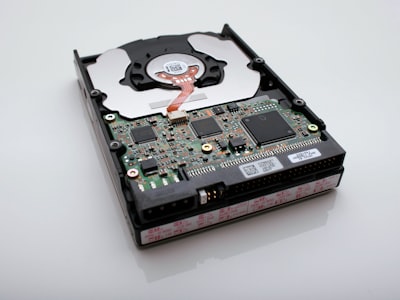
In the world of data storage, there is a widespread belief that the simplest way to get an external hard drive is to go to a store and buy one already assembled. However, for those looking for maximum value for money, the most economical and often most efficient option is to build it yourself. This alternative, which consists of purchasing a hard drive chassis or enclosure and installing an internal drive in it, allows you to save money, customize the capacity and choose higher quality components. But beyond the domestic sphere, this philosophy of self-construction has interesting parallels in the business world, where the optimization of resources and customization are key. Companies such as Q2BSTUDIO, which specialise in software and technology development, understand that tailoring tailor-made solutions is essential to achieve operational efficiency.
The first step to understanding why assembling your own external hard drive is cheaper than buying it is to analyze the costs. A commercial external hard drive includes the cost of the chassis, cable, power supply (if required), and a profit margin for the manufacturer and distributor. By purchasing a separate internal unit and enclosure, you eliminate several of those margins. In addition, you can choose a higher quality or higher speed drive (such as an NVMe SSD) that is often not available on pre-configured external models. This is especially relevant for professionals who handle large volumes of data, such as designers, developers or data analysts. In fact, many companies that use AWS and Azure cloud services also need local storage for backups or to work with sensitive data without relying exclusively on the cloud.
Building an external drive does not require advanced knowledge. Simply select a compatible enclosure (USB 3.2, Thunderbolt, etc.) and an internal hard drive or SSD. Mounting usually involves sliding the unit into the chassis and connecting the cable. Although it may seem like a trivial operation, it involves a basic understanding of interfaces and transfer speeds. This knowledge is similar to what is needed to design a company's storage infrastructure. For example, if an organization decides to deploy a hybrid storage system (on-premises and cloud), it must evaluate which data resides on-premises and which resides in the cloud, and how to synchronize it securely. This is where applications come into play as Q2BSTUDIO developed to automate data backup, replication, and management processes.
From a technical perspective, mounting your own external drive also allows you to choose the most suitable type of storage for each use. For tasks that require high read and write speeds, such as video editing or running virtual machines, an external SSD built with an NVMe disk and a Thunderbolt enclosure offers superior performance to most commercial external disks. For mass file storage, a high-capacity HDD in an inexpensive enclosure is unbeatable in cost per terabyte. This flexibility is analogous to that offered by business intelligence solutions: there is no one-size-fits-all. With Power BI and other tools, companies can tailor their dashboards to their specific needs, just as a user can adapt their external drive.
Another aspect to consider is security. Commercial external hard drives often include basic encryption software or no protection at all. By mounting your own device, you can implement stronger security measures, such as full disk encryption using BitLocker or LUKS, or even combine local storage with professional cybersecurity solutions. In the business environment, data protection is critical. Q2BSTUDIO offers pentesting and security auditing services to ensure that both on-premises and cloud storage meet the highest standards.
But the economics of building your own external drive go beyond the initial savings. There is also a long-term benefit: the possibility of reusing components. When an internal hard drive fails or becomes obsolete, the drive can be replaced without having to dispose of the entire chassis. This not only reduces e-waste, but also allows the capacity or speed to be progressively upgraded. This philosophy of modularity and sustainability is increasingly valued in the technology sector. Companies that adopt flexible infrastructure strategies, such as those offered by Q2BSTUDIO with its cloud solutions and custom software, are able to scale their operations without incurring unnecessary fixed costs.
In today's context, where artificial intelligence is transforming data management, efficient storage is key. AI agents and other AI-based tools can analyze storage usage patterns to predict when more capacity will be needed, automate data migration between on-premises disks and the cloud, or even detect anomalies that indicate a risk of hardware failure. Q2BSTUDIO develops AI for enterprises that integrate these capabilities, enabling organizations to dynamically optimize their storage resources.
Returning to the home user, the decision to mount an external hard drive is not only economical, but also educational. It allows you to better understand how storage works and what the limitations of the interfaces are. This knowledge is transferable to professional settings. For example, when designing a backup system for a small business, the same principles can be applied: choose appropriate disks, configure redundancy (RAID), and set rotation policies. It can even be combined with cloud solutions to have an off-site copy. Here, AWS and Azure cloud services offer scalable storage (S3, Blob Storage) that can be synchronized with a local disk using scripts or custom-developed applications by Q2BSTUDIO.
The apparent simplicity of an external hard drive hides a technical complexity that, if well managed, can bring great benefits. It is not just a matter of savings, but of control and customization. And in the business world, that customization is what makes the difference between a generic infrastructure and one that truly adapts to business processes. Q2BSTUDIO, with its expertise in process automation and custom software development, helps companies design storage solutions that integrate both on-premises devices and cloud services, all under the highest standards of security and efficiency.
In conclusion, the cheapest way to have an external hard drive is not to buy it, but to build it. This practice not only reduces costs, but also provides valuable knowledge about the hardware and allows for customization that commercial products do not offer. For companies, the lesson is even deeper: resource optimization and tailor-made adaptation are strategies that, when applied to data storage and management, generate competitive advantages. Companies like Q2BSTUDIO are prepared to accompany this process with services ranging from custom software development to the implementation of business intelligence and AI solutions for companies. Because, in the end, the best investment is the one that fits exactly what you need.