
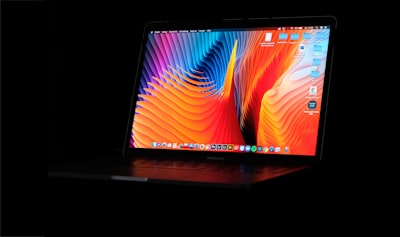
In a world where efficiency and convenience set the tone for technological development, more and more tools are emerging that seek to reduce friction between the user and the machine. One such recent innovation allows you to scroll content on the screen by simply tilting your head, without touching the trackpad, mouse, or touchscreen. Although it may sound like science fiction, it is a native application for macOS that uses the motion sensors integrated in headphones such as the AirPods Pro or Beats Fit Pro to convert cephalic gestures into scrolling commands. This functionality, although seemingly simple, opens up a range of possibilities that goes far beyond summer laziness: from accessibility to productivity in environments where hands are busy.
The idea of controlling a computer with head movements is not new; There are systems based on artificial vision or external sensors, but the revolutionary thing here is the direct integration with mass consumption hardware. Modern headphones incorporate high-precision gyroscopes and accelerometers, and this app leverages them to detect up or down tilts, generating a smooth and customizable scroll. The user can adjust the sensitivity, acceleration and even the direction of the scroll, adapting it to their preferences. There's even a mode that pauses the function in one swift motion, preventing accidental triggers while reading or working.
From a technical perspective, these types of solutions are an excellent example of how bespoke software can transform an everyday device into an innovative interface. At Q2BSTUDIO, we understand that the key is not just in the idea, but in the precise implementation and optimization of performance. Developing applications that interact with hardware sensors requires in-depth knowledge of operating system APIs, efficient latency management, and fatigue-free user experience design. Our team of engineers regularly works on projects where artificial intelligence and signal processing are combined to create natural interfaces, whether for wearable devices, augmented reality or industrial environments.
But beyond personal convenience, the true potential of this technology lies in its business application. Let's imagine a logistics warehouse where operators wear smart helmets and need to consult documents without letting go of the tools; or a surgeon who, during an operation, reviews medical images without contaminating his gloves. In these scenarios, a hands-free navigation system based on head gestures increases safety and efficiency. This is where the AWS and Azure cloud services we offer at Q2BSTUDIO come into play, as the information queried can reside in the cloud, be synchronized in real time, and protected through end-to-end cybersecurity. Such an application could connect to a serverless backend, use distributed databases, and employ AI agents to anticipate user needs, offering contextual suggestions as they scroll through a technical manual or sales report.
Accessibility is another fundamental pillar. People with reduced upper limb mobility or with disorders such as carpal tunnel syndrome can benefit greatly from not having to use a mouse or trackpad. Although the original creator of this app didn't think of it as an accessibility tool, the community has proven its value. At Q2BSTUDIO, we believe that technology should be inclusive by design. That's why, when developing custom applications, we incorporate universal design principles and testing with diverse users. AI for business can help personalize the experience: for example, a computer vision system that detects user fatigue and automatically adjusts scroll sensitivity.
Integration with data analytics platforms is also relevant. If a company deploys this type of in-house solution, usage data can feed into power bi dashboards to identify behavior patterns, measure productivity, or detect bottlenecks. At Q2BSTUDIO we offer business intelligence services that allow us to transform that data into strategic decisions. For example, an operations manager might see that employees who use tilt scrolling reduce time on document query tasks by 15%, thus justifying the investment in compatible equipment.
The evolution of these interfaces leads us to think about a future where gestures, voice and even eye movements are combined to create a multi-channel interaction. AI agents will act as intelligent intermediaries, interpreting user intent and executing complex actions. At Q2BSTUDIO we are developing prototypes that unite gesture recognition with conversational assistants, all on scalable and secure cloud infrastructures. Cybersecurity is not an add-on, but a requirement from the first line of code, especially if the application handles sensitive data or integrates with corporate systems.
While the app discussed is free today, it is likely to evolve into freemium or paid models. In the business environment, having custom software ensures that functionality is exactly adapted to internal processes, avoiding dependencies on third parties. At Q2BSTUDIO we help companies design and build these types of solutions, from requirements capture to production deployment. Our approach combines agile methodologies with deep technical knowledge in cross-platform application development, allowing you to reach end users on different devices (macOS, iOS, Windows) with a consistent experience.
The lesson from this innovation is that great ideas often arise from everyday and seemingly trivial needs. The desire to read a document while holding an iced coffee led to a solution that is now being adopted by people with disabilities, remote workers, and productivity enthusiasts. In the business world, where every second counts, small automations like this can have a significant impact. That's why at Q2BSTUDIO we encourage experimentation and technical creativity. If your organization is exploring ways to improve human-machine interaction, we invite you to consider the potential of gesture and sensor-based interfaces. Whether it's through advanced artificial intelligence or simply by optimizing existing processes, the path to efficiency is full of opportunities yet to be discovered.
In short, summer can be an excuse to relax, but also to get inspired. The technology that allows us to move around by tilting our heads is just one example of how innovation can be born from observing our own habits. At Q2BSTUDIO, as a software and technology development company, we are committed to helping our customers turn those observations into robust, scalable, and secure solutions. Because, in the end, the best technology is the one that adapts to us, and not the other way around.
.jpg)
.jpg)
.jpg)
.jpg)