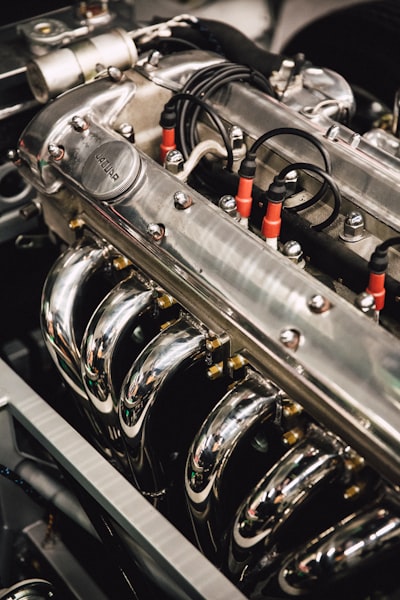
In the automotive industry, engine quality is a determining factor for customer satisfaction and vehicle safety. During hot tests on production lines, engine sound analysis has become a key technique for detecting anomalies. However, the factory environment is full of background noise: nearby machinery, ventilation systems, conveyors, and other acoustic sources that pollute the engine signal. This makes it difficult for technicians, who traditionally rely on their trained ear to identify problems such as knocking, vibration or wear. Unfortunately, this method is subjective and error-prone, especially when fatigue or ambient noise variability works against it.
To overcome these limitations, artificial intelligence has emerged as a transformative tool. In particular, deep neural networks have demonstrated an outstanding ability to separate sound sources, eliminating unwanted noise and leaving the signal of interest intact. A notable advancement in this field is the U-Net architecture, originally designed for image segmentation, but which has been successfully adapted to audio processing. The U-Net, with its encoder-decoder structure and jump connections, allows clean signals to be reconstructed from noisy mixes. The key is that the encoder extracts hierarchical features from the noisy input, while the decoder uses them to generate a clean output, using the jump connections to preserve fine details that would otherwise be lost in compression.
The RAB-U-Net variant introduces residual care blocks that reinforce this capacity. A residual attention block combines attention mechanisms that weigh the importance of each characteristic, with residual connections that facilitate deep network training. In practice, these blocks allow the network to focus on the harmonic components of the engine and suppress frequencies from background noise more effectively. Experiments show that the RAB-U-Net achieves a multi-decibel improvement in the signal-to-noise ratio compared to the standard U-Net, resulting in more accurate anomaly detection.
This technology is not limited to the automotive sector. In the aircraft industry, jet engines also generate complex acoustic patterns, and the same architecture can be applied to filter out noise from the test track. In the manufacture of household appliances, the sound analysis of compressors or electric motors also benefits from robust signal cleaning. The versatility of deep learning models allows them to be adapted to different frequencies and types of noise, as long as representative training data is available.
From a business perspective, the implementation of these systems requires a comprehensive technology ecosystem. It is not enough to have an advanced algorithm; It needs to be integrated with audio acquisition hardware, real-time storage and processing systems, user interfaces, and maintenance protocols. This is where companies like Q2BSTUDIO bring their expertise to the table. We offer services for the development of custom applications that allow these models to be deployed in industrial environments, from audio capture to the visualization of results on control panels. In addition, our tailor-made software solutions are tailored to the specific needs of each customer, whether it is an automotive production line or an appliance plant.
The underlying infrastructure is also critical. AWS and Azure cloud services provide the scalability needed to process large volumes of acoustic data, train models with GPUs, and deploy inference at the edge or in the cloud. At Q2BSTUDIO, we help companies design cloud architectures that balance performance and cost. For example, you can store your audio in AWS S3, process it with Spot Instances to reduce training costs, and deploy your final model to edge devices with Azure IoT Edge. All this with the necessary cybersecurity guarantees, since production data is sensitive and must be protected against unauthorized access and cyberattacks. Our cybersecurity services include security audits, pentesting, and regulatory compliance advice.
Once the diagnostic data is clean, the next step is to turn it into actionable insights. This is where business intelligence comes into play. Tools such as Power BI allow you to create interactive dashboards where quality engineers can visualize trends, correlate defects with production parameters, and generate automatic alerts. At Q2BSTUDIO we offer business intelligence services ranging from the creation of data models to the implementation of complete reporting solutions. Our Power BI experts help businesses unlock the full potential of their data, connecting diverse sources and designing relevant metrics.
The future points towards autonomous systems where AI agents not only detect anomalies, but also act on them. For example, an agent could adjust production line parameters in response to anomalous sound patterns, closing the control loop. This is one of the areas that is evolving the most in Industry 4.0. At Q2BSTUDIO, we develop custom AI agents that integrate with existing control systems, using technologies such as process mining or robotic automation. In addition, our artificial intelligence services for companies cover everything from consulting to the implementation of state-of-the-art models.
Of course, each industry has particular needs. Not all production lines are created equal, and a generic model may not work optimally. That's why we offer a customized approach: we analyze the acoustic data of each customer, design network architectures such as the RAB-U-Net and train them with their own examples. In addition, we integrate these solutions with your existing infrastructure, whether on-premise or in the cloud. Our multidisciplinary team includes audio engineers, data scientists, and software developers.
In conclusion, noise removal in engine sound analysis using RAB-U-Net is a clear example of how artificial intelligence can transform industrial processes. The combination of deep learning, cloud computing and business intelligence allows us to achieve levels of precision that were previously unthinkable. For companies looking to make the leap to smart production, having a technology partner like Q2BSTUDIO makes all the difference. Our comprehensive approach ranges from custom software to cybersecurity, automation and data analysis. The future of automotive diagnostics is quiet, in a good way: engines will speak clearly, and we'll be ready to listen to them.