
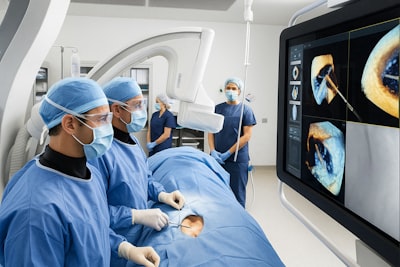
In the field of minimally invasive robotic surgery, the real-time three-dimensional reconstruction of deformable tissues represents one of the most complex and promising challenges. Current systems, based on Gaussian Splatting, have demonstrated exceptional reconstruction quality, but their reliance on precise camera trajectories obtained from robotic kinematics limits their use in scenarios where such information is noisy or non-existent. Faced with this limitation, Track2Map emerges, an inline deformable SLAM approach that jointly optimizes the camera path and the deformable representation of the scene directly from the surgical video, eliminating the need for external priors.
The core innovation of Track2Map lies in its ability to operate as a simultaneous localization and mapping (SLAM) system without requiring robot kinematics data. This is made possible by a strain initialization anchored in tracks of dense 2D dots, which stabilizes the optimization process even in the presence of tissue movement and ambiguous visual cues. In addition, the system uses statistics from such tracks to separate camera movement from scene deformation, detecting periods of static camera and reducing drift during incremental mapping.
From a technical perspective, Track2Map represents a significant advance because it addresses two fundamental problems in robotic-assisted surgery: the need for precise reconstructions without relying on external sensors and the ability to work in real time. In the context of an operating room, where tissues are constantly moving due to breathing or heartbeat, having a system that can adapt and correct its own error is crucial. The results obtained in benchmarks such as StereoMIS show an improvement in the quality of the reconstruction and in the estimated trajectory compared to competing SLAM methods, and even surpass non-SLAM approaches that do use trajectory priors.
This type of development not only has an impact on the surgical field, but also opens the door to new applications in fields such as autonomous robotics, navigation in unstructured environments and augmented reality. The ability to perform in-line deformable SLAM is especially valuable in environments where the environment changes dynamically, such as in industrial inspection or human-robot interaction.
For companies working in advanced technology sectors, implementing solutions like Track2Map requires deep knowledge in computer vision, machine learning, and numerical optimization. This is where a specialized technology partner makes a difference. At Q2BSTUDIO, we are experts in developing bespoke applications that integrate artificial intelligence and computer vision to solve complex problems. Our team can design customized SLAM systems, tailored to the specific needs of each customer, whether in the healthcare, industrial, or service sectors.
Creating deformable 3D models in real time requires a robust and scalable infrastructure. AWS and Azure cloud services facilitate distributed processing of large volumes of video data, as well as the deployment of AI models in low-latency environments. At Q2BSTUDIO, we offer AWS and Azure cloud services that ensure the availability and performance needed for surgical applications in real time. In addition, cybersecurity is a fundamental pillar when handling sensitive patient data; Our cybersecurity solutions protect both infrastructure and transmitted information.
Beyond 3D reconstruction, extracting knowledge from the data generated by these systems is a key enabler. Business intelligence allows correlating surgical parameters with clinical results, optimizing protocols. At Q2BSTUDIO we develop interactive dashboards with Power BI that visualize performance and reconstruction quality metrics, helping medical teams make informed decisions. We also integrate AI agents that automate the detection of anomalies during surgery, improving patient safety.
The future of robotic surgery lies in increasingly autonomous and adaptive systems. Track2Map is an example of how the combination of SLAM techniques, neural networks and online optimization can overcome current limitations. However, bringing this technology into clinical practice requires more than algorithms – it needs careful orchestration of software, hardware, and data. Companies like Q2BSTUDIO, with experience in AI for companies, are prepared to accompany you on this path, from proof of concept to deployment in real environments.
In conclusion, Track2Map not only solves a specific technical problem, but illustrates a broader trend towards perception systems that learn and adapt in real time. Collaboration between research centers and software development companies is essential to transform these academic advances into practical solutions. Whether your organization is looking to implement similar technologies or needs custom software to automate complex processes, we Q2BSTUDIO have the knowledge and experience to make it happen.
.jpg)
.jpg)
.jpg)
.jpg)