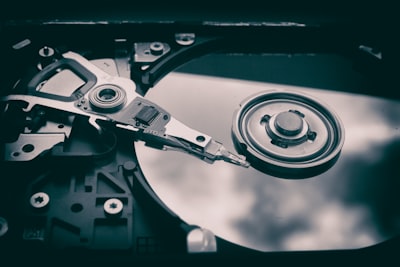
In many offices and homes, it's common to find old hard drives gathering dust in a drawer. The temptation to reuse them as 'free' storage is strong, but the reality is that those devices can become a trap for your data. Businesses, especially, can't afford to lose critical information by relying on outdated hardware. Below, we look at six key statistics that prove why you should think twice before putting your trust in an old hard drive.
Annual failure rate after 3-5 years: According to reports from data centers such as Backblaze, the annual failure rate (AFR) of hard drives increases dramatically from the third year onwards, exceeding 10% in the fifth. This means that, statistically, one in ten discs will fail within twelve months. For a company, losing one in ten backups is not acceptable. That's why many organizations choose to migrate their storage to robust platforms such as AWS and Azure cloud services, where redundancy and availability are guaranteed by SLAs.
60% of failures occur without warning: Contrary to what many believe, hard drives don't always emit strange noises or display SMART warnings before collapsing. In fact, a study by Carnegie Mellon University revealed that most catastrophic failures are sudden. Relying on an old disc implies taking a blind risk. Companies that handle sensitive data should implement advanced protection measures, such as those offered by Q2BSTUDIO in their cybersecurity area, including encrypted backups and continuous monitoring.
Broken bit data degradation: Magnetic hard drives suffer from a phenomenon known as bit rot or magnetic bit degradation over time, especially if they remain without power for months or years. Sectors can become unreadable, corrupting files without the user noticing until they try to access them. This is especially dangerous when it comes to historical data used in business analytics, such as that processed with business intelligence tools such as power BI. If that data comes from an old HDD, the report could be based on corrupted information. To avoid this, Q2BSTUDIO recommended to keep data on active systems with regular integrity checks.
Exorbitant recovery costs: Recovering data from a hard drive that has physically failed can cost between 500 and 3000 euros, depending on the severity of the damage and the urgency. In contrast, an annual subscription to an enterprise cloud service with automated backups costs a fraction of that amount. In addition, companies that develop custom applications or custom software often need development and test environments that rely on reliable data. Betting on old disks to store versions of code or databases is a recipe for disaster. Investing in modern solutions is much more cost-effective in the long run.
Performance limited by outdated interfaces: Hard drives older than five years typically use IDE or SATA 2 interfaces, with maximum transfer speeds of 133 MB/s or 300 MB/s, respectively. By comparison, modern SSDs and NVMe connections multiply those numbers tenfold or more. This bottleneck directly affects the performance of applications that require fast access to large volumes of data, such as AI-based solutions or AI agents. Enterprises that deploy enterprise AI need low-latency storage to train models and serve real-time inferences. Using an older HDD for these tasks is unfeasible. Q2BSTUDIO helps organizations design data architectures that leverage the latest in cloud storage and hybrid systems.
Uncorrectable Read Errors on Old Disks: A Google study of hard drive failures found that, after five years, 30% of drives exhibit uncorrectable read errors (UNC). This means that certain sectors are permanently unreadable, and the data stored there is lost forever. For any business that manages critical, financial, or customer information, this is a scary statistic. The business intelligence services platforms that Q2BSTUDIO deploys for its customers rely on enterprise storage with redundancy and fault tolerance, ensuring that no data is lost.
In short, relying on old hard drives is a gamble that is not worth it. Statistics show that reliability decreases dramatically over time, hidden costs are high, and performance is insufficient for today's demands. The sensible alternative is to adopt a modern storage strategy, whether through the cloud, hybrid systems, or specialized software solutions. At Q2BSTUDIO, as a software and technology development company, we offer advice and tools for your organization to protect its data in an efficient and scalable way. Don't let a hard drive left in a drawer put your business at risk.