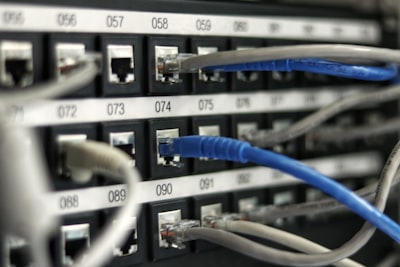
The transition to faster home and business networks is creating more headaches than immediate benefits. The 2.5GbE standard, born as a bridge between the veteran Gigabit Ethernet and the still expensive 10GbE, promised to double the bandwidth without requiring specialized cabling. However, the reality is a puzzle of incompatibilities, poorly designed hardware, and hasty business decisions that end up confusing users. Far from being a simple upgrade, the 2.5GbE ecosystem has become a testing ground where manufacturers launch products without testing their interoperability, generating chaos that only companies with true experience in technology integration can successfully navigate.
The central issue is not the technology itself, but the way it has been implemented. While the IEEE 802.3bz specification clearly defines 2.5 and 5 Gbps speeds over Cat5e wire, commercially available chipsets, controllers, and switches present subtle but critical differences. A switch from one brand may not properly negotiate speed with a network card from another, or worse, some ports labeled as 2.5GbE work only in 1GbE mode if a specific cable is not used. This clutter is compounded by the proliferation of USB adapters that promise 2.5GbE but in practice overheat or lose packets under sustained load. The urgency to bring products to market has taken precedence over quality and compatibility, leaving users with half-baked solutions that don't solve the real bottlenecks.
To understand the magnitude of the chaos, it is useful to analyze the context of use. In a home with multiple devices consuming 4K content, video conferencing, or downloading large files from a NAS, a 2.5GbE link to the router can make all the difference. However, if the router has only one port at that speed and the rest at 1GbE, traffic to slow devices is still congested. In the business world, the situation is even more critical. Small businesses that are migrating their workloads to the cloud, for example, using AWS and Azure cloud services, need an on-premises network that can handle backups, file synchronization, and database access without latency. A misconfigured 2.5GbE switch can lead to more problems than solutions, especially if you don't have proper monitoring software.
That's where the need for bespoke applications to diagnose and manage these hybrid environments comes into play. It's not enough to buy new hardware; You need to understand how data flows interact with existing infrastructure. A company that uses business intelligence services such as Power BI to analyze its network performance metrics will be able to identify bottlenecks that the human eye does not perceive. Combined with artificial intelligence and AI agents that learn traffic patterns, it is possible to adjust priorities and avoid saturation. Q2BSTUDIO, as a firm specializing in software and technology development, offers solutions that integrate cybersecurity at every layer of the network, protecting sensitive data traveling at 2.5 Gbps. Because a faster network is also a bigger attack vector if access points are not shielded.
Another aspect that aggravates the chaos is the lack of standardization in management systems. Manufacturers such as Realtek, Intel or Aquantia have their own configuration tools, and rarely dialogue with each other. A user who builds a PC with a motherboard that includes 2.5GbE from one manufacturer and then adds a PCIe card from another may find that the operating system does not properly recognize both interfaces. The solution is to develop custom software that unifies control, or to resort to specialized network operating systems. At Q2BSTUDIO we help companies design AI for companies that automate incident detection, reducing downtime and improving the end-user experience. It's not just about installing a switch, it's about creating an intelligent ecosystem.
The immediate future of on-premises networking points toward 5GbE and even 10GbE, but today's rushed hardware is sowing distrust. Many users who invested in 2.5GbE devices feel cheated when they find that their actual performance does not even reach a stable 2 Gbps. Lab tests with bulk transfer applications reveal speed drops and latency spikes that destroy the user experience. On the other hand, a well-planned network, even if it uses Gigabit Ethernet technology, can be more reliable than a poorly assembled 2.5GbE. The lesson is clear: speed isn't everything if the foundation isn't solid.
For companies that can't afford to experiment, the recommendation is to work with technology partners who understand both hardware and software. Integrating AWS and Azure cloud services with high-performance on-premises networks requires deep analysis of data patterns. In addition, cybersecurity must be present by design, especially when handling critical data. Q2BSTUDIO offers pentesting and network auditing services to ensure that every 2.5 Gbps hop is secure. And beyond that, the possibility of implementing AI agents that monitor traffic in real time and make autonomous routing or prioritization decisions.
In conclusion, 2.5GbE is not a bad technology, but its adoption is being torpedoed by an industry that prioritizes time-to-market over quality. The chaos will only be solved when manufacturers collaborate on open interoperability standards and when users demand complete solutions, not simple components. Until then, the best strategy is to surround yourself with experts who turn chaos into order. At Q2BSTUDIO we are prepared to design and implement networks that really work, using custom applications, business intelligence and cloud computing so that speed is not an issue, but a competitive advantage.