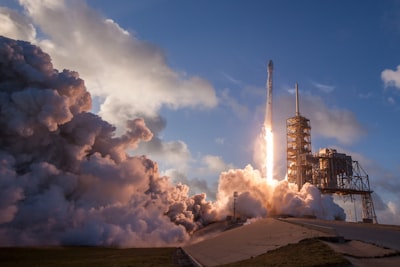
The development of reusable rockets has gone from a sci-fi dream to a tangible reality that redefines space exploration. SpaceX, with its Starship spacecraft and Super Heavy booster, is at the forefront of this transformation. After test flight number 12, which left important lessons on engine ignition dynamics and the reliability of control systems, the company is preparing for flight 13, scheduled for July 16. This mission will not only test technical improvements, but will also carry 20 next-generation Starlink satellites on board, marking a milestone in the integration between launch vehicle and orbital constellation.
Starship Flight 13 is much more than a repeat: it represents a testbed for technologies that will one day take humans to Mars and enable the deployment of global communications infrastructure. From a technical perspective, one of the most interesting aspects is the modification in the starting sequence of the Raptor engines to avoid the directional turn failure suffered by the Super Heavy booster in the previous flight. SpaceX has implemented hardware and software changes to make the ignition more robust against timing variations. These types of adjustments are similar to those that any technology company faces when scaling a product: the difference between a system that works in the laboratory and one that operates reliably in extreme conditions is precisely continuous iteration and data analysis.
For companies developing software and technology, the challenges SpaceX solves offer valuable lessons. Real-time telemetry management, autonomous in-flight decision-making, and coordination of multiple redundant systems are issues that also appear in industrial and business environments. For example, the need to process large volumes of sensor data to predict failures motivates the use of artificial intelligence and AI agents capable of adjusting parameters on the fly. Similarly, the cybersecurity of control systems is critical, as an attack on the chain of command could have catastrophic consequences. In this context, Q2BSTUDIO's expertise in cybersecurity and AWS and Azure cloud services is especially relevant for companies looking to protect their critical operations.
The mission also includes an interesting experiment: six of the satellites carry cameras to inspect Starship's heat shield, and some tiles have been painted white to simulate absences. This type of testing with embedded instrumentation is reminiscent of the Internet of Things solutions and applications that many companies deploy to monitor assets. Instead of sending a technician to check a solar panel or turbine, sensors and cameras connected to cloud platforms are installed that analyze images and alert on anomalies. Q2BSTUDIO has developed custom software for this type of deployment, combining image analysis with AI models to detect defects before they become failures.
From a business perspective, Flight 13 also illustrates the importance of risk management and rapid iteration. The FAA closed the investigation of Flight 12 by accepting SpaceX's corrective actions, which included changes to hardware and software configurations. This continuous improvement methodology can be transferred to any organization that develops technological products. It's not just about fixing a bug, it's about understanding the root causes—such as thermal effects on propulsion components or erroneous thresholds on alarms—and redesigning the system to be more forgiving. In the world of business intelligence, for example, a poorly configured Power BI dashboard can lead to incorrect decisions; That is why Q2BSTUDIO offers business intelligence services that guarantee the reliability of data and alerts.
Another highlight is the strategy of deploying satellites on a suborbital trajectory, which involves the 20 satellites re-entering the atmosphere just 20 minutes after being released. This may seem like a waste, but it's actually a deliberate test to validate the ability for laser separation and communication between satellites before their destruction. It's a brave approach reminiscent of proofs of concept in AI development for enterprises: sometimes you need to sacrifice a prototype to get data to validate the final design. Companies that adopt this mindset reduce the risk of costly failures in production.
The reuse of the booster and the ship is still in the experimental phase; neither the propeller nor the Starship will be recovered on this flight. However, the long-term goal is to achieve precise and re-ignited landings in space that allow orbital and lunar missions. To do this, SpaceX needs to demonstrate the reignition of a Raptor engine in space, which is essential to meet NASA's requirements on Artemis. This technical challenge parallels the one companies face when integrating AI agents into their processes: it's not enough to train a model, you have to deploy it in a real environment and ensure that it works autonomously and securely. Q2BSTUDIO helps its customers bridge the gap between prototype and production with AWS and Azure cloud services that scale and monitor models.
In short, Starship Flight 13 is an event that transcends space exploration. It reminds us that technological innovation is an iterative process where every failure is an opportunity to learn. Companies that adopt this philosophy, relying on technology partners such as Q2BSTUDIO, will be able to develop custom applications, implement artificial intelligence and strengthen their cybersecurity with the same determination with which SpaceX seeks to reach the stars. Technology isn't just about rockets; It's about how we solve complex problems with creativity, data, and perseverance.