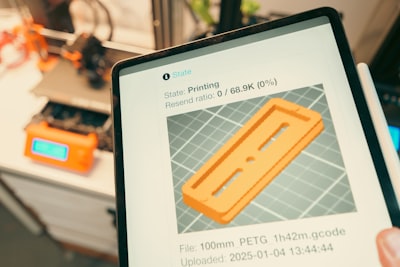
In the world of 3D printing, the choice of filament is critical to the success of any project. While PLA is the star material for its ease of use, PETG has earned a prominent place for its superior mechanical and thermal properties. Below, we explore five applications where PETG clearly outperforms PLA, along with key technical considerations. In addition, we will look at how modern technology and software can optimize these processes, with the support of experts such as Q2BSTUDIO.
1. Parts exposed to high temperatures. PLA begins to deform at around 60°C, while PETG withstands up to 85°C or more. Therefore, components close to motors, power supplies or warm environments (such as fan supports) are ideal for PETG. In an industrial environment, the monitoring of these parts can be integrated with artificial intelligence systems to predict deformations. Companies looking for custom applications for quality control find in Q2BSTUDIO a technological ally.
2. Objects in contact with food. Although both materials are considered safe under certain conditions, PETG is more resistant to chemicals and repetitive washing. Storage containers, kitchen utensils or aquarium accessories benefit from PETG. To manage the traceability of these products, custom software can be the solution, and custom platforms Q2BSTUDIO developed.
3. Mechanical prototypes that require impact resistance. PETG is more ductile than PLA, making it less brittle. Parts such as structural supports, device housings or protectors can be manufactured in PETG to prevent breakage. In this context, the digitization of processes through AWS and Azure cloud services allows impact test data to be stored and analyzed, facilitating continuous improvement.
4. Outdoor parts. UV radiation degrades PLA over time, while PETG offers better weather resistance. Outdoor furniture, pots or signage can be printed in PETG with greater durability. Remote facility monitoring can be supported by AI agents and business intelligence services, such as those offered by Q2BSTUDIO with Power BI.
5. Containers for liquids. Thanks to its low moisture absorption and excellent adhesion between layers, PETG is ideal for containers, bottles or tanks containing water or oils. Waterproofing is key. To ensure quality, cybersecurity in the digital supply chain is vital; Q2BSTUDIO provides cybersecurity and pentesting services to protect design data.
What you should know: PETG requires higher extrusion temperatures (230-250°C) and heated bed (70-80°C). It is more prone to stringing and needs good ventilation. Humidity is your enemy, so dehydration beforehand is recommended. In addition, their attachment to the bed can be challenging; using PEI bed or glass with adhesive is common. The print speed is usually lower than in PLA. With the help of business AI, such as Q2BSTUDIO's AI agents, it is possible to optimize parameters automatically.
In conclusion, PETG is a versatile material that expands the possibilities of 3D printing beyond PLA. Whether in industrial, domestic or creative applications, its use is justified in multiple scenarios. To maximize performance, integrating modern digital tools is essential. Q2BSTUDIO, with its expertise in custom application development, cloud services, business intelligence, and cybersecurity, helps you take your manufacturing projects to the next level.