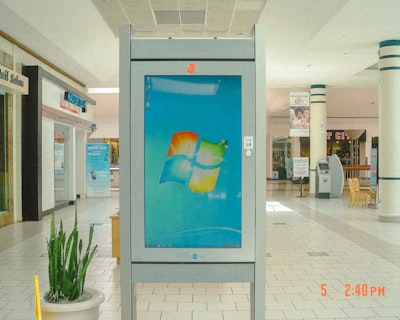
In the heart of Derby, a digital screen unexpectedly became the protagonist of a scene that many Windows users instantly recognize: a 'Backup in progress' message that, far from fulfilling its function, completely paralyzed advertising content. The image was as ironic as it was revealing: a system designed to communicate in a dynamic and modern way was reduced to a simple reminder that, sometimes, the most advanced technology can fail in the most basic way. This incident, although anecdotal, opens a deep reflection on the dependence we have on traditional operating systems in environments where continuity is critical, and on how companies should rethink their backup and maintenance strategies.
The scene is an everyday one: a digital billboard located on a busy street shows a Windows window asking the user to make a backup. But who was going to connect to that screen to accept? The paradox is obvious: the very system that should be showing announcements, schedules or relevant information has become an obstacle, blocked by an update or by the insistence of the Redmond company that we back up our data. For the owner of that poster, the problem is not only technical, but strategic: a failure of this type can result in loss of advertising revenue, discredit of the brand and, above all, a bad experience for the passerby who expects to see useful content.
Behind this anecdote lies a fundamental question: what does it really mean to make a backup in a digital signage environment? It's not just about saving files to the cloud or an external drive; We are talking about guaranteeing the availability of the service 24 hours a day, 7 days a week, with the ability to react immediately to any incident. In this context, the traditional model of 'Windows + PC + automatic updates' becomes obsolete. Companies that need robust digital signage deployments require much more specialized solutions, where remote management, virtualization, and AWS and Azure cloud services become essential allies.
Modern digital signage should be able to be restored automatically without human intervention. If an operating system goes into an update loop or requests a backup, the administrator must have the ability to reboot it, force a clean image, or even redirect content from another node. This is precisely what cloud-based platforms offer: high availability, fault tolerance, and disaster recovery. At Q2BSTUDIO, for example, we develop custom applications for digital content management that integrate proactive monitoring and self-healing mechanisms. Our team understands that a frozen sign is not a minor technical failure, but an incident that directly affects the business.
In addition, cybersecurity plays a crucial role. A screen connected to the Internet running a generic operating system can be vulnerable to attacks. Cybercriminals could hijack the poster to display fraudulent or harmful messages. That's why we recommend integrating cybersecurity solutions from the design phase: periodic pentesting, network segmentation, controlled updates, and intrusion detection systems. It is not a question of avoiding any risk, but of minimizing it and having a solid response plan.
Another aspect that this incident brings to the table is the need for business intelligence applied to digital signage. With tools such as power bi or business intelligence services, companies can analyze the performance of their screens: what content works best, at what times there is more influx, when there are crashes. This information allows you to optimize your investment and anticipate problems. At Q2BSTUDIO we offer AWS and Azure cloud services that facilitate the collection and processing of this data, integrating it with early warning systems. Thus, if a screen is left hanging, the technical team receives a notification and can act remotely, even using AI agents that diagnose and solve simple incidents without human intervention.
Artificial intelligence is transforming digital signage. From the dynamic generation of content based on the profile of the audience (using AI for companies) to the prediction of hardware failures using machine learning models. A smart signage system doesn't just display ads, it learns from its surroundings. For example, you can adjust the brightness based on the ambient light, or change the message if it detects that no one is looking. All of this requires tailor-made software that is tailored to the specific needs of each customer. At Q2BSTUDIO we design modular architectures that allow you to scale from a single billboard to networks of thousands of geographically distributed screens.
Returning to the Derby screen, the image of 'Backup on the go' is also a metaphor for how big tech imposes its processes on users. Microsoft wants us to back up in its cloud, but the owner of that cartel would probably prefer a system that doesn't ask for anything. The ideal solution is to eliminate reliance on general-purpose operating systems in mission-critical environments. Instead, embedded systems or Linux-based platforms with lightweight runtime environments can be employed, or even completely cloud solutions where the display is just a terminal that receives content from a centralized server. This approach dramatically reduces points of failure and simplifies maintenance.
Another important lesson: the importance of backups of not only data, but the entire system configuration. A bug like Derby's would have been resolved in seconds if the administrator had been able to restore a system image from the cloud. At Q2BSTUDIO we implement automated backup processes that include both the content and the state of the device, allowing bare-metal recovery in less than five minutes. In addition, our process automation solutions ensure that software updates are deployed in a controlled manner, without interrupting service.
Finally, this incident reminds us that technology must be at the service of the business, not the other way around. A digital display that becomes a 'Windows needs your attention' sign is a failure of technical design. Companies that invest in digital signage must demand reliable systems from their suppliers, with remote support, redundancy and, above all, with a philosophy of 'no human intervention' for routine operations. At Q2BSTUDIO we work every day to offer that level of professionalism, combining tailor-made applications, artificial intelligence and cloud services so that digital posters fulfil their function: to communicate, not to ask for backups.