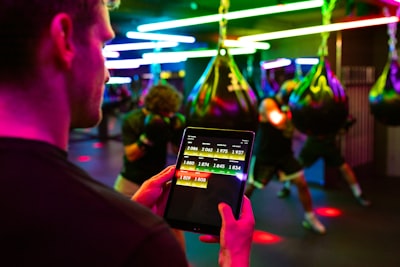
The fitness app ecosystem has evolved rapidly in recent years. Today anyone can record sets, repetitions and weights with an accuracy that was previously only available to professional trainers. However, the real leap in quality is not in the record, but in the interpretation of that data. Most of today's tools are limited to storing what you do, but they leave you alone to understand why you're not progressing, when you need a download, or if you're training too close to failure. This gap between data and decision is exactly the space that the new generations of intelligent assistants are occupying, and not only in the sports field: in any sector where large volumes of information are generated, the ability to turn numbers into concrete actions makes the difference between a useful tool and a simple warehouse.
Let's think about the specific case of a developer who decides to build a virtual trainer based on artificial intelligence. The most common temptation is to take a large language model (LLM), feed it dozens of physiology manuals, and ask it to generate recommendations. The result sounds convincing, but it lacks traceability. There is no way of knowing whether the suggestion to increase weekly biceps volume is based on a proven methodology or a spurious correlation that the model learned from some forum. That's why the strongest projects in this field are abandoning the 'black box' approach and adopting an architecture where artificial intelligence only acts as a conversational interface, while training rules, progression algorithms, and stalemate diagnostics are implemented by deterministic engines written and validated by human experts. It's a model reminiscent of how more mature tech companies approach their products: business logic is written with code, not delegated to a neural network, and the LLM is used exclusively to translate that logic into natural language.
This philosophy fits perfectly with Q2BSTUDIO's way of working, where custom application development is supported by a deep understanding of the domain, not generic solutions. When a customer needs a system that analyzes training, performance, or health data, Q2BSTUDIO engineers first design the business logic with industry experts: progression rules, fatigue thresholds, recovery factors. That logic is coded into specific engines, tested against specific test vectors, and only then is an AI layer added to facilitate user interaction. The result is a product that not only answers questions, but does so with an accuracy that can be scientifically audited and justified.
Behind this type of project there is considerable data engineering work. For a self-regulation engine to work properly, it needs to be fed with granular information: it is not enough to know how many sets of chest the user did, but the fractional contributions of each exercise to all the muscle groups involved must be accounted for. A pull to the chest not only works the dorsal, it also adds volume to the biceps, posterior deltoid and rhomboid. Ignoring those indirect contributions leads to bias in weekly volume analysis. This is where capabilities such as those offered by AWS and Azure cloud services come into play, allowing data processing to scale without worrying about the underlying infrastructure. Q2BSTUDIO, with its expertise in cloud architectures, helps design systems that ingest, cleanse, and model this data so that decision engines work with accurate and up-to-date information.
Traceability and trust are precisely the most powerful selling point in a market saturated with apps that promise magical results. When a tool claims that its recommendation is based on a documented and proven methodology, the user stops perceiving it as a technological whim and starts seeing it as a trusted partner. That same principle is what Q2BSTUDIO applies in its artificial intelligence projects for companies: it is not about installing a generic chatbot, but about building AI agents that operate within a perimeter defined by business rules, regulatory compliance and expert knowledge. In sectors such as health, finance or logistics, an agent who invents answers is not acceptable. The solution is to combine deterministic engines with language models that only act as translators, just as in the case of the virtual trainer.
But it's not all rules and tests. The most delicate part of this type of system is the conversational interface. The user does not want to fill out forms; He wants to have a fluid conversation with an assistant who understands nuances such as 'I want to prioritize my arms' or 'lately I've been stagnating in bench press'. For this conversation to be useful without losing rigor, the LLM must be limited to a set of predefined actions: answering questions, explaining diagnoses, proposing modifications that must then be validated by deterministic engines. Cybersecurity also plays a crucial role here, because training data is personal and cannot be exposed to models that use it to train or leak it to third parties. Q2BSTUDIO integrates cybersecurity practices by design, ensuring that all sensitive information is protected and that language model APIs are used under strict access controls.
The natural next step in this architecture is to incorporate predictive analytics and visualization capabilities. Many users don't know how to read the signs of overtraining until it's too late. A system that combines deterministic engines with a dashboard of business intelligence services such as power bi can proactively alert on fatigue patterns, show weekly volume evolution by muscle group, or suggest shocks just as the performance curve begins to flatten. This integration between domain logic and business intelligence is a specialty of Q2BSTUDIO, helping companies connect their proprietary algorithms with leading visualization tools for product managers to make informed decisions.
Of course, not all startups have the resources to write deterministic engines from scratch. This is where custom software proves its value again. Instead of buying a generic system that never quite fits, the company defines its needs alongside a technical team that understands both the sports domain and software engineering. Q2BSTUDIO offers just that: a discovery process in which business rules are mapped, engines are designed, tests are built, and everything is deployed in a scalable cloud architecture, either with AWS and Azure cloud services according to customer preferences. The result is not a fitness app, but a platform that could be applied to any other area where performance data needs to be interpreted with medical or scientific criteria.
Looking ahead, the trend points to an even greater hybridization between rule engines and language models. AI agents will begin to learn from interactions with users without going beyond the limits set by the original methodology, which will allow recommendations to be personalized without losing scientific soundness. The doors will also be opened to integration with wearables and sensors that provide real-time data on heart rate, sleep or pulse variability. The ability to process that torrent of information and turn it into actionable advice will be the real differentiator. And there, again, the combination of custom software, cloud and business intelligence will continue to be the winning formula.
In short, the training record is already resolved. The next challenge is to build systems that analyze, diagnose, and guide with the same depth as a human trainer, but with the scalability of a machine. What makes this approach special is not the technology itself, but the conscious decision to put methodology ahead of hype. Whether it's in the gym or in a boardroom, trust is earned by demonstrating that behind every recommendation is a rigorous process, a team that supports it, and an architecture that sustains it. And for those who want to take that leap, having a technology partner like Q2BSTUDIO is not a luxury, it is a strategic necessity.